Merz and Macron: A Franco-German week of harmony
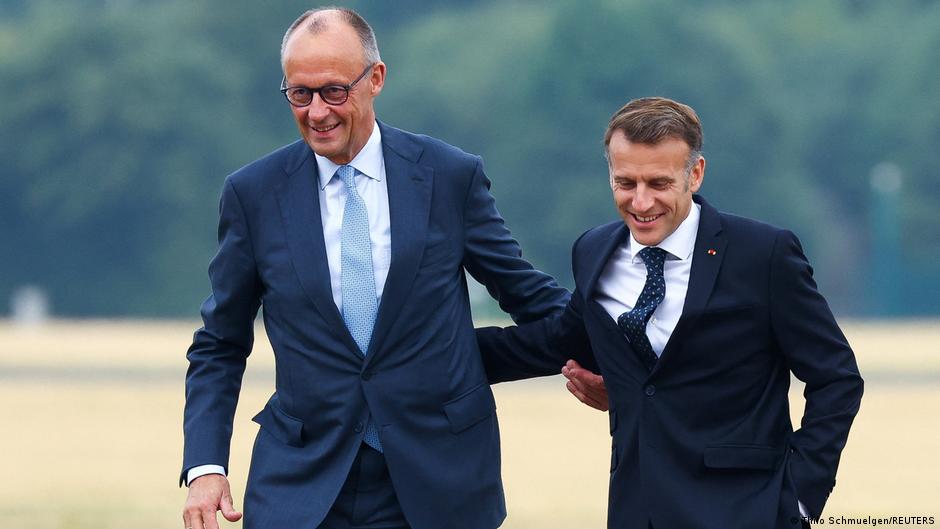
Friedrich Merz and Emmanuel Macron did everything they could this week to demonstrate a close partnership. This is likely because both fear that the next
Friedrich Merz and Emmanuel Macron did everything they could this week to demonstrate a close partnership. This is likely because both fear that the next French president could be nationalist Marine Le Pen. The Franco-German partnership reached a real high point this week with several joint ministerial meetings and a total of four meetings between Chancellor Friedrich Merz and President Emmanuel Macron. The venue on Friday was particularly symbolic: Augustusburg Palace in Brühl, western Germany, where President Charles de Gaulle and Chancellor Konrad Adenauer laid the foundation for the Franco-German partnership in 1962. Another highlight was Merz's participation in the parade on France's Day, July 14, in Paris. The last time a German chancellor attended was in 2019, when Angela Merkel was in office. German government spokesperson Steffen Meyer said beforehand that this was a personal honor for the chancellor, and dismissed speculation about a cooling of relations between Merz and Macron: "There is absolutely no question of a cooling of relations; on the contrary, the relationship is very good, and we are continuing to work to ensure that it stays that way." France’s Bastille Day show of unity To view this video please enable JavaScript, and consider upgrading to a web browser that supports HTML5 video But it's not quite that simple, believes Stefan Seidendorf, deputy director of the German-French Institute in Ludwigsburg.
"The time since Merz took office has shown that there are indeed very significant differences between France and Germany and that this cooperation is not a sure thing — rather, it requires hard work," he told DW. There are differences, for example, in energy policy — Germany's phase-out of nuclear power versus France's pro-nuclear stance — or in European fiscal policy. Cooperation is, however, being stepped up in the area of nuclear deterrence: In Berlin, there is a growing sense that the United States' nuclear protection is becoming unreliable, and, for the first time ever, German troops are expected to participate in a French nuclear exercise this fall. This year's Bastille Day parade, the largest since Macron took office in 2017, was held under the theme "Europe's strategic awakening." Macron wanted to send a clear signal in support of continued aid to Ukraine and for greater European self-confidence in the face of the United States under Donald Trump. Germany considers new fighter project after FCAS collapse To view this video please enable JavaScript, and consider upgrading to a web browser that supports HTML5 video Regarding Russia's war against Ukraine, Germany has now, after some initial hesitation, agreed to participate in the first military exercises of the so-called "coalition of the willing," a group of about 35 countries that wants to support Ukraine in the event of a ceasefire with Russia.
 The BriefWire