Explained: Why Is There A 3rd-Place Playoff In FIFA World Cup 2026?
Explained: Why Is There A 3rd-Place Playoff In FIFA World Cup 2026? Published By Last Updated: July 17, 2026, 19:12 IST England and France will
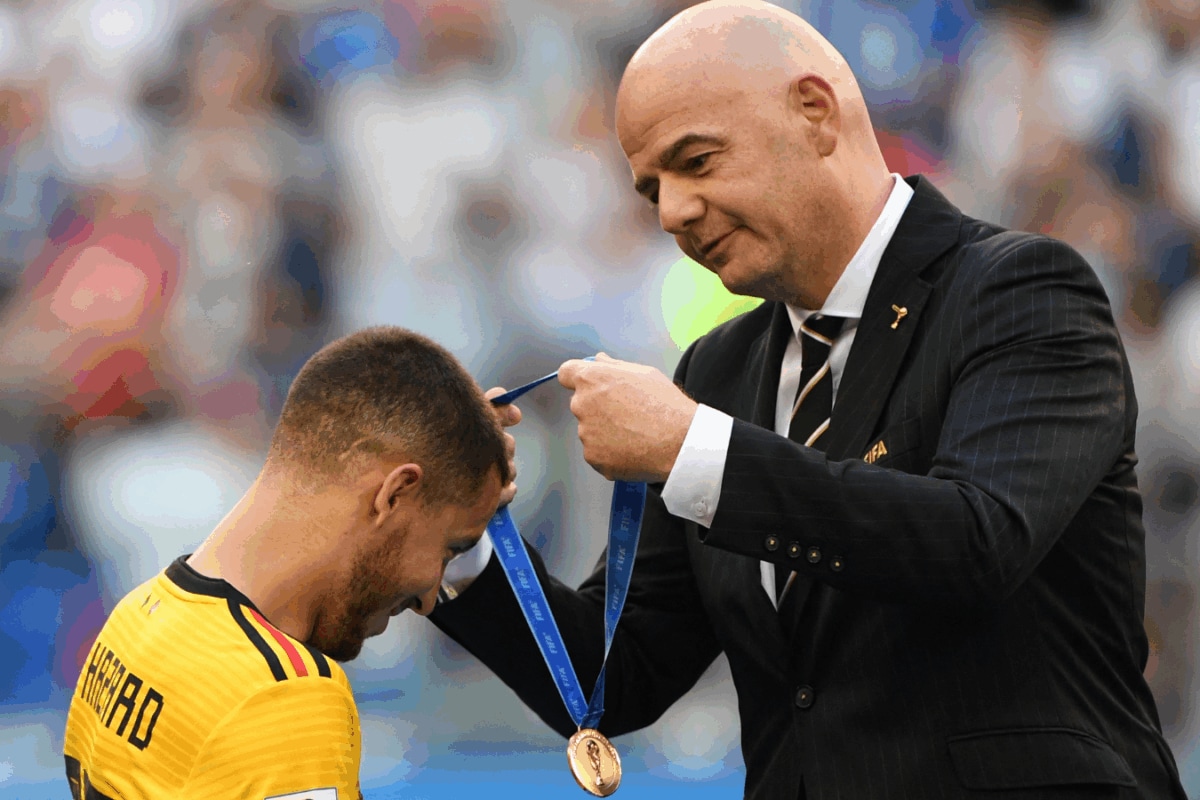
Explained: Why Is There A 3rd-Place Playoff In FIFA World Cup 2026? Published By Last Updated: July 17, 2026, 19:12 IST England and France will play in the 2026 FIFA World Cup third-place play-off on Saturday. But why's there such a match in the first place? History and controversies explained. FIFA president Gianni Infantino (R) presents the bronze medal to Belgium's forward Eden Hazard following their win in the Russia 2018 World Cup play-off for third place football match between Belgium and England at the Saint Petersburg Stadium in Saint Petersburg on July 14, 2018. (Photo by Paul ELLIS / AFP) England and France will clash in the 2026 FIFA World Cup third-place play-off on Saturday night after suffering semi-final defeats, with the match offering both teams a chance to end their campaigns on a winning note before Sunday’s final between Spain and Argentina. The fixture, officially called the ‘Bronze Final’ by FIFA, has been a regular feature of the men’s World Cup since 1934, apart from the 1950 edition, which used a round-robin format to determine the champion.
It decides the tournament’s third- and fourth-placed teams, with the winners receiving bronze medals. Beyond sporting prestige, the match carries financial and ranking significance. The winning team earns USD 29 million (approx INR 279 crore) in prize money, USD 2 million (approx INR 19 crore) more than the fourth-placed side, while the result also contributes valuable FIFA ranking points that can influence future tournament seedings and Nations League standings. The third-place play-off has also produced several iconic World Cup moments. Turkey’s Hakan Sukur scored the fastest goal in tournament history after just 11 seconds against South Korea in 2002, while France legend Just Fontaine struck four times against West Germany in 1958 to finish with a record 13 goals in a single World Cup, a mark that still stands. Despite its history, the fixture remains divisive. Many managers have criticised it, arguing it forces teams to play an emotionally draining match after missing out on the final. Netherlands coach Louis van Gaal famously called it ‘unfair’. “This match should never be played.
I’ve been saying that for 10 years; it’s unfair," Van Gaal said in 2014, ahead of the third-placed match against Brazil, which they won 3-0. “There is only one award that counts and that is becoming world champions. The worst thing is that there is a chance you are going to lose twice in a row. And in a tournament in which you have played so marvellously well you go home as a loser." As a result, several teams use the match to rotate their squads and hand opportunities to fringe players. However, for many nations, securing a podium finish remains a significant achievement, particularly after deep runs in the tournament. News18 Newsletter Handpicked stories, in your inbox A newsletter with the best of our journalism submit Key Questions Answered Will the 3rd-place playoff continue in future World Cups? The 3rd-place playoff has been a regular feature of the men's World Cup since 1934, except for the 1950 edition. The match offers teams a chance to end their campaigns on a winning note.
 The BriefWire