India's 1st hydrogen train hides bigger story
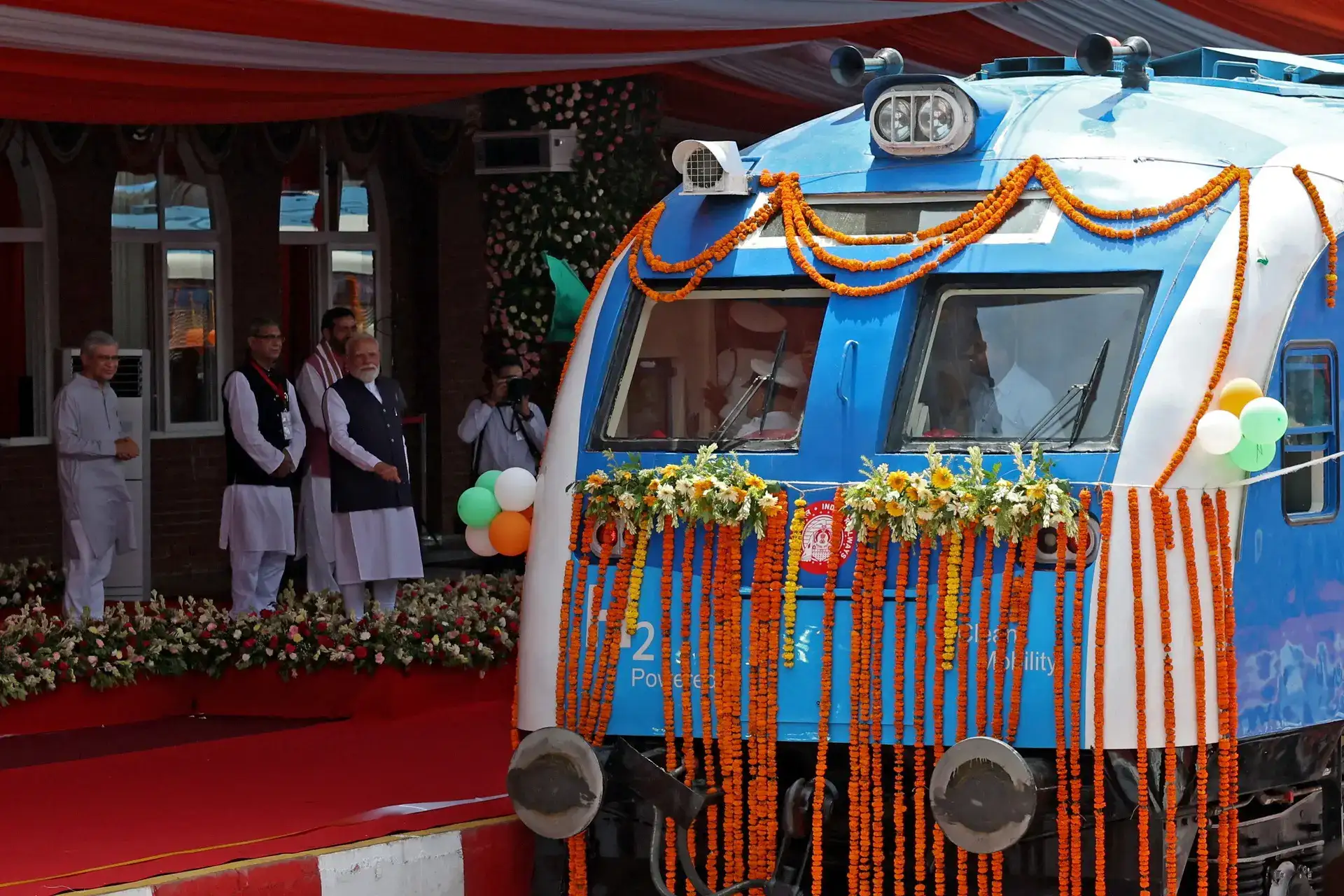
The launch of India’s first hydrogen-powered train on the Jind-Sonipat route in Haryana today marks a milestone that might appear slightly puzzling at first glance
The launch of India’s first hydrogen-powered train on the Jind-Sonipat route in Haryana today marks a milestone that might appear slightly puzzling at first glance. After all, Indian Railways has already electrified more than 99 per cent of its broad-gauge network. The country has spent years replacing diesel locomotives with electric traction and is close to completing one of the world's largest railway electrification drives. So why is India suddenly experimenting with hydrogen trains?The answer lies not in railways but in India's larger energy transition. The hydrogen train is less a transport solution and more a technology demonstrator. It is a visible symbol of a much broader bet that the government is making on green hydrogen as a future industrial fuel, a storage medium for renewable energy and a strategic tool to reduce dependence on imported fossil fuels. The train is merely the most public-facing manifestation of that ambition.ALSO READ | PM Modi flags off India's first hydrogen-powered train in Haryana, joins select global club of nationsA train runs through itThe train flagged off on Friday runs between Jind and Sonipat, covering an 89-kilometre stretch in Haryana. It uses hydrogen fuel cells to generate electricity onboard. Hydrogen combines with oxygen inside fuel cells, producing electricity to power the train while emitting only water vapour. The train has two hydrogen-powered driving cars, eight passenger coaches and a dedicated refuelling facility at Jind.ALSO READ | All you need to know about India's first hydrogen-powered trainYet the obvious question remains -- why use hydrogen on railways when India has already electrified virtually its entire network?In most circumstances, direct electrification is more efficient than hydrogen. Electricity flowing through overhead wires powers a train directly. Hydrogen introduces several additional steps. Electricity is first used to produce hydrogen through electrolysis. The hydrogen must then be compressed, stored, transported and finally converted back into electricity inside a fuel cell. Every stage results in energy losses.That is why countries typically deploy hydrogen trains on non-electrified routes as a replacement for diesel. India too plans to use hydrogen trains on such routes. However, very few such routes are left. The hydrogen train therefore is not intended to replace mainstream electric railways.
It is best understood as a pilot project designed to develop domestic expertise in fuel cells, hydrogen storage, safety systems and refuelling infrastructure.The target beyond transportThe strongest case for hydrogen in India lies elsewhere. Unlike batteries, hydrogen is not merely a way to move vehicles. It is also an industrial feedstock, especially in fertiliser and steel industries. Several sectors already consume large quantities of hydrogen today. The problem is that most of this hydrogen is produced from natural gas, a process that generates significant emissions.India's Green Hydrogen Mission seeks to replace this conventional hydrogen with hydrogen produced using renewable electricity. The goal is to create a domestic hydrogen economy that can support industries that are difficult to decarbonise through direct electrification alone. Many think hydrogen is a competitor to solar and wind power. It is not. Solar and wind generate electricity. Hydrogen is something that can be manufactured using that electricity and then used in places where electricity itself is difficult to deploy.The relationship is therefore complementary rather than competitive. India's hydrogen ambitions actually require a massive expansion of renewable energy capacity because producing green hydrogen consumes enormous quantities of electricity.Why fertilizers matter more than trainsIf there is one sector where hydrogen has an immediate and obvious role, it is fertilizers. Ammonia, which forms the basis of urea and several other fertilizers, is made by combining nitrogen from the air with hydrogen. The hydrogen is not merely providing energy. It becomes part of the final chemical product itself. That means electricity cannot simply replace hydrogen in fertilizer production. The hydrogen molecule is a necessary ingredient. What India can do, however, is change the source of that hydrogen.Today, most hydrogen used by fertilizer plants comes from natural gas. Green hydrogen offers a way to produce the same chemical feedstock using renewable energy instead. For a country that is among the world's largest fertilizer consumers, this represents one of the most important long-term applications of hydrogen.Steel is the next frontierSteel presents a similar challenge. Conventional steelmaking relies heavily on coal. Coal does more than generate heat. It also acts as a reducing agent, removing oxygen from iron ore and enabling the production of metallic iron.
 The BriefWire