Why India's first hydrogen train is special - explained
With the launch of a hydrogen train, India has undoubtedly taken a big leap in the sphere of greener transportation. How does the Hydrogen-powered train
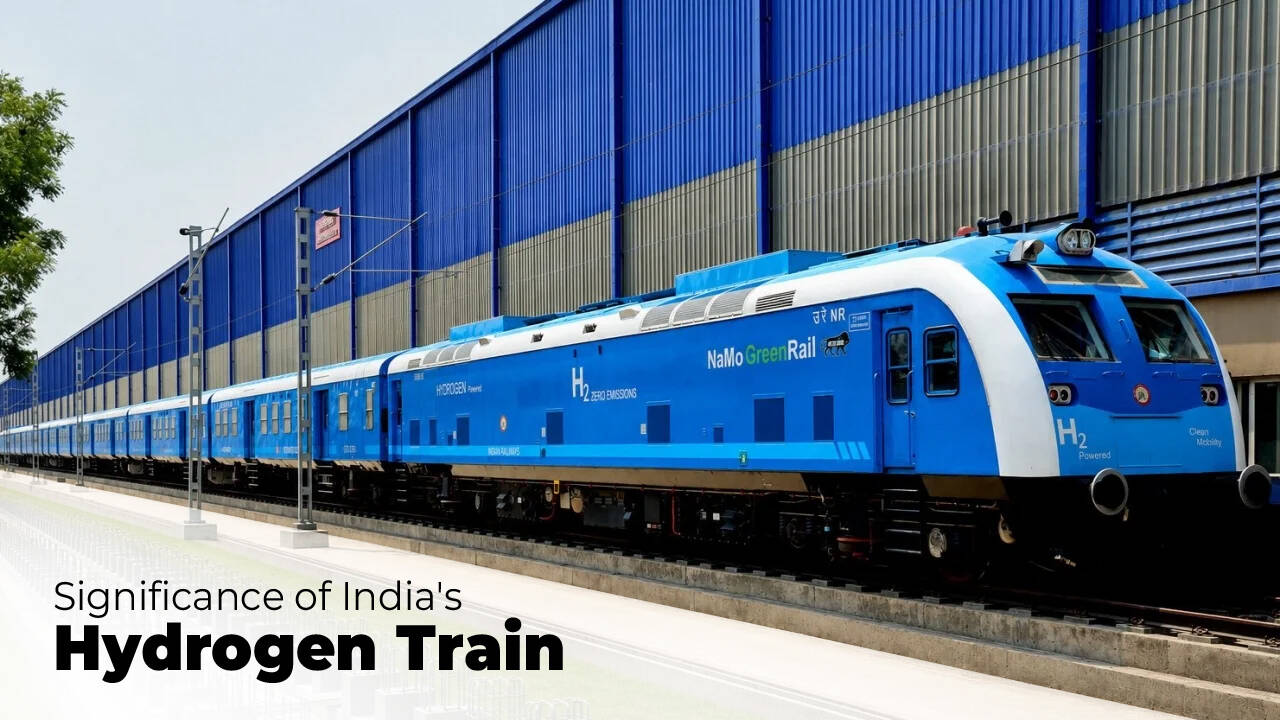
With the launch of a hydrogen train, India has undoubtedly taken a big leap in the sphere of greener transportation. How does the Hydrogen-powered train work? This produces electricity to power the traction motors of the train without combustion, smoke or any direct carbon emissions. The only by-product is water vapour! How does a Hydrogen Train Work? Hydrogen Train tech: Understanding its workings What makes it special India’s Hydrogen Train - 10 Key Facts Hydrogen Fuel Cell Power Car - Interior Future of hydrogen mobility India's first hydrogen train Challenges Hydrogen Facility At Jind Hydrogen Train Interior Importance of project beyond railways Hydrogen train: Zero emissions Prime Minister Narendra Modi on Friday flagged off India's first hydrogen-powered train. This ushers India into a group of select countries that have hydrogen trains. India’s first hydrogen-powered train has 10 coaches, with the capacity to carry 2,600 passengers. It will run between Jind and Sonipat in Haryana at a maximum operational speed of 75 kmph, though it is designed for 110 kmph.Why hydrogen? Because it is the cleanest fuel available today. Hydrogen-powered trains are quiet, they produce zero emissions, and also help reduce dependence on diesel. The launch is being seen as a significant step towards India’s move to cleaner transportation. The network is already 99% electrified, and hydrogen-powered trains would help ensure greener transport in remote areas.With the launch of a hydrogen train, India has undoubtedly taken a big leap in the sphere of greener transportation. But challenges are plenty, and the economic viability of the project is not possible, unless it forms part of a broader hydrogen economy ecosystem not limited to railways alone. We decode what makes the project special and why its significance extends beyond just the train and railways.The train is powered by hydrogen fuel cell technology. It works by combining the hydrogen that is stored onboard cylinders with oxygen from the air inside a Proton Exchange Membrane (PEM) fuel cell.The train is equipped with two hydrogen driving power cars.
These produce 1,200 kW of power each, supported by lithium iron phosphate batteries and hydrogen storage cylinders.How is the train refueled? Indian Railways has set up India's first integrated hydrogen railway ecosystem at Jind for this purpose. It includes facilities for the production of hydrogen through electrolysis. There is storage, compression and refuelling at the same plant.Apart from being the country’s first hydrogen-powered train, the project is special for several reasons. The train has been designed, engineered and integrated in India, a mark of the railway engineering prowess. RDSO, ICF, Medha have worked together to manufacture and extensively test the train.There are only a handful of countries in the world that are currently operating or testing hydrogen trains. Germany remains the pioneer in hydrogen train commercial passenger operations. China has operational deployments, and India now joins the small group of countries running hydrogen-powered passenger trains. France and Italy are rolling out services, while Japan, the US, UK and South Korea are largely at pilot or demonstration stages.Globally, hydrogen trains have 2-3 passenger coaches - India has launched its train with 10 coaches, making it the longest in the world right now. It is also one of the most powerful hydrogen-powered trainsets in the world, with a 3,200 HP propulsion system.According to Pranav Master, the biggest lesson that India can derive from Germany’s success is that success depends on the ecosystem, not just the train.“Germany showed the importance of reliable hydrogen supply and maintenance infrastructure. China demonstrated the value of domestic manufacturing, while Japan highlighted the need for rigorous safety standards and gradual scaling,” he says.Hydrogen trains form part of India’s net-zero emissions by 2030 project, though their contribution is likely to be limited to begin with. Hydrogen trains can act as a small contributor to India’s net zero railway ambition on non-electrified routes, say experts.“Hydrogen trains can help eliminate diesel use on the remaining non-electrified routes while supporting India's Green Hydrogen Mission. They also reduce dependence on imported fossil fuels by creating demand for domestically produced green hydrogen,” says Pranav Master, Director, Crisil Intelligence.Hydrogen trains are suitable for routes where electrification is difficult.
 The BriefWire