German tenants need better heat protection
Heat waves are becoming longer, hotter and more frequent. Record temperatures have left many tenants struggling. Now Chancellor Friedrich Merz has said the building law
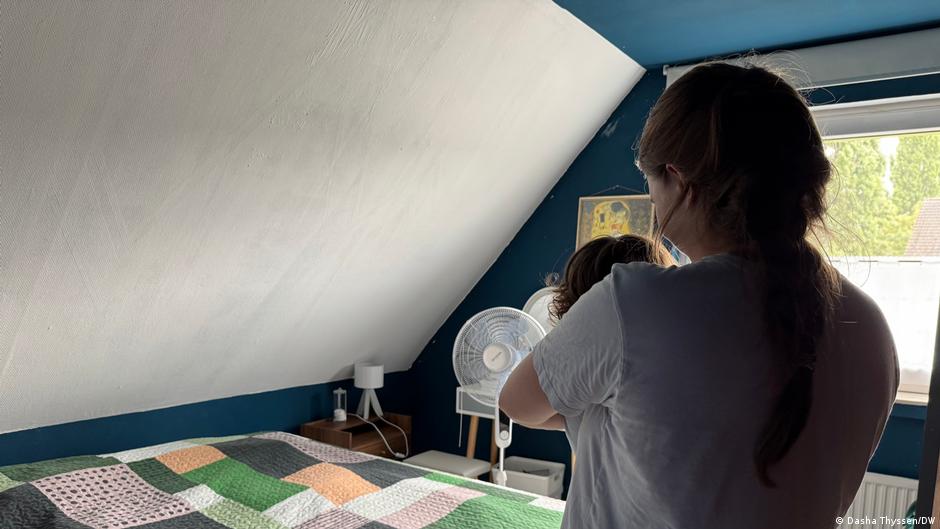
Heat waves are becoming longer, hotter and more frequent. Record temperatures have left many tenants struggling. Now Chancellor Friedrich Merz has said the building law needs to be amended. Darya* was very happy with her holiday plans: Her short trip to Turkey coincided with the start of a heat wave in Germany. But when she returned to her flat in the northwestern city of Bochum on June 26, she was in for an unpleasant surprise. The temperature inside her apartment reached 31°C (87.8°F) - higher than the 29°C she had experienced at the Turkish seaside. Outside, temperatures were soaring to a scorching 39°C. "This flat turns into a thermos over the summer," said Darya, describing the attic apartment where she lives with her husband and one-year-old daughter. Her south-facing flat has no external blinds or air conditioning. Last year, Darya had to buy her own blackout curtains, and now on hot days she relies on a fan. "We tried putting frozen bottles of ice in front of the fan, but it didn't help much - it was just moving the hot air around," she says, adding that her bedroom, with its dark walls, turned into the hottest spot in the flat. During the winter months, Darya appreciates how well the flat is shielded from the cold, thanks to its triple-glazed windows and an insulated facade. But when extreme heat occurs, these perks become liabilities. Europe's heat wave: The worst is yet to come To view this video please enable JavaScript, and consider upgrading to a web browser that supports HTML5 video Heat and health issues The EU's climate monitor 'Copernicus' said that June 2026 was the hottest June on record in western Europe and the second hottest globally. The Robert Koch Institute (RKI) has recorded an estimated 5,120 heat-related deaths in Germany so far in 2026, most of them during the late June heat wave. In comparison, over the whole of 2025, the RKI estimated 2,600 heat-related deaths. In this context, protecting people from extreme heat "should be seen also as a health measure," said Trinidad Fernandez, head of the Climate Transition Strategies Unit at the Fraunhofer Institute for Industrial Engineering (IAO).
"We need to treat heat resilience as a core requirement of good housing and also good urban planning," she added. Tenants are protected from cold, but not heat More than half of all people living in Germany rent their homes, the highest proportion in the EU. Darya's tenancy agreement explicitly sets clear rules for winter, quoting a minimum daytime indoor temperature of 21°C. Yet, there is no mention of any summer temperature targets. "Under the Federal Court of Justice's rulings, residential tenants do have a right to sufficiently warm rooms (20–24°C, depending on the room), but no right to cooling," Michael Selk, a lawyer who specializes in rental law, told DW in an email. That, he added, is likely due to the temperatures that Germany has been used to historically. Nowadays, buildings in Germany must be designed to limit overheating in summer under the Building Energy Act (GEG). Houses in a changing climate To view this video please enable JavaScript, and consider upgrading to a web browser that supports HTML5 video Yet, according to a study published by the Working Group for Contemporary Building e.V. in 2023, 75% of Germany's housing stock was built before 1990, so many renters live in buildings that do not meet today's heat protection requirements. In most cases, landlords are under no obligation to meet those standards either. "The landlord is only required to provide the standard that applied at the time the building was constructed," explained Selk, citing case law rulings from the Federal Court of Justice regarding property defects. "The tenant has no right to modernization," he adds. In practice, that means that for a building constructed in 1990, the corresponding standards would apply in a court hearing. Tenants in Germany can sometimes win property defect cases in lower courts if their apartments regularly become overheated. This has mainly applied to buildings that failed to meet the heat protection standards applicable at the time of construction, or in truly extreme cases of general uninhabitability.
 The BriefWire