How ‘bulldozer justice’ undermines the law
The sight of a five-year-old gifting a toy to Uttar Pradesh Chief Minister Yogi Adityanath on March 27 at Gorakhpur made for a tender photo
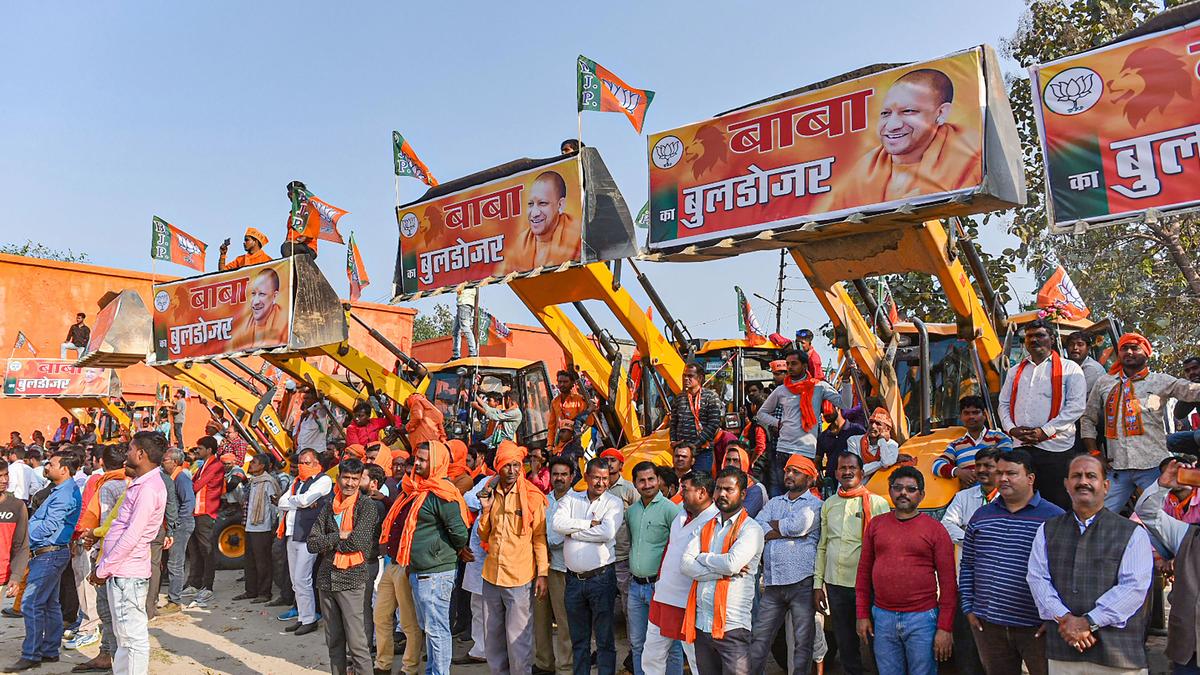
The sight of a five-year-old gifting a toy to Uttar Pradesh Chief Minister Yogi Adityanath on March 27 at Gorakhpur made for a tender photo moment. The Chief Minister returned the gift and asked the child to focus on her studies. Supreme Court shifts contempt pleas on ‘bulldozer justice’ to High Courts A child showing her admiration for a political leader is nothing out of the ordinary, as leaders are meant to be role models for the younger generation. But the five-year-old’s choice of toy — a replica of a bulldozer — raises uncomfortable questions. The episode not only shows public approval for “bulldozer justice”, it also reflects the normalisation of extrajudicial action by the state. What is arguably a problematic political symbol is now part of our everyday consciousness and holds the potential to influence impressionable minds. The much-hailed “bulldozer justice” model isn’t just a negation of the concept of due process but a direct challenge to it. Not the first time Though “bulldozer justice” is now part of India’s political lexicon, the concept of bulldozers being used as an instrument of state policy is not new. Instances of bulldozers being used to clear encroachments and demolish unauthorised houses in Old Delhi’s Turkman Gate area in 1976 — when the country was under the Emergency imposed by the then Prime Minister Indira Gandhi— have been well chronicled.
However, there is a key difference in how such actions have been perceived over time. From being examined as part of the excesses of the Emergency by a judicial commission, bulldozer action is now being amplified as a symbol of the state’s firmness in dealing with those who break the law. It is premised on the fact that judicial processes are cumbersome and come in the way of delivering instant retributive justice. In an era of 10-minute deliveries, government authorities are not immune to the same pressure. And since the judicial process does not follow a fixed timeline, some argue that this pressure is multiplied. The drive for ‘instant’ justice The backlog of cases across all courts in India has crossed 5.5 crore, with the figure in the Supreme Court alone accounting for over 90,000 cases. The India Justice Report 2025 noted that there are only 15 judges for every million Indians, as against a 1987 Law Commission of India recommendation of 50 judges per one million. In 22 of the 25 States, the same report noted, cases pending for over three years in subordinate courts amount to 25% of all pending cases. And across 25 High Courts, the number of cases which are pending for over five years account for 51%. The burden of proof and the long road to litigation often act as a deterrent and, therefore, common citizens prefer quick justice.
 The BriefWire