How government aims to save billions in forex with ethanol blended petrol
With a biofuel in the mix, E20 petrol aims at lowering emissions, at the same time reducing the requirement of petrol in the fuel mix
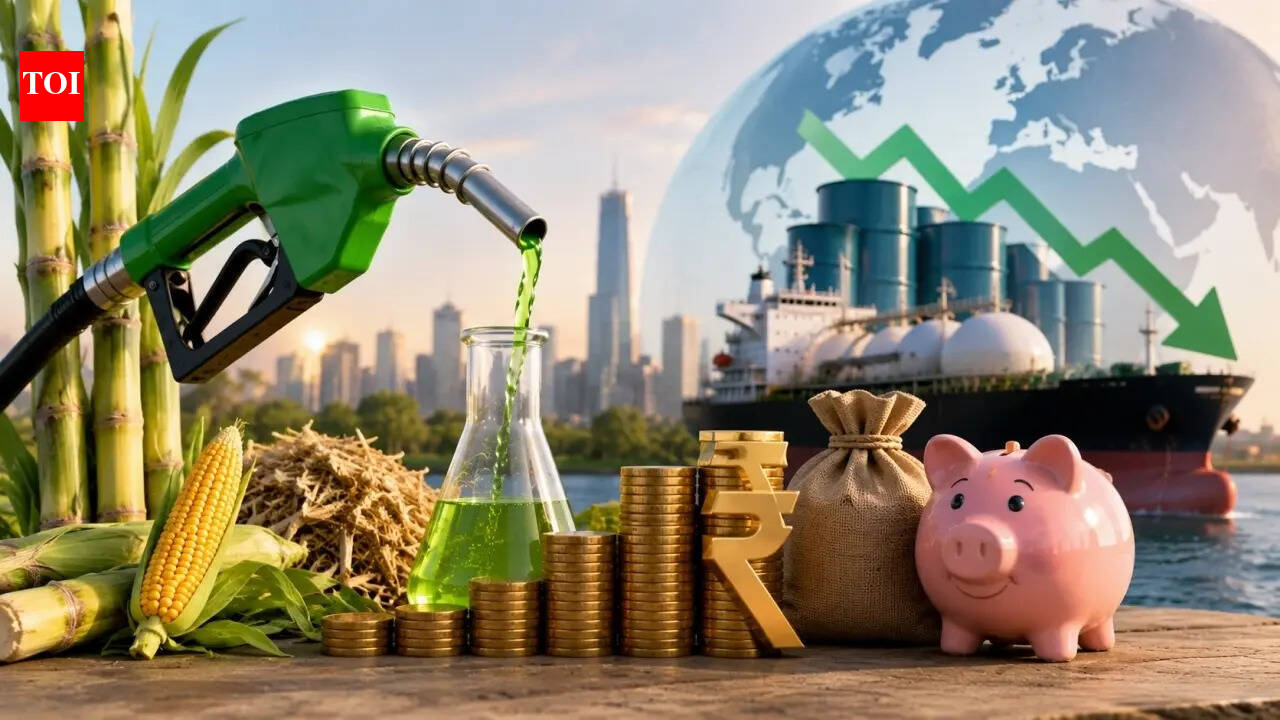
With a biofuel in the mix, E20 petrol aims at lowering emissions, at the same time reducing the requirement of petrol in the fuel mix. (AI image) So, is ethanol blended petrol the way forward for India? What are the advantages and challenges in place? What about industry concerns on fuel efficiency for cars? Where does India stand globally in terms of ethanol petrol adoption? E20 petrol: Forex & crude bill savings, focus on energy security As per the latest government estimates, the ethanol blending programme has so far resulted in foreign exchange savings of around Rs 1.59 lakh crore. And the benefits extend beyond the obvious savings in crude import bills. Ethanol blending materially strengthens India’s energy security and cushions the economy from global oil price shocks. Replacing a portion of petrol demand, which is significantly derived from imported crude oil, with domestically produced ethanol diversifies India’s transport fuel basket, says Mitra. This roughly translates to around one billion dollars savings due to decreased crude import requirements and projected to nearly double as the crude price remains high due to war related supply disruption. Benefits beyond energy security & crude oil bills Building greater resilience through stronger domestic supply chains: Government measures to support the EBP such as expanding permitted ethanol feedstocks, administered pricing for molasses based ethanol procurement, enabling long‑term offtake agreements (LTOAs) between OMCs and dedicated ethanol facilities, supporting advanced biofuel projects (including lignocellulosic/2G pathways) through schemes such as PM JI‑VAN, facilitating multimodal ethanol movement, and expanding ethanol storage and handling infrastructure, collectively help build a robust domestic biofuel ecosystem, says Majumdar.
Strengthening the rural economy: EBP has facilitated direct payments of more than Rs 1.4 lakh crore to farmers over the last decade, directly supporting farm incomes and strengthening the rural economy. And if global oil price spikes can impact prices and demand; ethanol-linked rural income flows can potentially act as a partial stabilizer, especially in agrarian regions of India. Ethanol blended petrol: Challenges & concerns But while the savings in forex and energy security benefits stay, there are still several challenges that exist and need to be streamlined to maximise the gains. For one, there is always the debate on food versus fuel security. If emphasis is on feed for the blend, then will food security take a hit? There are also concerns about the impact of E20 petrol, and increasingly more blended variants of petrol on cars. But other challenges are there, and ones that will need to be addressed, if the government is looking to scale up the ethanol blending percentage. Some of these are Feedstock challenge: There is dependence on sugarcane, maize and grains. This in turn creates supply volatility amid food-vs-fuel concerns and seasonal availability cycles. There is dependence on sugarcane, maize and grains. This in turn creates supply volatility amid food-vs-fuel concerns and seasonal availability cycles. Capacity challenge: Experts point to heavy reliance on 1G ethanol which directly makes use of the food crop. They suggest scaling up 2G ethanol production and feedstock sourcing. Experts say that scaling up 2G and 3G ethanol can help reduce the dependence on food crops by using crop residues, agricultural waste, lignocellulosic biomass and other renewable feedstocks.
Experts point to heavy reliance on 1G ethanol which directly makes use of the food crop. They suggest scaling up 2G ethanol production and feedstock sourcing. Experts say that scaling up 2G and 3G ethanol can help reduce the dependence on food crops by using crop residues, agricultural waste, lignocellulosic biomass and other renewable feedstocks. Logistics challenge: The production is currently concentrated in a few states. Hence there is a need for stronger transport, storage and blending infrastructure. The production is currently concentrated in a few states. Hence there is a need for stronger transport, storage and blending infrastructure. Storage & distribution gap: More blending terminals, dedicated tanks and depot-level segregation for E0, E10 and E20 fuels are needed. More blending terminals, dedicated tanks and depot-level segregation for E0, E10 and E20 fuels are needed. Sustaining E20: There needs to be reliable year-round feedstock supply and efficient nationwide logistics to maintain higher blending levels. There needs to be reliable year-round feedstock supply and efficient nationwide logistics to maintain higher blending levels. Water consumption varies significantly across feedstocks. Rice-based ethanol is estimated to require around 10,790 litres of water per litre of ethanol, compared with roughly 4,670 litres for maize and 3,630 litres for sugarcane, highlighting the need to favour less water-intensive feedstocks wherever possible. Rice-based ethanol is estimated to require around 10,790 litres of water per litre of ethanol, compared with roughly 4,670 litres for maize and 3,630 litres for sugarcane, highlighting the need to favour less water-intensive feedstocks wherever possible.
India currently has an overall ethanol blending target under t he Ethanol Blended Petrol Programme, but no separate target for 2G ethanol. Introducing phased 2G ethanol sub-targets could create assured demand, strengthen investor confidence and steadily increase the share of advanced biofuels. he Ethanol Blended Petrol Programme, but no separate target for 2G ethanol. Introducing phased 2G ethanol sub-targets could create assured demand, strengthen investor confidence and steadily increase the share of advanced biofuels. Advanced biofuels are still at an early stage of scale-up in India, making continued R&D, technology upgrades and innovation critical for long-term success. International standards The Middle East crisis has brought home with stark clarity the vulnerability in global supply chains and the importance of energy security. As India looks to build more strategic petroleum reserves, its move to diversify into other renewable sources of energy, the move to blend ethanol in petrol to reduce imports will also play a crucial role. However, as experts point out, the step comes with its set of supply chain and implementation challenges which will need to be overcome if the percentage of blending has to be stepped up for more notable gains and for more agriculturally sustainable benefits.
 The BriefWire