China's 125-million-year-old dinosaur fossil reveals preserved skin, strange spikes and a previously unknown species
PC: AI Generated A 125-million-year-old fossil reveals a previously unknown dinosaur PC: ScienceAlert What the fossil's preserved skin revealed Why it became known as the
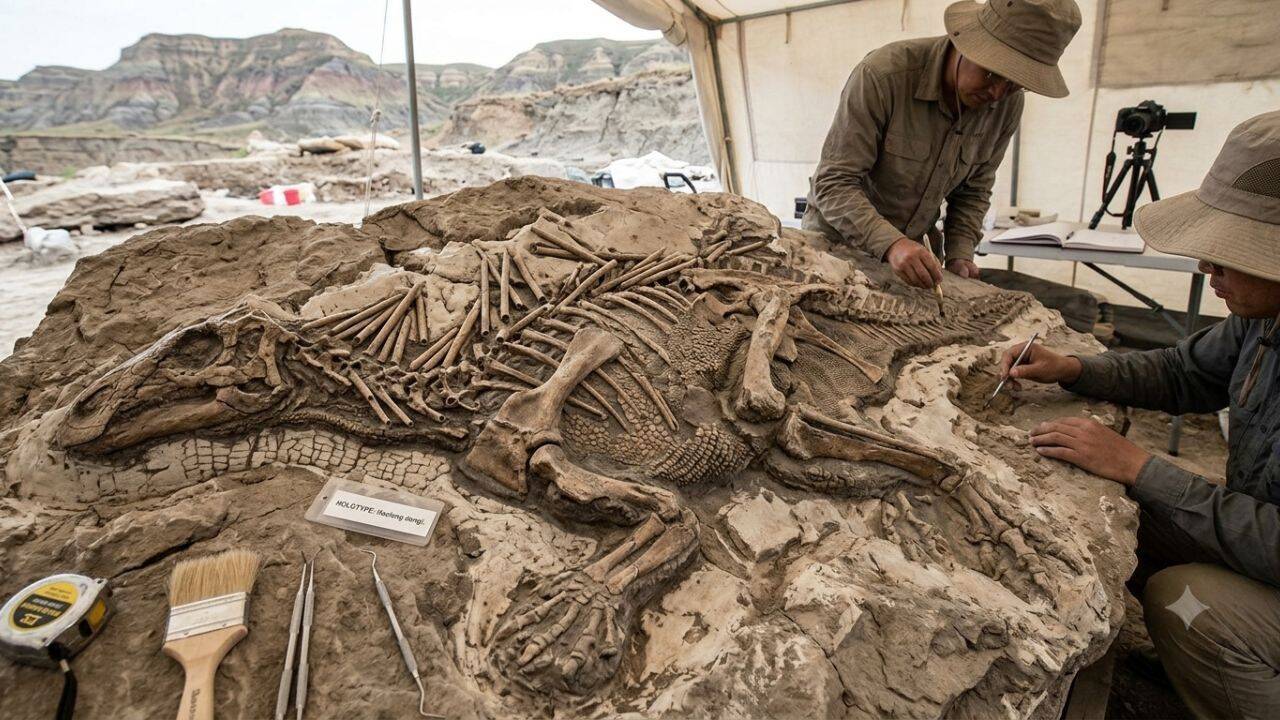
PC: AI Generated A 125-million-year-old fossil reveals a previously unknown dinosaur PC: ScienceAlert What the fossil's preserved skin revealed Why it became known as the ' spiny dragon ' Possible roles for the unusual spikes What makes this fossil exceptionally important Fossils often preserve bones well enough to reveal the shape of an ancient animal, but traces of soft tissues are much less common. That is why a newly described dinosaur from north-eastern China has drawn such close attention from palaeontologists. Dating back around 125 million years to the Early Cretaceous period, the specimen offers more than a skeleton. Extensive patches of preserved skin have given scientists a rare chance to examine the animal's outer covering in unusual detail, revealing features that have not previously been documented in dinosaurs.The dinosaur has been named Haolong dongi and belongs to the iguanodontians, a group of herbivorous dinosaurs that were widespread during the Early Cretaceous. Although relatives within this family have been studied for decades, this newly described species stands apart because of the condition of the fossil rather than its bones alone.The remains were uncovered in north-eastern China by an international research team led by the Anhui Geological Museum in collaboration with the Institute of Natural Sciences in Belgium.
As reported by The French Centre for Scientific Research (CNRS), fossils have been dated to roughly 125 million years ago, placing the animal in an ecosystem that supported a wide range of dinosaur species living alongside one another.While fossilised skin has occasionally been found with dinosaurs before, complete sections are exceptionally uncommon. In this specimen, preserved skin extends across sizable parts of the body, allowing researchers to study details that are usually lost long before fossilisation takes place.According to the scientists involved in the study, the preserved tissue shows a surprisingly varied surface rather than a single uniform texture. Different parts of the body carried different types of scales, suggesting dinosaur skin could be more specialised than earlier discoveries had indicated.The preservation is detailed enough to provide information at an extremely fine level, offering clues that bones alone cannot reveal about the appearance and biology of the animal.One feature immediately caught the attention of the research team. Across much of the dinosaur's body were spike-like structures of different lengths, giving the species a distinctive appearance that inspired the nickname "spiny dragon".Its tail was covered with large overlapping scales, while the rest of the body displayed both shorter and longer spines.
 The BriefWire