Amarnath Yatra: Fresh Batch Of 5,201 Pilgrims Leaves Jammu Under Tight Security
Amarnath Yatra: Fresh Batch Of 5,201 Pilgrims Leaves Jammu Under Tight Security Published By, Last Updated: July 16, 2026, 11:46 IST A fresh batch of
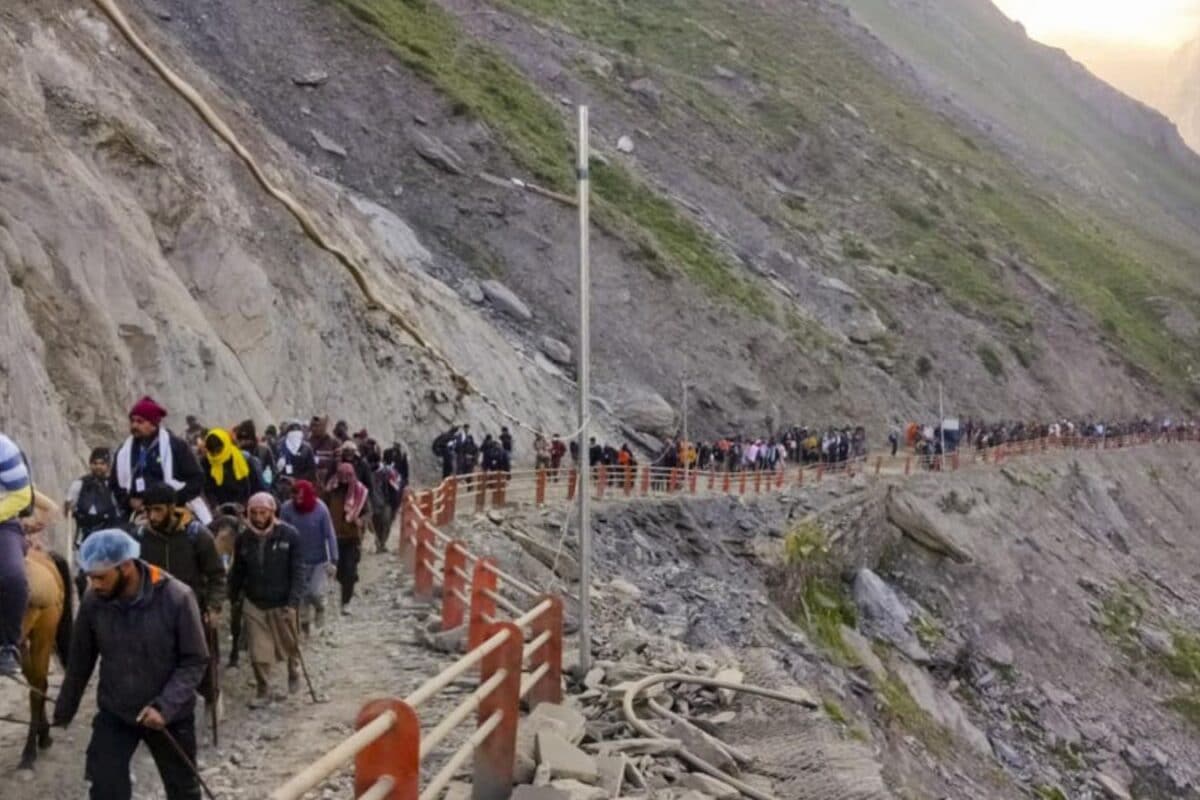
Amarnath Yatra: Fresh Batch Of 5,201 Pilgrims Leaves Jammu Under Tight Security Published By, Last Updated: July 16, 2026, 11:46 IST A fresh batch of 5,201 pilgrims left Jammu for the Amarnath Yatra under tight security on Thursday. So far, over 3.25 lakh devotees have offered prayers at the cave shrine. Rapid Read News18 A fresh batch of 5,201 pilgrims left Jammu for the twin base camps of the annual Amarnath Yatra on Thursday under a tight security escort, as the number of devotees who have offered prayers at the holy cave shrine crossed 3.25 lakh. Pilgrims Leave In Two Convoys Under Security Cover The batch comprised 3,970 men, 1,124 women, 92 sadhus, nine sadhvis, five children and one transgender pilgrim. They left in a convoy of 251 vehicles escorted by the CRPF and police. According to officials, the convoy departed in two groups. The Baltal-bound convoy, carrying 1,745 pilgrims in 74 vehicles, left at 3 am, while the Pahalgam-bound convoy, comprising 3,456 pilgrims in 177 vehicles, departed at 3.30 am. With Thursday’s departure, a total of 1,04,488 pilgrims have left the Bhagwati Nagar base camp in Jammu for Kashmir since the yatra commenced on July 2.
Devotional Chants Mark Another Day Of The Pilgrimage Before the convoy rolled out, the Bhagwati Nagar base camp echoed with chants of “Bam Bam Bhole", “Har Har Mahadev" and “Jai Barfani Baba Ki" as devotees began their journey to the revered shrine. Many pilgrims also expressed satisfaction with the arrangements made for the smooth conduct of the yatra. Over 3.25 Lakh Devotees Visit Cave Shrine So Far So far, more than 3.25 lakh devotees have offered prayers at the 3,880-metre-high cave shrine. The 57-day annual pilgrimage is scheduled to conclude on August 28. Why Is Security So Tight During The Amarnath Yatra? 1. Massive Daily Footfall Demands Round-The-Clock Crowd Management The Amarnath Yatra witnesses thousands of pilgrims travelling to the cave shrine every day during its 57-day duration, requiring authorities to regulate movement at registration centres, transit camps, base camps, trekking routes and the shrine itself. Security personnel help manage queues, prevent overcrowding at bottlenecks, coordinate convoy movement, regulate traffic and assist in emergency response. The deployment is aimed not only at maintaining law and order but also at ensuring that the pilgrimage proceeds safely and smoothly despite the continuous influx of devotees.
2. The pilgrimage passes through sensitive mountainous terrain The Amarnath Yatra takes pilgrims through remote Himalayan routes, including Baltal and Pahalgam, which require extensive security due to difficult terrain, heavy pilgrim movement and logistical challenges. Security personnel are deployed along the routes, at camps and near the shrine to ensure safe passage. 3. Multi-layer security covers the entire route The annual pilgrimage is protected through a multi-layer security grid involving the Jammu and Kashmir Police, CRPF and other Central Armed Police Forces. Security personnel are stationed at base camps, checkpoints, convoy routes and the cave shrine, while surveillance is maintained throughout the yatra. 4. Convoys move under escorted protection Pilgrims travelling from Jammu to the twin base camps are allowed to move in escorted convoys rather than individually. This helps authorities regulate traffic, monitor movement and respond quickly to any emergency along the route. 5. Strict registration and identification measures Only registered pilgrims are permitted to undertake the yatra. Authorities have also introduced QR-based identification systems and issued detailed travel advisories to regulate pilgrim movement and strengthen security. 6. Security has been a priority for decades The Amarnath Yatra has remained under heavy security for many years because terror groups have targeted the pilgrimage in the past.
 The BriefWire