Are There More Trees On Earth Or Stars In The Milky Way? The Answer Will Completely Stun You
Are There More Trees On Earth Or Stars In The Milky Way? The Answer Will Completely Stun You Published By, Last Updated: July 15, 2026
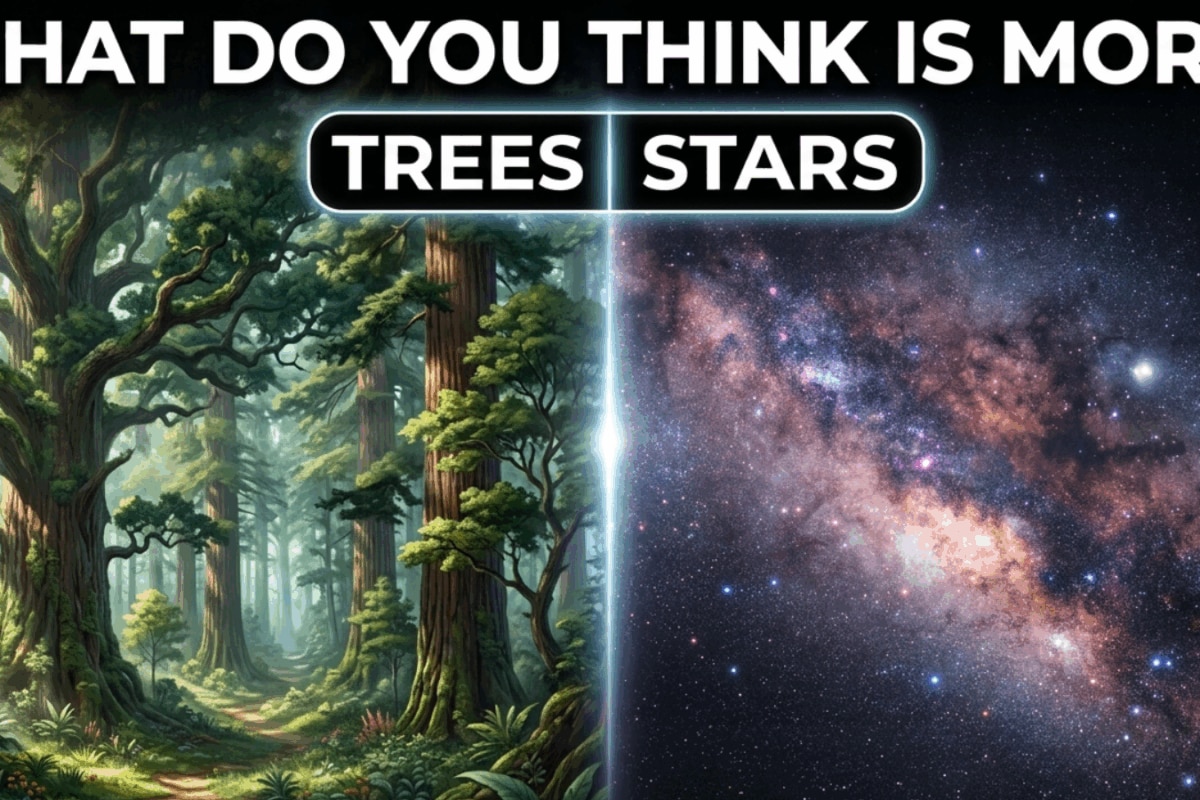
Are There More Trees On Earth Or Stars In The Milky Way? The Answer Will Completely Stun You Published By, Last Updated: July 15, 2026, 14:00 IST What do you think is more: the total number of trees on Earth or stars in our entire galaxy? The reality of this showdown will shock you. To understand just how massive this ecological reality is, we have to look at how scientists mapped both the sky and the soil. If you were asked which is more: the total number of trees growing on planet Earth and the total number of stars glittering in the Milky Way galaxy, what would your instinct tell you? Most people would immediately vote for outer space. After all, the cosmos feels infinite, while our planet is just a tiny speck of dust in the grand scheme of the universe. But science has a funny way of upending common sense. The verified reality is completely upside down: There are significantly more trees right here on Earth than there are stars in our entire home galaxy. The Cosmic Numbers Behind The Showdown To understand just how massive this ecological reality is, we have to look at how scientists mapped both the sky and the soil.
Astronomers calculate the number of stars in the Milky Way by measuring the galaxy’s total mass and analyzing its light signature. According to consensus data from NASA and global astrophysicists, our home galaxy contains anywhere between 100 billion and 400 billion stars. It is a mind-bogglingly large number, but it completely pales in comparison to what is happening on the ground. Read more: Karachi’s Secret: Did You Know This Megacity Of 20 Million Hides A 400-Year-Old ‘Car-Free’ Island? For years, scientists estimated that Earth was home to around 400 billion trees- a number roughly equal to the stars. However, a groundbreaking global study published by an international team of researchers revolutionized our understanding. By combining satellite imagery, supercomputer modeling and actual ground-level forest counts from every continent, they discovered the true number: Earth is home to an astonishing 3.04 trillion trees. That means for every single star shining in the night sky, there are roughly seven to thirty trees breathing on our planet. Three Reasons Earth Wins The Number Game How did our planet manage to outnumber the stars? The explanation comes down to the sheer density of Earth’s biological ecosystems The Power of Tropical Rainforests: The Amazon basin alone houses hundreds of billions of trees.
Tropical zones pack vegetation so tightly that a single square kilometre can contain tens of thousands of individual trees, creating a dense blanket of life unmatched by cosmic dispersion. The Boreal Forests of the North: A massive chunk of the world’s trees doesn’t sit in the tropics but in the subarctic regions. The vast boreal forests stretching across Russia, Canada, and Scandinavia act as a massive, uninterrupted carpet of conifers. Earth’s Hyper-Productive History: Trees have had roughly 370 million years to evolve, adapt and colonize every habitable corner of the globe, surviving multiple mass extinctions to blanket the continents. News18 Newsletter Handpicked stories, in your inbox A newsletter with the best of our journalism submit Key Questions Answered How do scientists accurately count trees globally? Scientists estimate there are approximately 3 trillion trees on Earth. Counting trees globally is not straightforward. While astronomers estimate the Milky Way has between 100 billion and 400 billion stars, new research suggests Earth has more trees. Could the number of stars in the Milky Way be underestimated? Astronomers estimate the Milky Way contains between 100 billion and 400 billion stars. A global study found Earth has approximately 3.04 trillion trees, meaning there are roughly seven to thirty trees on Earth for every star in the Milky Way.
 The BriefWire