I spent a night as a cockroach at CJP's Jantar Mantar protest. This is what I saw
By the time Delhi's employed public was heading home and the evening traffic had begun swallowing Connaught Place, I had transformed into a cockroach. Not
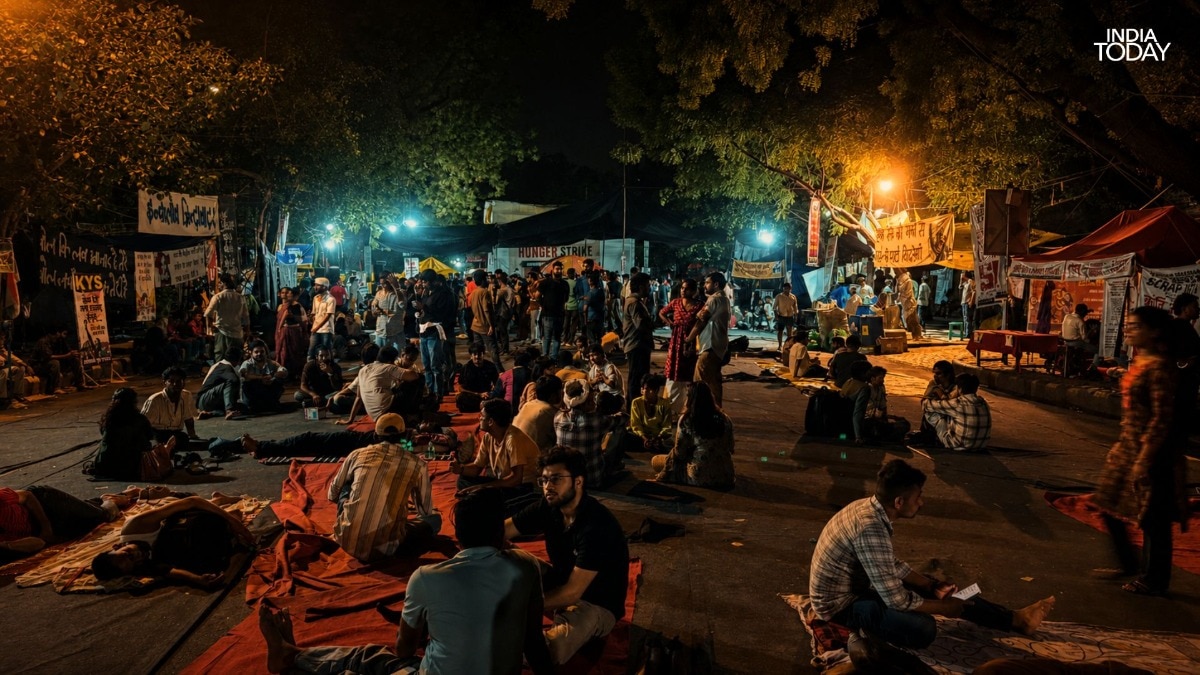
By the time Delhi's employed public was heading home and the evening traffic had begun swallowing Connaught Place, I had transformed into a cockroach. Not the kind after whom people instinctively run with their slippers, but the kind that has, over the past few weeks, found a home at New Delhi's Jantar Mantar. The Cockroach Janta Party (CJP) has been protesting here since June 28 seeking Union Education Minister Dharmendra Pradhan's resignation and activist Sonam Wangchuk is on an indefinite hunger strike here. So, for one night, I became one of them. I will tell you here about one night and the many stories. Read Full Story I arrived at the protest site at Jantar Mantar around 5.30 pm, carrying my phone, an umbrella, a blanket, and the curiosity not of a journalist but of a young protester. I have been to Jantar Mantar earlier too, including on the first day the CJP, led by Abhijeet Dipke, started the protest. This time, however, I planned not to spend my time here as a journalist. Protests are mainly remembered for fiery speeches, sloganeering, and sacrifices. Spending an entire night at Jantar Mantar, I also saw that they are built on other aspects as well. THE FOOTFALL OF PROTESTERS WAS BEYOND EXPECTATION While travelling to the protest site, I'd been thinking that it would be a quiet Tuesday. After all, it was a working day. I imagined lower turnout of protesters, a sparsely occupied stage, and volunteers waiting for the weekend when larger crowds return. The first few minutes after reaching ground zero almost confirmed my assumption. Plastic chairs were mostly occupied by Delhi Police and Rapid Action Force (RAF) personnel, and some were still scattered across the protest site. A few protesters under the banner of Left-wing students' outfits AISF, SFI and AISA sat in circles, demanding Pradhan's resignation. On the main stage were the prominent faces of the CJP. At the entrance of the protest site, a Delhi Police personnel stopped me for a security check, called "anti-sabotage check". Even as he inspected my bag, I struck up a conversation. I asked the cop at what time people gather in large numbers every day. "Exactly at the time you have come," he replied. "After 10 in the morning, very few people stay back. But wait till six in the evening. That's when they all begin arriving," the police officer added. Months of deployment at Jantar Mantar had made the police officer an expert observer of protest behaviour. His prediction took less than half an hour to come true. The footpath outside Jantar Mantar began delivering people. Some walked in straight from work. College students entered in groups carrying rolled-up banners. Elderly men and women were also arriving to make the "future of their grandchildren's education secure". NOT EVERYONE AT JANTAR MANTAR HAD COME TO PROTEST OR SEEK RESIGNATION Interestingly, not everyone at the Jantar Mantar was participating in the protest. Young couples wandered through the agitation zone hand in hand, stopping to read a poster before moving on. Families posed for photographs near the main stage. Groups of youths appeared more interested in filming Instagram Reels than listening to the speeches. For one section of Delhi, Jantar Mantar remains the country's designated protest ground, where citizens gather to demand accountability from those in power. For another, it has quietly become a place to walk, watch and spend time before heading home. However, the CJP protest is worth watching as it has embraced protesters from across the country and ideology. PEOPLE COMING TO JANTAR MANTAR TO SUPPORT SONAM WANGCHUK Beyond the mix of curiosity and activism in Jantar Mantar, there was one unmistakable centre of gravity.
 The BriefWire