As the world rearms, South Korea aims to cash in
Weapons and military equipment produced in South Korea are sought-after due to their reliability, proven effectiveness, short delivery times and relatively low prices. The South
Weapons and military equipment produced in South Korea are sought-after due to their reliability, proven effectiveness, short delivery times and relatively low prices. The South Korean defense industry was stung by the recent decision of the Canadian government to select a German design for its next generation of submarines, but it has moved swiftly to reassert its strengths in advanced military equipment and make a new play for a greater share of growing global defense spending. South Korea has long maintained a robust defense sector, in order to protect the nation from a belligerent and unpredictable regime over its border in North Korea. Successive governments in Seoul, however, have also placed greater emphasis on developing export markets in the last decade. That tactic has paid off since Russia's full-scale invasion of Ukraine in February 2022. "South Korea is in a unique political and geopolitical situation because of North Korea and our heavy reliance on the US military presence for security," said Park Saing-in, an economist at Seoul University. "But governments have been trying to be more independent in the equipment we provide for our armed forces, with the government spending heavily on research and development at defense companies that has allowed them to catch up with other nations," he told DW. Poland has been the biggest buyer of South Korean weapons in recent years [FILE: August 15, 2024] Image: Dominika Zarzycka/SOPA Images/ZUMA/picture alliance Emerging as a major defense exporter High-end items are still purchased from the US — such as F-35 Lightning II stealth fighters — but South Korean arms manufacturers have become adept at producing mid-range weapons systems and equipment that is delivered to buyers rapidly and at comparatively low cost because manufacturers already have production lines in place. The Cheongung-II medium-range surface-to-air missile, for instance, is designed to intercept ballistic missiles and aircraft at a range of up to 40 kilometers (24.8 miles).
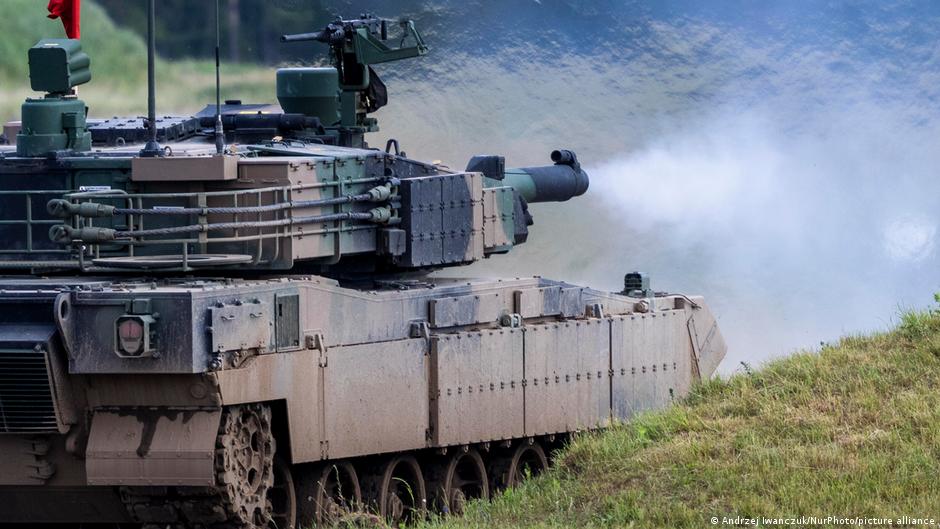
Similar to the US-made Patriot, South Korea sold 10 batteries to the United Arab Emirates (UAE) in 2022 and the system caught defense analysts' attention when it achieved a 96% interception rate during early missile attacks in the ongoing Middle East conflict. Each interceptor is estimated to cost $1.1 million (€970,000) — substantially less than Patriot interceptors, which can cost several million dollars apiece — and the manufacturer can deliver a complete system in around a year. Delivery times for a Patriot battery are a minimum of four years. As a result, in recent years, South Korea has emerged as one of the top arms-exporting countries globally. In 2025, its weapons exports reached $15.4 billion, according to the Seoul Economic Daily quoting the Defense Acquisition Program Administration (DAPA). Exports hit a peak of $17.3 billion in 2022. South Korean firms have also diversified their offerings. In the past, the nation drew heavily on its shipbuilding heritage to deliver warships, alongside artillery systems and aircraft. That has since expanded to armored vehicles, missiles and air defense systems. Europe is a key market for South Korea European nations — shocked at Russia's aggression against Ukraine and weakened by years of underinvestment in defense — have been key markets. Poland has been the biggest buyer in recent years, accounting for more than 40% of total South Korean exports. Warsaw has ordered 364 customized K9 Thunder 155mm self-propelled howitzers and 360 K2 Black Panther main battle tanks, recognized as one of the most capable tanks in the world. Poland is also purchasing K239 Chunmoo multiple rocket launchers, 48 FA-50 light combat and training aircraft and 1,266 "Legwan" four-wheel-drive combat vehicles. The dramatic overhaul of Poland's military hardware has enabled Warsaw to give its older Soviet-era equipment to Ukraine. Elsewhere in Europe, Finland, Estonia, Norway and Romania have all purchased K9 howitzers, while deals are also expected for K2 tanks and redback infantry fighting vehicles, which are also being acquired by the Australian Army in a AU$2.4 billion (€1.46 billion) deal.
 The BriefWire