Germany's Ahr Valley: Rebuilding better after deadly flood
New walls, redesigned bridges and restored floodplains: Towns in a small German valley are testing how they can survive the next extreme flood. When Alexandra
New walls, redesigned bridges and restored floodplains: Towns in a small German valley are testing how they can survive the next extreme flood. When Alexandra Wiemer recalls the night of July 14, 2021, what she remembers most is water suddenly "coming from every direction." It was 10:30 p.m. when she felt it rushing towards her. The normally gentle Ahr river that starts in the mountains of western Germany and flows more than 85 kilometers (53 miles) before emptying into the mighty Rhine, had burst its banks. The region received an entire month's worth of rainfall in just two days, turning the usual trickle into a torrent. The force of the water swept away cars, houses, trees and other flotsam that, in turn, tore down bridges. The floods caused huge amounts of damage to infrastructure built along the river Image: Thomas Frey/dpa/picture alliance Alexandra Wiemer and her son managed to escape to safety, but many others were not so lucky. The flood, the worst in the country's living memory, claimed 135 lives, most of them in Wiemer's town of Bad Neuenahr-Ahrweiler. Some 80% of the town was inundated. The raging waters also caused billions of euros in damage to homes and infrastructure. Five years on, the valley is one vast reconstruction site, as several billion euros — mostly from state and federal money — are invested in rebuilding and preparing for future floods. How towns in the Ahr Valley are building back better One particularly large construction site is located right by the river in Bad Neuenahr-Ahrweiler, right where the water breached the medieval town wall and flooded the historic old town.
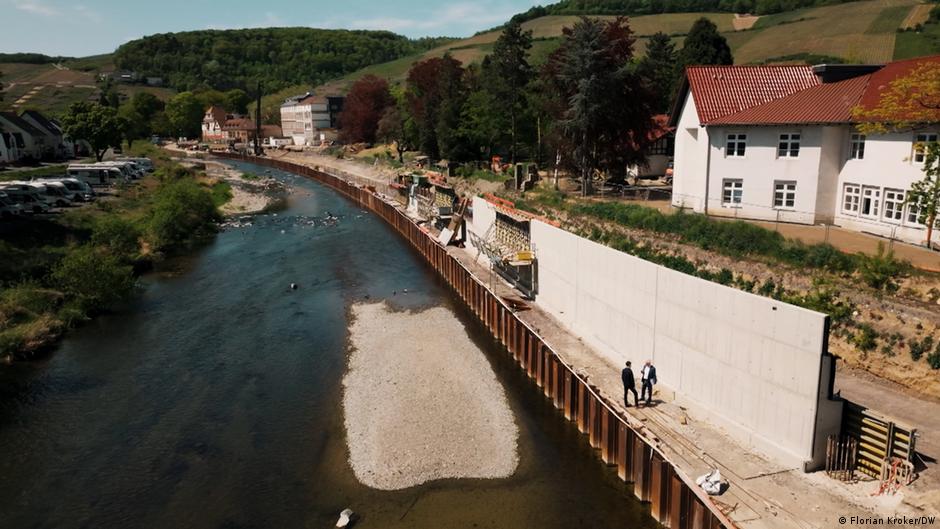
Now, a new 480-meter-long retaining wall is being built as additional protection. "It's a very solidly anchored wall, built with bored piles 1.20 meters in diameter and driven 15 meters deep," says Hermann-Josef Pelgrim, managing director of the local reconstruction and development corporation. Many other safety measures are more subtle, but equally effective, says Pelgrim. They include the construction of a new fire station built on underground stilts to prevent easy collapse. In the inner city, green spaces are being connected to underground drainage trenches to absorb and redirect heavy rain. The 16 bridges destroyed in 2021 are being redesigned. The remains of a five-arch medieval one will be left standing as a memorial, and its replacement will have just one wide arch to allow water and debris to pass safely underneath. Old bridges that were torn away in flood waters are being replaced by more flood-resistant designs Image: Florian Kroker/DW "This bridge will not collapse under any circumstances," Pelgrim explains, "even in the event of extreme flooding." But he also says preventing another disaster requires a combined, cross-community effort. "We can prepare for what's coming our way. But it would be better if not so much came our way in the first place — and that's the responsibility of those further upstream." Giving more room to the Ahr river (again) Old maps from around 220 years ago show the Ahr river meandering freely across its valley floor, sometimes in several branches at once. But as more people moved into the valley, they channeled the river and built along its banks, meaning flood waters have nowhere to go except straight into built-up and agricultural areas.
 The BriefWire