Why US, EU and 13 nations are backing 2016 South China Sea ruling against Beijing's claims
On ruling's 10th anniversary, 14 nations and EU reject China's South China Sea claims What the 2016 ruling said Countries warn against coercion China rejects
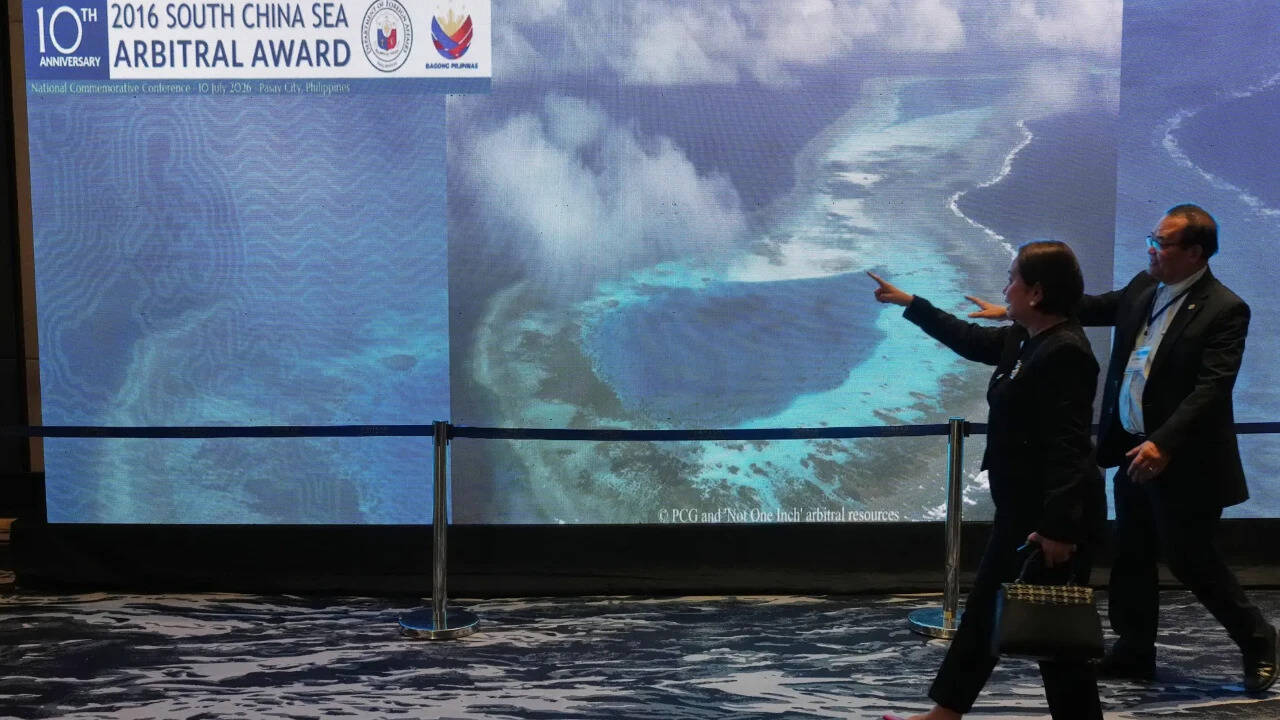
On ruling's 10th anniversary, 14 nations and EU reject China's South China Sea claims What the 2016 ruling said Countries warn against coercion China rejects ruling again Tensions remain high Fourteen countries, led by the United States, on Sunday reaffirmed that China's expansive claims in the South China Sea have no legal basis under international law, marking the 10th anniversary of a landmark arbitration ruling that Beijing continues to reject.In a joint statement, the United States, the United Kingdom, Japan, Australia, the Philippines, Canada, Germany, Italy, New Zealand, Estonia, Latvia, Lithuania, Romania and Slovenia said the July 12, 2016 ruling by an arbitral tribunal constituted under the UN Convention on the Law of the Sea (UNCLOS) remains "final, legally binding and definitive". The 27-member European Union issued a separate statement describing the decision as a "landmark" ruling in the peaceful settlement of maritime disputes.China, however, reiterated that the award was "null and void" and said it "neither accepts nor recognises" the tribunal's decision.The arbitration case was initiated by the Philippines in 2013 after a standoff with China over the Scarborough Shoal.
Although Beijing refused to participate in the proceedings, the tribunal proceeded under UNCLOS and delivered its verdict on July 12, 2016.The tribunal ruled overwhelmingly in favour of the Philippines, concluding there was no legal basis for China's claim to historic rights over most of the South China Sea under its so-called "nine-dash line".It also found that several maritime features claimed by China did not generate extensive maritime zones under international law.The ruling did not decide questions of sovereignty over islands or reefs but clarified maritime entitlements under UNCLOS, which has been ratified by more than 170 parties, including both China and the Philippines.Why the South China Sea mattersThe South China Sea is among the world's most strategically important waterways, carrying roughly one-third of global maritime trade each year. It is also believed to contain significant reserves of oil, natural gas and rich fishing grounds.China claims sovereignty over almost the entire sea, overlapping with claims by the Philippines, Vietnam, Malaysia, Brunei and Taiwan.
The competing claims have made the region one of Asia's most volatile security flashpoints.The 14 countries said there was "no legal basis for China's expansive maritime claims", including those based on alleged historic rights, and reiterated their opposition to unilateral actions that undermine regional stability."We reiterate our strong opposition to any destabilizing or unilateral actions including by force or coercion that threaten peace and stability in the region," the statement said.The countries also criticised the use of coast guard vessels, military aircraft and maritime militia to intimidate or obstruct the lawful activities of other states, saying such actions endanger lives and undermine regional security. They called for disputes to be resolved peacefully in accordance with international law while reaffirming the importance of freedom of navigation and overflight.Responding to the joint statement, China's Foreign Ministry said the arbitration tribunal and its award "seriously contravene the general practice of international arbitration" and infringe upon China's sovereign rights under UNCLOS.The ministry maintained that China "opposes and will never accept any claim or action based on those awards" and reiterated that Beijing does not accept third-party dispute settlement or externally imposed solutions regarding the South China Sea.The renewed diplomatic backing for the arbitration ruling comes amid continuing confrontations between Chinese and Philippine vessels in disputed waters.
 The BriefWire