Puppet Legislature Crisis: The Constitutional Flashpoint Threatening PoK Polling | Exclusive Details
Puppet Legislature Crisis: The Constitutional Flashpoint Threatening PoK Polling | Exclusive Details Reported By, Last Updated: July 12, 2026, 02:22 IST The manipulation of 12
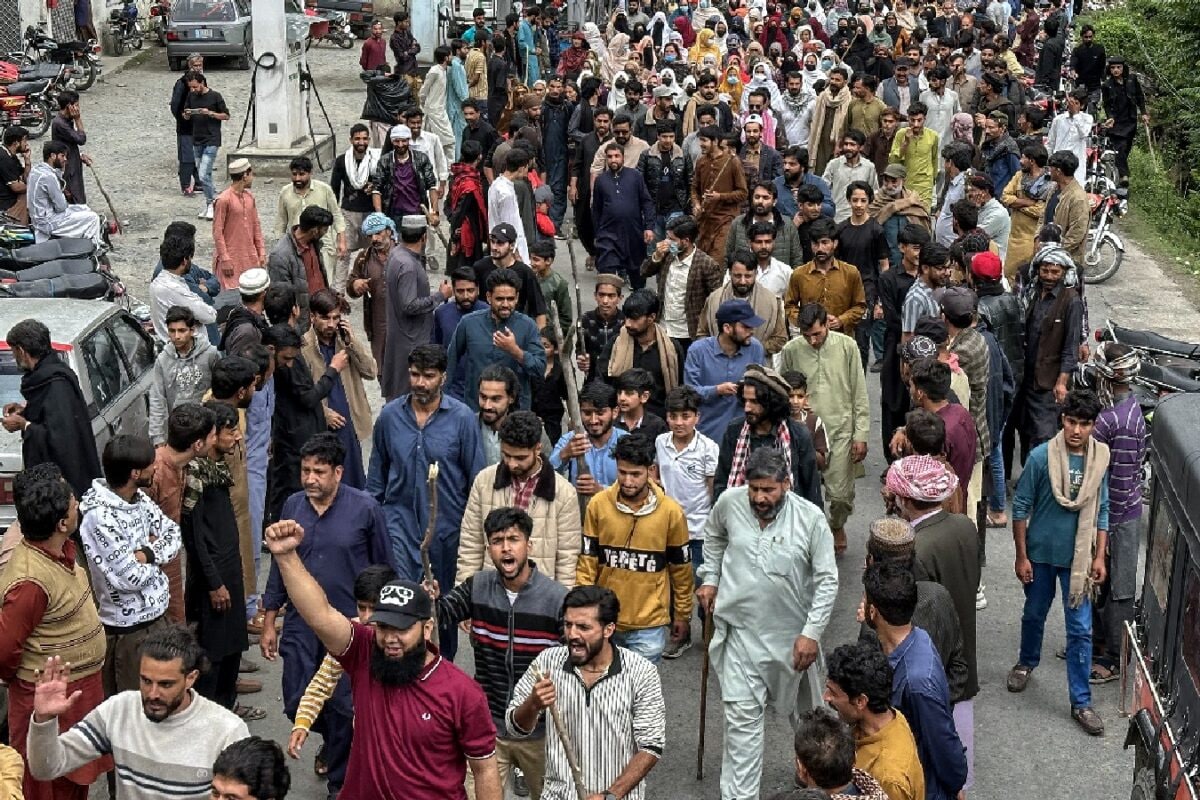
Puppet Legislature Crisis: The Constitutional Flashpoint Threatening PoK Polling | Exclusive Details Reported By, Last Updated: July 12, 2026, 02:22 IST The manipulation of 12 refugee seats remains an unresolved constitutional flashpoint that guarantees continued instability Supporters of the Joint Awami Action Committee (JAAC) gather during a weeks-long protest in Neelum Valley, in Pakistan-occupied Kashmir. (File pic: AFP) The political landscape of Pakistan-occupied Kashmir has imploded into widespread violence ahead of the legislative elections, with a highly coordinated assault targeting the electoral campaign of the Pakistan Peoples Party in Kotli. Local law enforcement authorities confirmed the arrest of three activists affiliated with the Jammu Kashmir Joint Awami Action Committee in Charhoi following violent clashes that culminated in the torching of an operational vehicle belonging to the convoy of senior PPP candidate Chaudhry Yasin. The targeted arson highlights a deep-seated structural resentment brewing across the territory against mainstream Pakistani political entities, effectively transforming a regional election campaign into a volatile battleground for civil rights. While state authorities frame the incident as a malicious disruption of democratic processes by a banned entity, deep background briefings from sources close to the JAAC reveal a far more complex institutional crisis.
The core driver behind the direct targeting of mainstream Pakistani political parties—specifically the PPP and the Pakistan Muslim League-Nawaz—is the highly contentious allocation of 12 reserved seats within the 45-seat Legislative Assembly. These specific seats are legally designated for refugees who migrated to mainland Pakistan following the 1947 partition. Because these voters reside entirely outside the geographic boundaries of the territory, local grassroots groups argue that mainstream parties exploit this expatriate voting bloc to systematically engineer and install puppet regional governments, fundamentally diluting and overriding the democratic will of the actual residents living on the ground. The Proscription and the Civilian Backlash The escalation in Charhoi comes on the heels of the state’s drastic legislative maneuvers to contain the growing civil resistance movement. Originally founded as a decentralised alliance comprising local traders, students, and regular working-class citizens seeking economic parity and governance reforms, the JAAC has recently been declared a proscribed organisation under the stringent Anti-Terrorism Act. Grassroots workers express intense fury over this sweeping terror label, viewing it as a calculated state mechanism designed to criminalise legitimate political dissent and dismantle their organisational structure ahead of the high-stakes polling.
 The BriefWire