AC First Class: World's cheapest private room on wheels is a money pit railways can't get out of
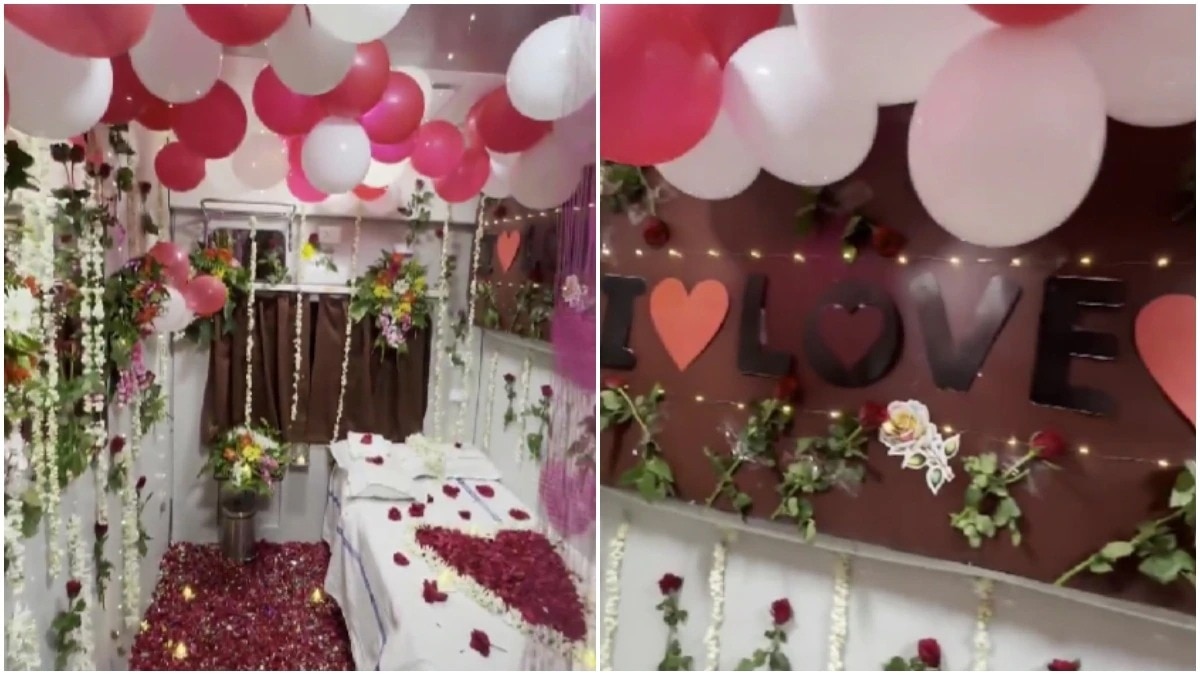
A decked up First AC coupe that’s trending online as a “honeymoon suite” was intended to welcome a newly married couple. Instead, it invited a
A decked up First AC coupe that’s trending online as a “honeymoon suite” was intended to welcome a newly married couple. Instead, it invited a railway inquiry, got the TTE (travelling ticket examiner) suspended and landed the decorator in legal trouble. The July 6 episode on the 11002 Nandigram Express, though, has also thrown an unlikely spotlight on one of Indian Railways’ curious offerings: First AC, arguably the world’s cheapest nationwide network of private overnight rail accommodation. It is a legacy product that seems almost structurally uneconomic for the railways, yet persists because it offers something even low-cost airlines cannot—your own, lockable room on wheels. Read Full Story The ornately decorated coupe on Nandigram Express, running between Mumbai CSMT and Balharshah in Maharashtra, was not arranged through any authorised railway service. The couple, through personal contacts and Instagram, found Rahat Room Decoration, a small Jalna-based event decoration business run by Azar Shaikh. Shaikh said his team boarded the train at Jalna, decorated the First AC coupe before passengers arrived, and got off the train. The consequences were striking. The TTE was suspended by the South Central Railway after an inquiry found the decorator should never have been allowed onto the train. The Railway Protection Force (RPF) booked the decorator under Railway Act, 1989, provisions relating to unauthorised entry, travelling without a valid ticket and criminal trespass. More importantly, the case registered is hardly about decorating a train coach. There is no specific offence under the Railway Act for turning a First AC coupe into what social media dubbed as a “honeymoon suite”. The alleged violations instead relate to how the decorator gained access to the train. The irony is hard to miss. As Indian Railways looks (and has been looking) for new ways to boost non-fare revenue, a private decorator momentarily demonstrated that at least some passengers might be willing to pay extra for a bespoke premium experience. Yet the experiment ended with disciplinary action, not a ‘business opportunity’. First AC is remarkable not only because it has private cabins—they exist in Europe, Japan and the United States too—but because of how cheaply Indian Railways sells them relative to comparable overnight rail services abroad.
The railways offers lockable two-berth coupes and four-berth cabins across its nationwide network, providing privacy at a fraction of what passengers pay overseas. But at a huge cost to the railways itself, as demonstrated by audits and reports time and again. The Comptroller and Auditor General of India (CAG) reported that AC First Class incurred an operational loss of Rs 139.39 crore in 2016-17—this despite charging the highest fares on the railway network. The reason is largely arithmetic. Only around 22 to 24 passengers can be accommodated in a First AC coach. An AC 2-Tier coach carries almost twice that number while AC 3-Tier coaches carry substantially more. The cost of the locomotive, track access, signalling and much of the staffing remains fixed regardless of coach composition, meaning those costs are spread over far fewer passengers in First AC. Operating costs are also higher because of enclosed cabins, dedicated attendants, complimentary bedding and higher maintenance standards. Every First AC coach, therefore, represents an opportunity cost. The same space could instead accommodate an AC 2-Tier or AC 3-Tier coach carrying far more passengers and generating substantially higher revenue on busy routes. AC 2-Tier is projected to make up 3 per cent of the passenger traffic volume while generating 9 per cent of the passenger earnings. The AC 3-Tier segment represents a significantly larger portion of railways’ business, accounting for 15 per cent of the passenger traffic volume and contributing roughly a third (33 per cent) of the total passenger earnings. The numbers, though, also tell another story. According to Indian Railways’ Budget Estimates for 2026-27, First AC is expected to account for around 0.4 per cent of non-suburban passenger-kilometres while contributing about 2 per cent to non-suburban passenger earnings. That effectively means First AC passengers pay roughly five times the network average fare per kilometre. It is simultaneously one of railways’ highest-yield passenger products and, as the national auditor found, one that still appears structurally uneconomic. Its footprint remains tiny. The coaching stock of Indian Railways comprises 1,100 AC First Class coaches—a small share of the total air-conditioned fleet. Yet, official projections suggest both passenger traffic and earnings from the class will continue to rise.
 The BriefWire