The emperor's new receipt: Rs 59 cr for a banana? Inside the world of absurd art pricing
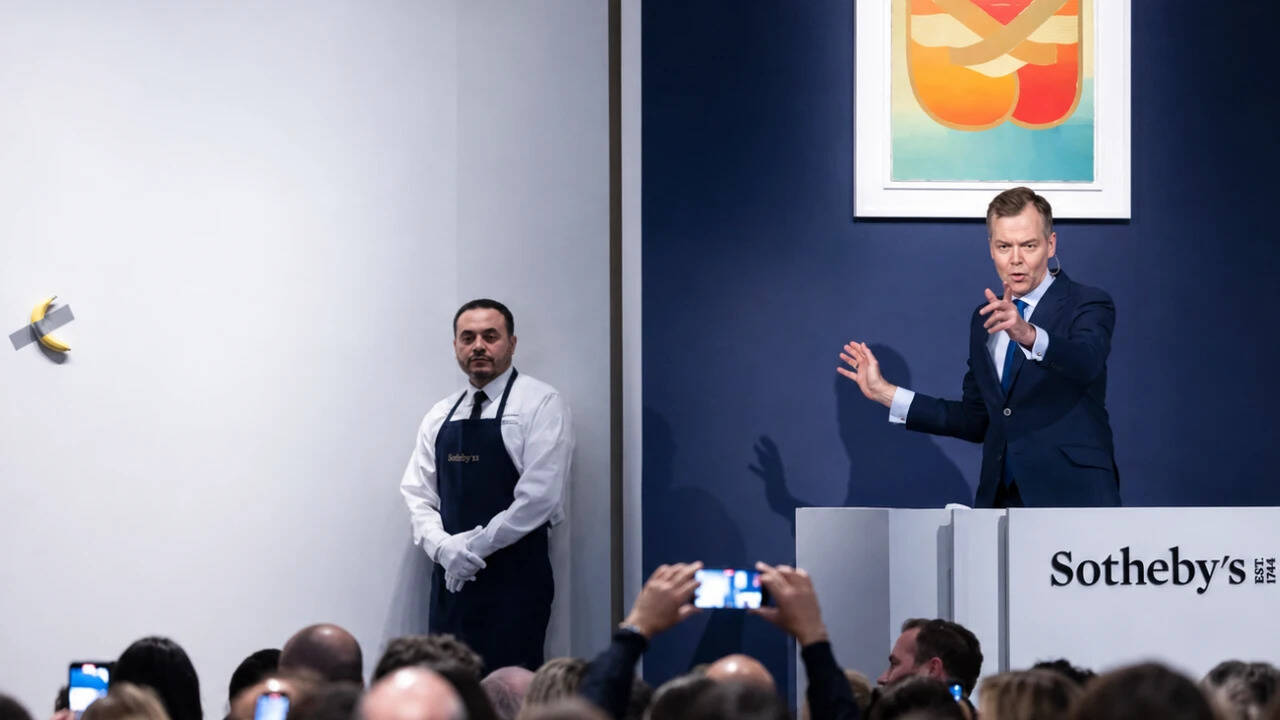
Sotheby's auctioneer overseeing the bidding for Maurizio Cattelan's Comedian (2019) at Sotheby's on November 20, 2024. Photo: Courtesy of Sotheby's Exhibit A: The man who
Sotheby's auctioneer overseeing the bidding for Maurizio Cattelan's Comedian (2019) at Sotheby's on November 20, 2024. Photo: Courtesy of Sotheby's Exhibit A: The man who threw paint Number 17A, 1948 by Jackson Pollock (Source: jackson-pollock.org) Exhibit B: The man who could not be moved Untitled, Mark Rothko (Source: MoMA) Exhibit C: The man who could not be understood Untitled (New York City), 1968, Cy Twombly (Source: Museum Brandhorst) Exhibit D: The man who sold nothing Blue Monochrome, 1961, Yves Klein Zones of Immaterial Pictorial Sensibility (Source: yvesklein.org) Exhibit E: The emperor who wears receipts In a very exclusive room far far away, a very ordinary looking wooden gavel comes down on an equally ordinary looking rostrum and somehow millions of dollars have transpired within that quarter of a second.At the centre of the stage, the reason a transaction of $6.24 million dollars (Rs 59.42 crore) just transpired, is a banana and a small piece of duct tape.This is not a fictional tale, though its absurdity may present it as one. Maurizio Cattelan's conceptual artwork, Comedian, was a banana taped with duct tape. Before the auction for the piece started a member of staff went out to get a banana from a local fruit vendor, because the Comedian was never about art. Its value lies in the theatrics. The fruit rotted within days, as fruit does. It has since been eaten — twice, by strangers, before the auction even happened, and a third time by its new owner, live on camera, minutes after paying millions for it. What actually changed hands was a certificate of authenticity and a laminated instruction sheet on how to tape up the next banana.It would be convenient to see modern and contemporary art as something that has fallen off the high horse that classical art seems to be saddled onto. Anyone can do it, so what makes it special? Why do people pay millions for art which looks like a toddler’s creation?Jackson Pollock is an artist who barely picked up a paintbrush and still became a millionaire.He laid his canvases flat on the floor of a barn and dripped, flung, and poured industrial enamel paint from a can, walking around and sometimes into the work as he made it.For the longest time, to an ‘uneducated’ eye, and sometimes even an ‘educated’ one, his art seemed to be just uncontrolled splashes framed on a wall. But this assumption was complicated in 1999 by a physicist.In 1999, a team led by physicist Richard Taylor analysed Pollock's poured canvases and found they were fractal – patterns that repeat at increasingly fine magnifications, the same geometry found in lightning, and the branching of trees – and that the complexity of these fractals increased systematically over the decade Pollock spent refining the technique. The finding was celebrated widely: here, finally, was science proving what the market had been pricing in all along, there was now scientific value to the price tag.But theories rarely stand the test of time and peers. Between 2006 and 2007, a separate team of physicists at Case Western Reserve University, Katherine Jones-Smith, Harsh Mathur, and Lawrence Krauss, tested the same fractal criteria against a wider set of images, and the results were uncomfortable for anyone hoping fractals could settle the argument for good.Two undisputed, museum-authenticated Pollock paintings failed the fractal test.
 The BriefWire