No Sunlight, No Fresh Food: NASA Wants Volunteers To Spend 14 Months Pretending They're On A Mission To Mars
No Sunlight, No Fresh Food: NASA Wants Volunteers To Spend 14 Months Pretending They're On A Mission To Mars Published By, Last Updated: July 10
No Sunlight, No Fresh Food: NASA Wants Volunteers To Spend 14 Months Pretending They're On A Mission To Mars Published By, Last Updated: July 10, 2026, 22:46 IST NASA is looking for volunteers to spend 14 months simulating a mission to the Moon and Mars, helping researchers study everything from isolation to adapting to a Martian day. Rapid Read News18 NASA isn’t looking for astronauts, instead the US space agency is instead searching for four volunteers willing to spend more than a year living as if they were travelling to the Moon and Mars but without ever leaving Earth. Earlier this month, NASA opened applications for the first Moon and Mars Exploration Analog (MMEA), a year-long simulation designed to recreate the isolation, confinement and day-to-day challenges of future deep-space missions. The experiment, which begins no earlier than August 2027 at NASA’s Johnson Space Center in Houston, aims to help scientists understand how humans cope with prolonged missions to the Moon and Mars. According to CNN, who first reported the development, the four selected participants will spend 12 months living inside two confined habitats that mimic interplanetary travel and planetary surface operations.
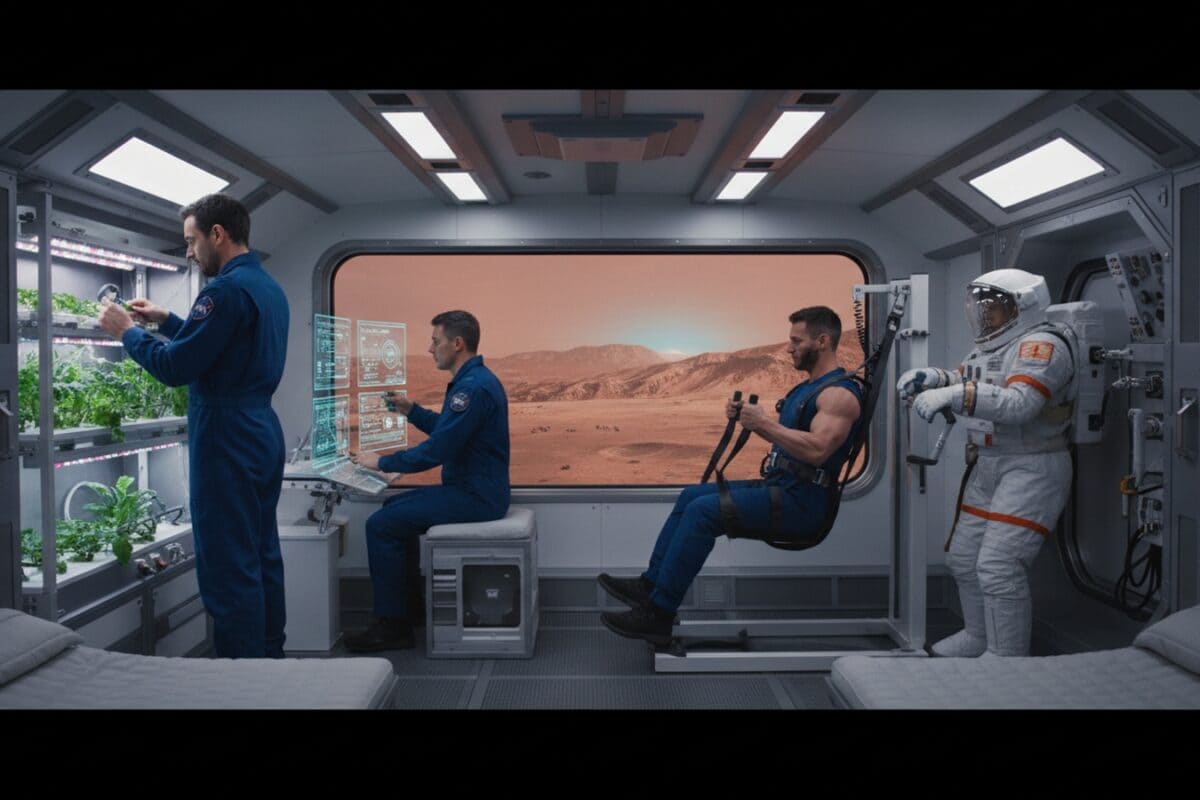
They will grow crops, monitor their physical and mental health, perform simulated spacewalks and complete astronaut-like tasks — all while researchers study how crews adapt to isolation, limited resources and the demands of long-duration missions. NASA spokesperson Kelsey Spivey told CNN that the simulation is designed to reduce the risks astronauts could face during future missions to the Moon and Mars. One focus of the experiment will be understanding how people adjust to Martian time, where a day — known as a “sol" — lasts roughly 40 minutes longer than an Earth day, a difference that can affect sleep, health and overall performance. Who Can Apply? The opportunity is open only to US citizens or permanent residents between the ages of 30 and 55, although NASA says exceptional candidates outside that age bracket may also be considered. Applicants must be fluent in English, stand no taller than 1.88 metres and hold at least a bachelor’s degree in engineering, biological science, physical science, mathematics or another relevant STEM discipline. Military experience and advanced STEM degrees are also considered favourably. Candidates must undergo physical and psychological screening and should not have a history of sleepwalking, dependence on sleep medication or dietary restrictions.
What Will Participants Do? The programme spans 14 months, including two months of training before and after the year-long simulation. During the first phase, the crew will live inside a simulated spacecraft, occupying compact personal quarters equipped with sleeping, working and bathroom facilities while mimicking the journey to the Moon or Mars. The second phase shifts the crew into a larger surface habitat, where they will conduct scientific experiments, monitor their health, cultivate crops and carry out mock planetary walks inside a specially designed sandbox that recreates extraterrestrial terrain. The final stage simulates the return journey to Earth. Unlike NASA’s earlier Crew Health and Performance Exploration Analog (CHAPEA) missions, which focused primarily on Mars habitat operations, MMEA combines both interplanetary transit and planetary surface living into a single integrated mission, allowing researchers to study the full arc of a future deep-space expedition. Nathan Jones, a physician who participated in a previous Mars habitat simulation, told CNN that the experience fundamentally changed the way he viewed everyday life. “I missed my wife and children during the one-year study period," Jones said. “It was difficult not being able to celebrate birthdays, holidays, graduations and other family milestones." He said the food was adequate but repetitive, with only a handful of fresh vegetables grown inside the habitat.
 The BriefWire