What's behind Germany's World Cup woes?
Germany have endured three straight disappointing World Cups. Experts say the reasons why are connected to football, but also to German society. Philipp Lahm has
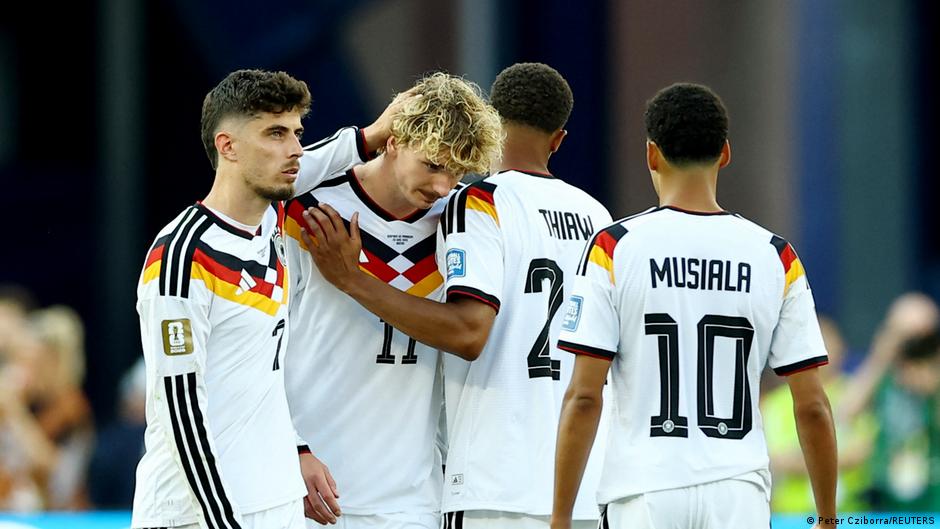
Germany have endured three straight disappointing World Cups. Experts say the reasons why are connected to football, but also to German society. Philipp Lahm has said German football's biggest problem is a lack of an identity. Toni Kroos believes Germany don't have world-class talent. Mats Hummels has spoken of issues in the system. There are plenty of opinions and arguments to choose from when it comes to why Germany endured a third straight World Cup disappointment. Frank Wormuth, a former player, German Football Association (DFB) coach-educator, first-division coach in the Netherlands, and currently a mental coach, believes the context of the team matters. German football identity: Frank Wormuth To play this audio please enable JavaScript, and consider upgrading to a web browser that supports HTML5 audio "It's not about the playing philosophy. It's about the quality of the players within that playing philosophy," Wormuth said. "You have to look at it separately—our top talents are still talents. (Florian) Wirtz had a less-than-ideal season in Liverpool. (Jamal) Musiala was out with an injury for a long time. (Leroy) Sane seems to remain the eternal prospect. What do you expect now? "So, right off the bat, you have three very important players on the field responsible for creativity who weren’t at peak form. And that has nothing to do with (head coach Julian) Nagelsmann. It’s a matter of individual form. (Kai) Havertz is just the way he is. He scores goals every now and then, but he thrives on passes. Then Havertz, the one penalty taker you are sure of, misses a penalty.
These are all little things, and I’d say that at this level, little things make all the difference. And that’s why it didn’t work out so well for us in attack, even though that was actually our strength." Wormuth also cities the example of Nico Schlotterbeck, whose injury early in the tournament was seen as a crucial blow to Germany's chances. "He gets injured and suddenly everything falls apart because we’re missing a left-footed player who can open up the play with his build-up. That’s a one-dimensional way of looking at it," Wormuth said. "The question is, are we really that good defensively? Just look at the other teams and how they use their bodies to challenge opponents. We don't do that anymore. I can clearly see that we have problems defensively in one-on-one situations." Frank Wormuth (left) has coached first team football in the Netherlands and Germany, as well as Germany's youth teams Image: Pro Shots/IMAGO Germany team impacted by system structure and societal change With relatively recent changes made to Germany's youth system, it feels misplaced to suggest youth football requires a complete overhaul. After all, the impact of the recent changes won't be felt for years to come. However, with character being another area questioned by those analyzing Germany's latest World Cup exit, there are case studies from abroad that might spark consideration in terms of the development of young players in Germany. Mark O'Sullivan, an associate professor of football at the Norwegian School of Sport Sciences in Oslo, highlights Bodo/Glimt's approach. Writing in his blog, O'Sullivan explains how the way the football club shaped their environment positively impacted their performance on the field.
 The BriefWire