California’s largest lake is turning to dust
The Salton Sea is drying up, worsening air pollution for people living near its shores. Authorities are working to stabilize the lakebed and lock down
The Salton Sea is drying up, worsening air pollution for people living near its shores. Authorities are working to stabilize the lakebed and lock down the dust. But for some families, it’s too late. Michelle Dugan-Delgado has had asthma for as long as she can remember. It's why she always takes an inhaler and face mask with her when she leaves the house — just in case the wind picks up and a dust storm hits. "I know that it's not safe for me to go outside,” she told DW. "It's like I live in a bubble. I have to really protect myself.” If dust enters her lungs, it could trigger an asthma attack. Invisible bacteria, fungal spores and viruses carried by dust could also cause a life-threatening infection. "If I'm outside and a dust storm hits, there's a very high chance I'm going to catch something, which means I will end up in the hospital,” the 35-year-old said. Dugan-Delgado knows the dangers well enough. She's been hospitalized multiple times. Asthma has also taken a deadly toll on her family. In 2009, her younger sister Marie died of an asthma attack at the age of 16. "It wasn't anything that we thought would take her life away,” she said. "It's painful to talk about it because I have a lot of survivor's guilt.” Dugan-Delgado lives in the Coachella Valley, an agricultural hub in California's far south that's surrounded by desert. She believes the poor air quality there is to blame for making her and Marie sick. Dusty air near an evaporating lake Dust storms are common in the region, which is home to around 500,000 people. A major source of that dust is a huge lake that's steadily drying up. Spanning some 343 square miles (888 square kilometers), the Salton Sea is California's largest lake.
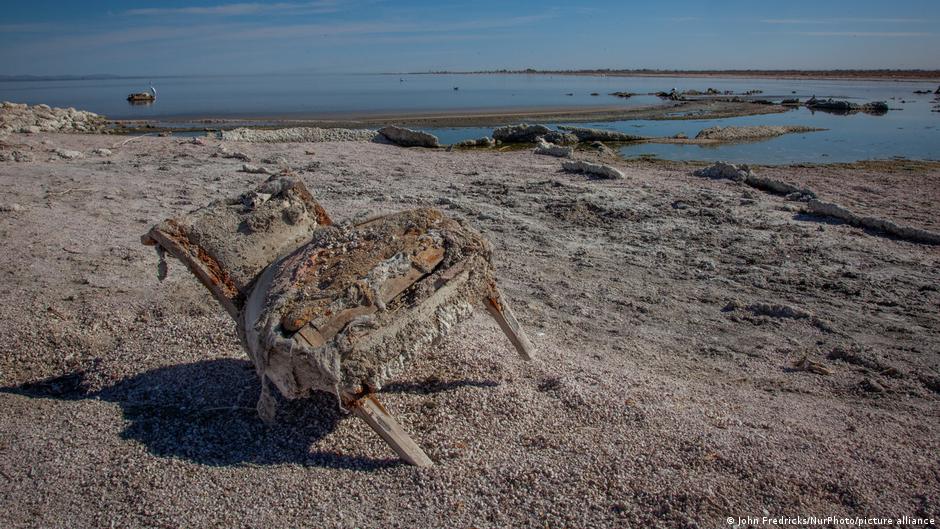
But it's rapidly shrinking. When winds sweep over the exposed lakebed, they pick up the parched sediment, producing harmful dust storms. As water levels steadily decline, they reveal sand, dust and toxins linked to respiratory illness Image: Thomas De Wever/Zoonar/picture alliance Children living near the lake have been found to have disproportionately high rates of asthma. One study that followed more than 700 primary-school aged children over a number of years found that 24% reported having the condition — far higher than the national rate of about 7% for boys and 5.5% for girls. Over 70% had allergies — more than three times the national average. "The majority of families that I know will have at least one child with respiratory illnesses,” said Dugan-Delgado. "That's really heartbreaking.” Her own 13-year-old daughter has asthma, and her 11-year-old son has allergies. From paradise to environmental crisis The Salton Sea was formed by accident in 1905 when the Colorado River burst an irrigation canal gate and flooded the area. Since then, the waterbody has been maintained by continuous agricultural runoff/irrigation wastewaters and local rivers. It became a popular holiday spot in the 1950s, with trendy lakeside resorts drawing tourists and celebrities. But then the water levels started to drop, partly due to a hotter climate and policies that diverted water away. In the last 30 years, the lake has shrunk by around 20%, or 70 square miles. The exposed lakebed holds more than just dust, though. Pesticides and other toxic chemicals from farms are also left behind to be picked up by the wind, only worsening air quality in the region. Once a tourist spot, the Salton Sea lake is now drying out Image: Olivier Hertel/ABACA/picture alliance Climate change driven by the continued burning of fossil fuels is leading to hotter temperatures and prolonged drought that's making desert regions around the world more arid.
 The BriefWire