UK: Police attempt to remove loyalist bonfire 'hate display'
A loyalist bonfire in Northern Ireland was lit a day early before police could remove a replica mosque from its top. Political and religious leaders
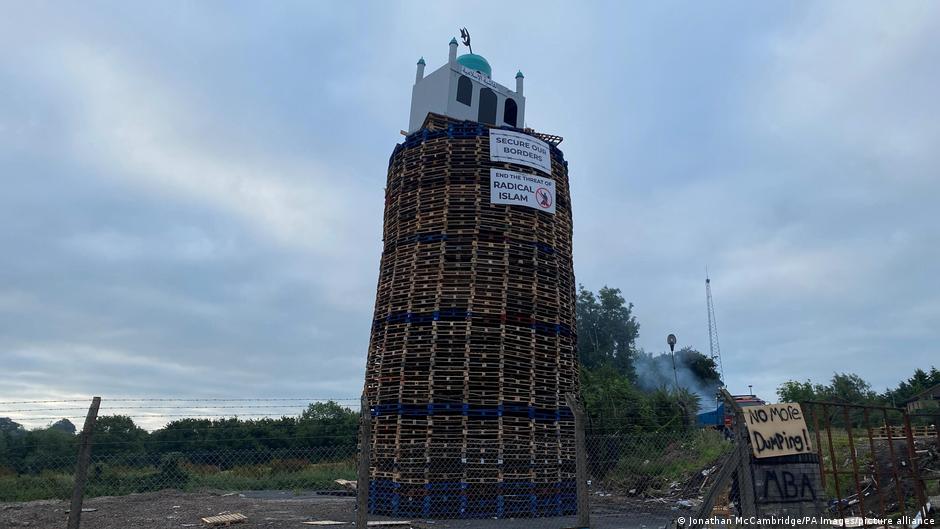
A loyalist bonfire in Northern Ireland was lit a day early before police could remove a replica mosque from its top. Political and religious leaders had condemned what organizers insisted was a "political protest." Police in the United Kingdom attempted to remove a replica of a mosque from the top of a loyalist "Eleventh Night" bonfire in Northern Ireland on Thursday night, prompting organizers to light the pyre a day early. The Police Service of Northern Ireland (PSNI) had earlier said the display on the bonfire in the town of Moygashel in County Tyrone was being treated as a "hate-motivated criminal offense" and had charged a 56-year-old man with incitement to hatred. Officers said they launched a "significant and complex policing operation" to remove the "hate display" and secure "offending material." But they said the bonfire was lit prematurely while the operation was at an "advanced stage." A PSNI spokesperson said: "Had the bonfire not been lit, police would have secured the site, removed the offending material and seized it as evidence." Chief Superintendent Norman Haslett said: "Hate crime has no place in our society and will not be tolerated," and added "That is why tonight we commenced a proactive policing operation to take action and remove the hate display from Moygashel Bonfire. Before police arrival the bonfire was set alight a day in advance to prevent removal of the criminal material. Where there is evidence that offenses have been committed, we will take robust action." Northern Ireland: What are the bonfires all about? The mosque replica, which was visible atop a pyre labeled with the Arabic words "Islamic fascism," had been widely condemned by political parties, religious leaders and human rights groups.
Signs reading "Secure our borders" and "End the threat of radical Islam" have also been placed on the pyre, which is due to be set alight on Friday night to mark the "Eleventh Night" on July 11, ahead of further unionist celebrations and parades on "The Twelfth" – July 12. For the loyalist community in Northern Ireland, the bonfires commemorate the Glorious Revolution of 1688, when the Protestant King William III of Orange deposed the Catholic King James II of England, and the subsequent Protestant victory at the Battle of the Boyne in what is now the Republic of Ireland in 1690. The Protestant community in Northern Ireland wishes to remain part of the United Kingdom and is opposed to the idea of Irish unification. Most "Eleventh Night" bonfires pass off without incident but, in some cases, Catholic and Irish Republican symbols such as Irish flags or religious effigies are placed on the pyres before they are set alight, sparking sectarian controversy. In recent years, anti-immigration symbols have also appeared on bonfires, including in Moygashel last year, when politicians condemned effigies of migrants in a boat which were burned along with a sign reading "Stop the boats." The three-word phrase refers to the illegal English Channel crossings by asylum-seekers and has become a rallying cry for anti-immigrant sentiment in the UK. This year's controversy comes just weeks after Northern Ireland was rocked by violent anti-immigration rioting mainly in pro-British areas following a knife attack by a Sudanese asylum-seeker. Anti-immigration symbols have also appeared on the bonfires, including this one in Moygashel last year Image: Niall Carson/empics/picture alliance Bonfire organizers: Act of 'political protest' The organizers of the bonfire, the Moygashel Bonfire Association, claimed the mosque replica was an act of "political protest" against "uncontrolled illegal mass immigration," which they said was "an issue of significant public interest." A statement insisted that the bonfire display "expressly does NOT target any individual" and that the group was opposed to "ideology and government policy" rather than people.
 The BriefWire