Remembering the Srebrenica genocide: ‘Fear is all that kept me moving’
The massacre in eastern Bosnia and Herzegovina was the largest in Europe since the Holocaust and among the darkest chapters in the Balkan wars that
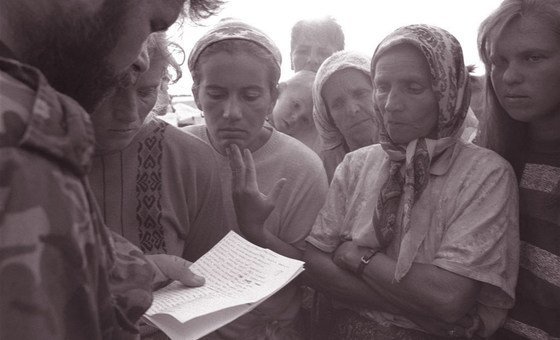
The massacre in eastern Bosnia and Herzegovina was the largest in Europe since the Holocaust and among the darkest chapters in the Balkan wars that erupted following the breakup of the former Yugoslavia. The Bosnian Serb army overran Srebrenica, which was previously declared a safe area under UN Security Council Resolution 819 (1993). Many of the victims had sought protection at the UN compound in nearby Potočari but were separated from their families, executed, and buried in mass graves. UN Photo/Eskinder Debebe Fear, loss and survival Hasan Hasanović was 19 when Srebrenica fell on 11 July 1995. Along with his father and twin brother Husein, he joined a column of men and boys attempting to escape through a forest. Within hours he was separated from his relatives, walking alone for days sleepless, hungry and scared amid ambushes, executions and artillery attacks. “Fear was all that kept me moving,” said Mr. Hasanović, head of the oral history programme at the Srebrenica Memorial Center, speaking in the UN General Assembly Hall. “Years later, after their remains were recovered from mass graves, I buried my father and my twin brother with my own hands.
Nothing could prepare me for those moments.” UN Photo/Eskinder Debebe A collective responsibility This is the second year the UN is commemorating the International Day of Reflection and Commemoration of the 1995 Genocide in Srebrenica, observed on 11 July. The massacre “will forever lay heavily on the collective conscience of the international community, the United Nations, and the modern history of our world,” said Chaloka Beyani, UN Special Adviser on the Prevention of Genocide. He called for a moment of silence to remember and honour the victims as well as the women and girls who were forcibly displaced from the enclave and tortured in the aftermath. Two top UN courts – the International Court of Justice (ICJ) and the International Criminal Tribunal for the former Yugoslavia (ICTY) – both recognized that the acts committed there constituted genocide. Heed the warning signs Following Srebrenica, “the world once again said: ‘Never again,’” the UN Secretary-General recalled in remarks read by his Chef de Cabinet, Earle Courtenay Rattray. “Yet, as we know, hate speech is on the rise – fueling discrimination, extremism and division. Convicted war criminals are glorified,” he said.
“We cannot turn away from these warning signs. We must act early – for prevention is our shared duty, and our surest protection.” UN Photo/Eskinder Debebe Genocide denial ‘a new threat’ Denis Bećirović, Chairman of the Presidency of Bosnia and Herzegovina, underscored the need to defend the integrity of international law and the authority of international institutions more than ever. “We must not allow facts established by court judgments to become a subject of political calculations,” he said. “The denial of the genocide against Bosniaks is an anti-civilisational act. It is an insult to the dead and a new threat to the living.” Tweet URL Uphold the promise of ‘never again’ Annalena Baerbock, the General Assembly President, said genocide – as unfortunately witnessed in Srebrenica, Rwanda, and elsewhere – “does not begin with mass graves” but with hatred and discrimination, attempts to divide people into “us” versus “them”, and policies and rhetoric that strip human beings of their dignity. In a video message, she urged the international community to “ensure that 'never again' is not merely a phrase we repeat, but a promise we uphold.” Emina Sinanović was only five years old when she lost her father, grandfather and uncle in the Srebrenica genocide.
 The BriefWire