Hidden Passage In Great Pyramid Of Giza Could Unlock New Secrets, May Rewrite History In 2026
Hidden Passage In Great Pyramid Of Giza Could Unlock New Secrets, May Rewrite History In 2026 Published By, Last Updated: July 09, 2026, 22:42 IST
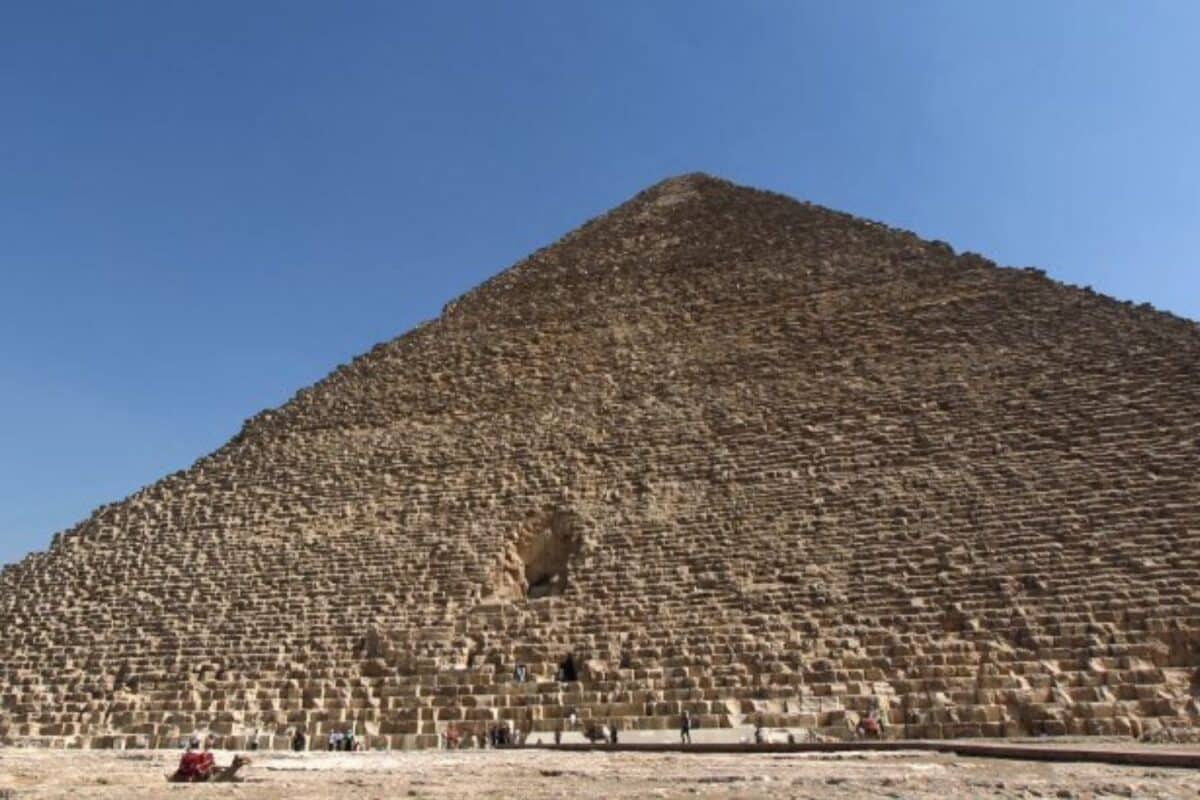
Hidden Passage In Great Pyramid Of Giza Could Unlock New Secrets, May Rewrite History In 2026 Published By, Last Updated: July 09, 2026, 22:42 IST Egypt’s most prominent archaeologist has announced that an international team of scientists will unveil a major archaeological discovery inside the ancient wonder. Rapid Read The discovery marks a monumental triumph for non-invasive archaeology, proving that some of the greatest historical finds are no longer unearthed by traditional shovels, but by subatomic particles and high-tech sensors. (Photo: AFP) For more than 4,500 years, the Great Pyramid of Giza has guarded its architectural secrets behind millions of tons of solid limestone. However, a major revelation is brewing beneath the desert sands. Dr. Zahi Hawass, Egypt’s most prominent archaeologist, has announced that an international team of scientists will unveil a major archaeological discovery inside the ancient wonder. According to Hawass, advanced scanning technology and remote-controlled robotics have successfully mapped a massive, previously inaccessible 30-meter-long (98-foot) hidden corridor deep within the body of King Khufu’s pyramid. Even more tantalisingly, the passage terminates at a completely sealed, ancient stone door—a threshold Hawass promises will “rewrite a chapter in the history of the pharaohs," Futura-Sciences reported. The full, official physical exploration and opening of what lies behind that door is slated to be broadcast globally.
Tech Revolution Subverting Spade The discovery marks a monumental triumph for non-invasive archaeology, proving that some of the greatest historical finds are no longer unearthed by traditional shovels, but by subatomic particles and high-tech sensors. The corridor’s existence was initially pinpointed via muon-radiography (cosmic-ray imaging). This astrophysical tech tracks subatomic particles called muons, which easily shower down through space and pass through stone but lose intensity when hitting dense matter. By installing ultra-sensitive detectors inside the lower chambers, independent scientific teams from Japan and France recorded a massive, anomalous “surplus" of cosmic particles directly above the pyramid’s Grand Gallery—confirming a substantial, completely hollow structural void. Once the coordinates were locked, archaeologists deployed autonomous mini-robots—direct algorithmic descendants of the famous Djedi robotic rovers—to clean out tiny ventilation shafts and maneuver through fractures too tight for any human to enter. Alongside ground-penetrating radar and thermal 3D mapping, the team confirmed that the 30-meter passage has remained entirely untouched since the reign of Khufu around 2600 BC. The Ultimate Hunt: Imhotep & Nefertiti For the octogenarian Hawass, who previously served as Egypt’s Minister of State for Antiquities Affairs, the Giza project runs alongside two lifelong, personal quests. He believes the ongoing technological wave could finally expose two of the ancient world’s most fiercely guarded locations The Lost Tomb of Imhotep: The legendary polymath and architectural genius who designed Djoser’s Step Pyramid (Egypt’s oldest pyramid structure).
 The BriefWire