Delhi And Tokyo Must Not Depend On Any Single Country: Japanese PM's Special Advisor | Exclusive
Delhi And Tokyo Must Not Depend On Any Single Country: Japanese PM's Special Advisor | Exclusive Reported By, Last Updated: July 09, 2026, 21:02 IST
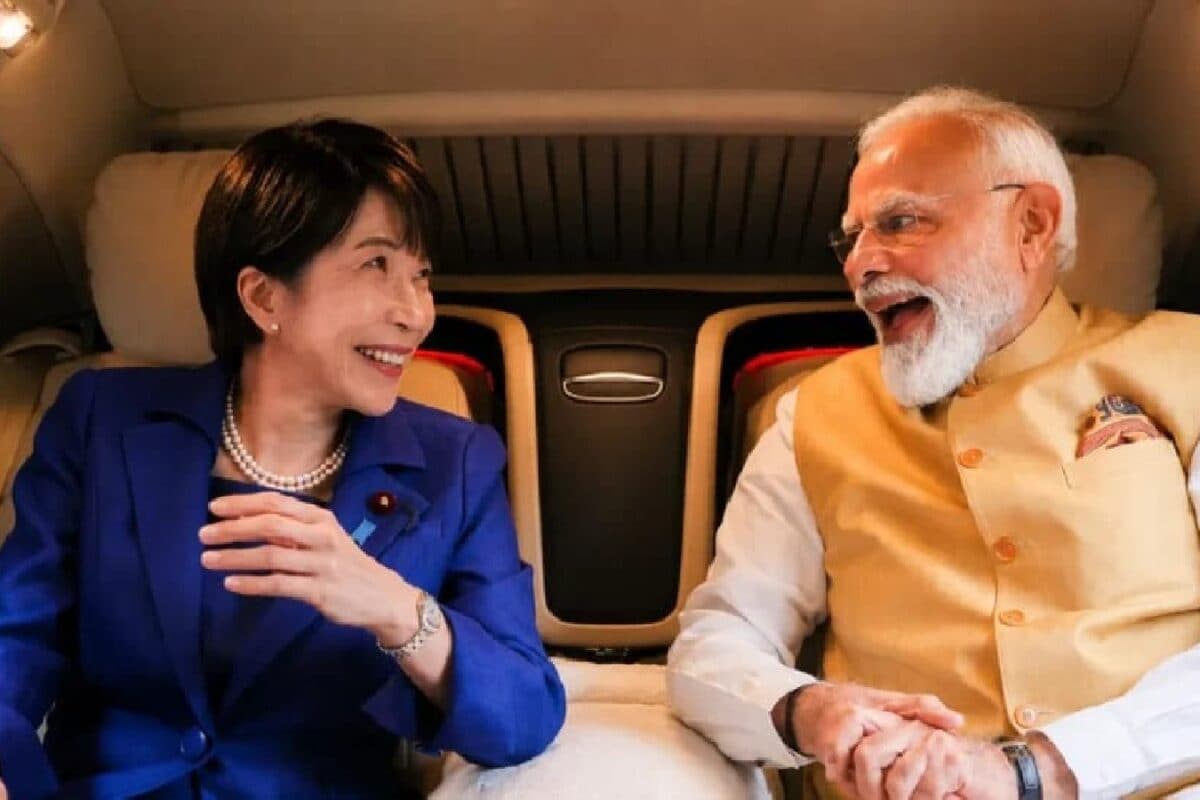
Delhi And Tokyo Must Not Depend On Any Single Country: Japanese PM's Special Advisor | Exclusive Reported By, Last Updated: July 09, 2026, 21:02 IST Sadamasa discusses why Tokyo believes the relationship with New Delhi has entered a new era of strategic convergence and trust. Sanae Takaichi was welcomed with ceremonial honours, played the santoor, addressed business leaders, and was warmly described by Prime Minister Narendra Modi as his "younger sister" during her visit to India. (IMAGE: PTI) It was diplomacy with a distinctly personal touch. Japanese Prime Minister Sanae Takaichi was welcomed with ceremonial honours, played the santoor, addressed business leaders, and was warmly described by Prime Minister Narendra Modi as his “younger sister" during her visit to India. But behind the optics lay one of the most substantive India-Japan summits in recent years. The two sides signed a series of agreements spanning economic security, artificial intelligence, defence technology and resilient supply chains, pushed forward negotiations on expanding economic cooperation, and reaffirmed a shared commitment to a Free and Open Indo-Pacific at a time of growing geopolitical uncertainty. But what did the summit really achieve beyond the headlines and photo opportunities? To unpack the strategic significance of the visit, CNN-News18 spoke with OUE Sadamasa, Special Advisor to the Prime Minister of Japan. In this exclusive interview, he discusses the next phase of India-Japan ties, the Quad’s role beyond symbolism, China’s growing assertiveness, economic security, and why Tokyo believes the relationship has entered a new era of strategic convergence and trust. Excerpts from the interview Prime Minister Takaichi’s visit to India last week has been described as a milestone in bilateral ties. What, in your view, was its single most consequential outcome, and what concrete deliverables should we expect over the next year?
The visit reaffirmed our shared commitment to advancing strategic cooperation under the ‘Special Strategic and Global Partnership’, with the common goal of promoting growth, prosperity and resilience. Equally important, the two Prime Ministers were able to deepen their personal relationship of trust, which will help drive cooperation across sectors. As next year marks the 75th anniversary of diplomatic relations between Japan and India, we expect to see greater engagement through commemorative events, stronger people-to-people ties, and expanded partnerships between local governments. China’s growing military presence in the East China Sea, South China Sea, and around Taiwan has fundamentally altered Asia’s security landscape. How closely are India and Japan coordinating their strategic responses to these challenges? Do Delhi and Tokyo now share intelligence or security assessments more closely than before? At the summit, the two Prime Ministers held wide-ranging discussions on developments in the Indo-Pacific, including issues related to China, and reaffirmed the importance of close Japan-India cooperation. They agreed to further strengthen collaboration in maritime security by expanding joint training and exercises, including in the Indian Ocean, enhancing maritime domain awareness through satellite capabilities, and deepening cooperation with the Indian Navy on the maintenance, repair and overhaul (MRO) of naval assets. As Quad members face pressure from China individually, how does Japan assess the Quad’s ability to act cohesively rather than symbolically in the Indo-Pacific? The Quad is not directed against any specific country, nor is it a military alliance. Rather, it is a framework for advancing practical cooperation to realise the vision of a Free and Open Indo-Pacific (FOIP). The four members remain committed to delivering tangible outcomes across key areas, including maritime and transnational security, economic prosperity and security, critical and emerging technologies, and humanitarian assistance and disaster response.
 The BriefWire