Hungary public media reform begins with black screen apology
People tuning in to public service media in Hungary on Tuesday were greeted by a black screen and an apology. Peter Magyar has begun dismantling
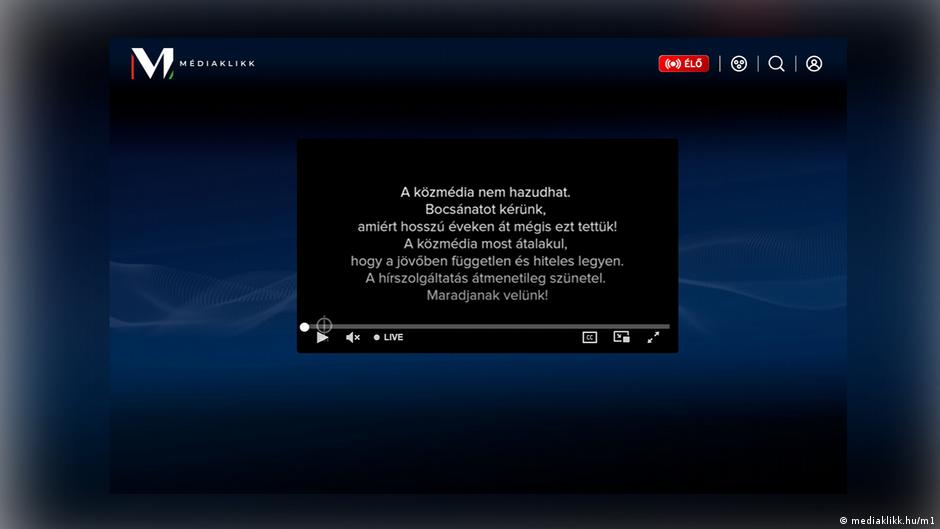
People tuning in to public service media in Hungary on Tuesday were greeted by a black screen and an apology. Peter Magyar has begun dismantling one of Viktor Orban's most potent tools of power. The disinformation that public service media in Hungary broadcast during the 16 years of Viktor Orban's rule was one of a kind in the EU. No other public service media in the EU published lies, hate and propaganda on this scale in recent decades. Some content was reminiscent of the fascist, antisemitic propaganda of the period between the two world wars; other content was similar to the output of Russian state media. To give but a few examples: Criminal Arab and African migrants who rape defenseless Hungarian girls; a US billionaire with Jewish Hungarian roots who is destroying Hungary's Christian identity; the EU's indoctrination of children with "LGBTQ propaganda;" a Ukrainian mafia state that wants to sacrifice Hungary's younger generation in the war and rob millions of Hungarian pensioners. Starting a new chapter But that era is now over. 'Today marks the end of propaganda broadcasts on public media platforms,' said Hungary's PM Peter Magyar on Tuesday Image: Bernadett Szabo/REUTERS At 4 p.m. on Tuesday, the news channel M1 broadcast a black screen with the following message: "Public media should not lie. We are sorry for doing it for so long. Public media will now be reformed so they will be independent and trustworthy. Our news service is currently suspended. Stay tuned!" All news bulletins and political programs broadcast by Hungary's public television and radio channels were replaced by the same apology/announcement. Only the website of the news agency MTI, which is also part of the public media holding MTVA, went on posting political news.
'They lied at night; they lied during the day' This is a watershed moment for Hungary. Nothing like this has ever happened before at the country's state broadcaster — not even when the Communist dictatorship collapsed in 1989/90 and Hungary began transitioning to democracy. "A historic day. Today marks the end of propaganda broadcasts on public media platforms," Hungary's Prime Minister Peter Magyar posted on Facebook on Tuesday. "They lied at night, they lied during the day, they lied on every wavelength. That is now over," he wrote. But there is more to this change than just a black screen and a written apology. The most senior figures at M1 have been removed from their posts. One of these is M1's director, Zsolt Nemeth (nicknamed "Pitbull" for his highly aggressive, confrontational style), and most of M1's directors of programming and senior news editors. Symbolic time for relaunch Just under four hours after the black screen appeared, M1 began broadcasting again at exactly 7:56 p.m. The choice of time (19:56 CET) was no coincidence. It was a nod to the anti-Communist, anti-Soviet revolution of 1956 that was brutally crushed by Soviet troops. The choice of film that followed was also highly symbolic: "The Witness" is a 1979 Hungarian classic, a political satire about the horrors of Stalinism and its absurd propaganda lies in Hungary. The black screen with the apology is still visible on the website of Hirado, M1's main news program. Keeping an election promise The radical overhaul of Hungary's public service media system was one of Peter Magyar's central campaign promises in the runup to the election on April 12. Even after his Tisza party's historic landslide victory, hardly a day passed without Magyar attacking the public service broadcasters, calling them a "factory of lies." And for good reason, too: The story of how his predecessor, Viktor Orban, reshaped Hungary's public-service media — and indeed most of the country's privately owned media, too — and got them to toe the government line, is one of the darkest chapters of his rule.
 The BriefWire