France's far right set to improve ties with Germany
France’s right-wing populist Marine Le Pen is running for President. Her chances aren’t bad. Her party, the RN, is already reaching out to Germany. "As
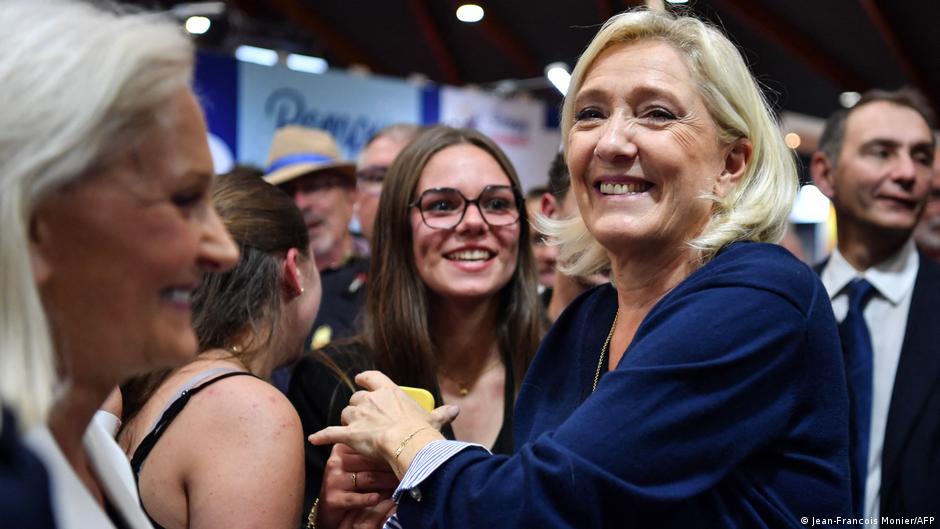
France’s right-wing populist Marine Le Pen is running for President. Her chances aren’t bad. Her party, the RN, is already reaching out to Germany. "As of tonight, I am a candidate for the presidential election," Marine Le Pen said Tuesday evening on French television. It was the day an appeals court in Paris upheld an earlier ruling against her for embezzlement of EU funds. Le Pen is the leader of the Rassemblement (RN) faction in the French Assembly. Her party is considered to range from right-wing populist to far-right. Le Pen was ordered to wear an electronic ankle monitor following the ruling. Her decision to run for the presidency came as a surprise to many, as she herself had previously ruled out campaigning while wearing one. She has already run for the highest office three times, losing the runoff election twice to incumbent Emmanuel Macron. Macron cannot run again. Her decision also means that Jordan Bardella, the 30-year-old RN party leader and Marine Le Pen’s political protégé, will not now be running in the election in the spring of 2027. Jordan Bardella is the President of French far-right Rassemblement (RN) party and Member of the European Parliament (MEP) Image: Alain Robert/SIPA/picture alliance An RN victory has never been so close The polls for the RN look promising. According to the surveys, the party's candidate is likely to win the first round of the French presidential election in April by a wide margin over the next-place candidate, with vote shares expected to range between 32% and 38%.
Prime Minister Edouard Philippe of the center-right party Horizons is considered the strongest contender for the presidency. If he faces the RN candidate in the runoff, he will need to rally both center-right and left-wing voters behind him to prevent an RN victory. This has already worked in several presidential and parliamentary elections. Similarly, in Germany, political parties from across the political spectrum often form alliances against Germany's far-right Alternative for Germany (AfD), which is now leading in opinion polls. "But this dynamic has grown weaker and weaker in recent years," Jacob Ross, a France expert at the German Council on Foreign Relations, tells DW. "The likelihood (that the RN will also win the runoff) is greater than ever before — that's for sure." The RN wants nothing to do with the AfD The rise of the Rassemblement was made possible by a long-term strategy that Marine Le Pen has called "de-demonization" — moving away from the antisemitism and overt racism that characterized the approach of her father, the party founder Jean-Marie Le Pen, and toward a more moderate, government-ready course that is accepted by middle-ground voters. The more a 2027 election victory seems possible, the more the RN distances itself from far-right parties in other countries and instead seeks contact with center-right parties. And this is where Germany comes into play. Both Le Pen and Bardella have clearly distanced themselves from the AfD in the past, calling it too extreme. They have even excluded the AfD from their joint parliamentary group in the European Parliament.
 The BriefWire