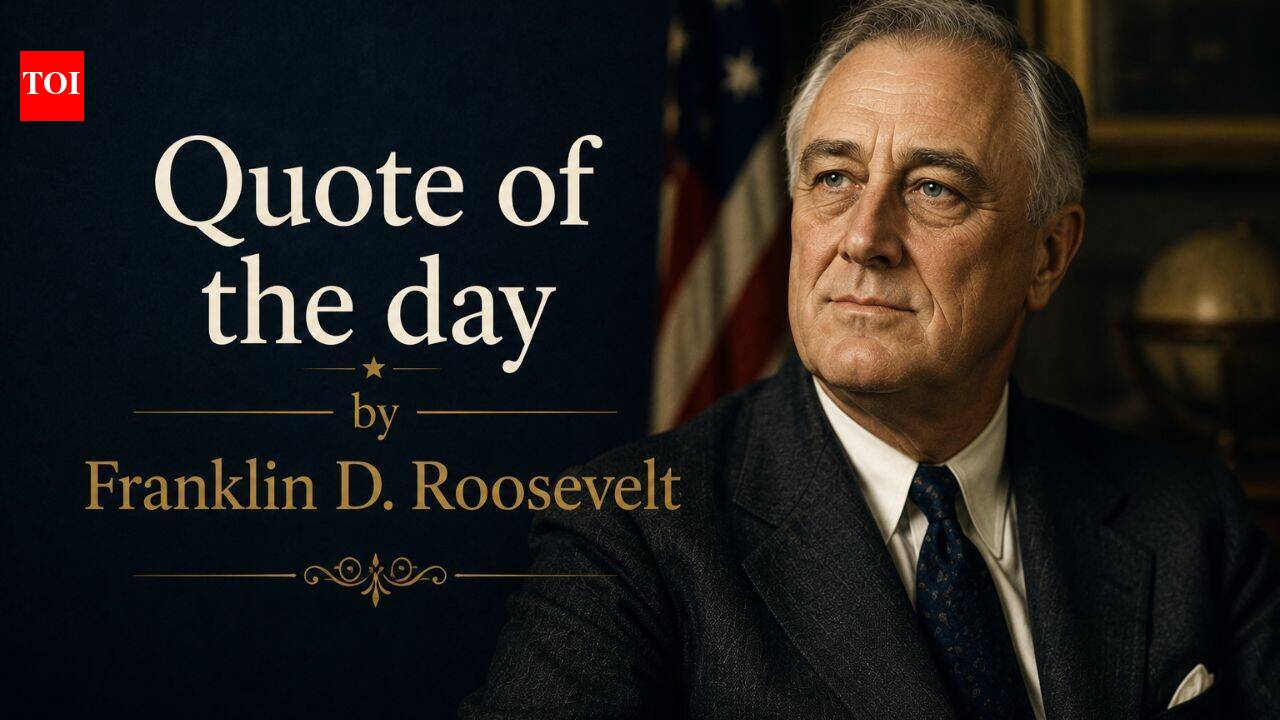
Quote of the day by Franklin D. Roosevelt: "Men are not prisoners of fate, but only prisoners of…"
Quote of the day by Franklin D. Roosevelt (AI-generated image) Quote of the day by Franklin D. Roosevelt "Men are not prisoners of fate, but
Quote of the day by Franklin D. Roosevelt (AI-generated image) Quote of the day by Franklin D. Roosevelt "Men are not prisoners of fate, but only prisoners of their own minds." The speech behind the words A president who tested this idea on himself Why the idea still holds up Putting it into practice Other famous quotes by Roosevelt "The only thing we have to fear is fear itself." "Happiness lies not in the mere possession of money; it lies in the joy of achievement." "Confidence thrives on honesty, honour, the sacredness of obligations, faithful protection, and unselfish performance. Without them, it cannot live." "The only limit to our realization of tomorrow will be our doubts of today." Franklin D. Roosevelt said this in a speech on the fourteenth of April, 1939, months before the Second World War began. "Men are not prisoners of fate, but only prisoners of their own minds," he told the audience. "They have within themselves the power to become free at any moment." He was speaking to a specific moment, but the line has outlived the occasion by decades, because it makes a claim that applies well beyond the politics that first produced it: circumstances alone do not decide what a person is capable of.
The mind usually gets there first. Roosevelt himself was in a position to know this better than most, given what he had already lived through by the time he said it.Roosevelt delivered this line during a Pan American Day address, at a time when European dictators were using the language of victimhood to justify aggression, describing their own countries as somehow "encircled" or "imprisoned" by neighbouring democracies. Roosevelt was directly rejecting that framing. A nation, he was arguing, is not actually a prisoner just because it claims to be one. The same, in his view, applied to individual people.He clearly thought the line mattered, because he repeated it himself two weeks later in a separate address on child welfare, quoting his own earlier speech almost word for word. That is not something a politician does with a throwaway line. It suggests the idea sat close to how he genuinely saw the world.At the time, fascist leaders in Europe were openly comparing their own nations to prisoners hemmed in by hostile neighbours, using that language to justify military expansion. Roosevelt's response treated the comparison as a kind of excuse dressed up as a grievance.
A nation choosing to see itself as trapped, in his framing, was making a choice about how to interpret its situation, not simply describing a fact about the world.Roosevelt was not just making a political point from a safe distance. In 1921, at thirty nine years old, he was diagnosed with polio and lost the use of his legs for the rest of his life. Many people at the time assumed his political career was finished. He did not accept that.He spent years working through rehabilitation and eventually returned to public life, becoming Governor of New York before serving four terms as President, guiding the country through the Great Depression and most of the Second World War. He never regained the ability to walk unaided. What he refused to accept was the idea that this fact alone determined what else was possible for him.Strip away the specific politics of 1939 and the core claim is a fairly ordinary one, just rarely stated this plainly. People often treat their circumstances as the whole story, age, background, one bad result, a difficult year, and quietly stop trying before circumstances have actually forced them to.Roosevelt is not claiming that hardship does not exist or that willpower fixes everything.
 The BriefWire