Rs 10 Lakh Drone Vs Rs 100 Crore Tank: 5 Rules Rewriting Modern Warfare
Rs 10 Lakh Drone Vs Rs 100 Crore Tank: 5 Rules Rewriting Modern Warfare Published By, Last Updated: July 07, 2026, 15:22 IST The future
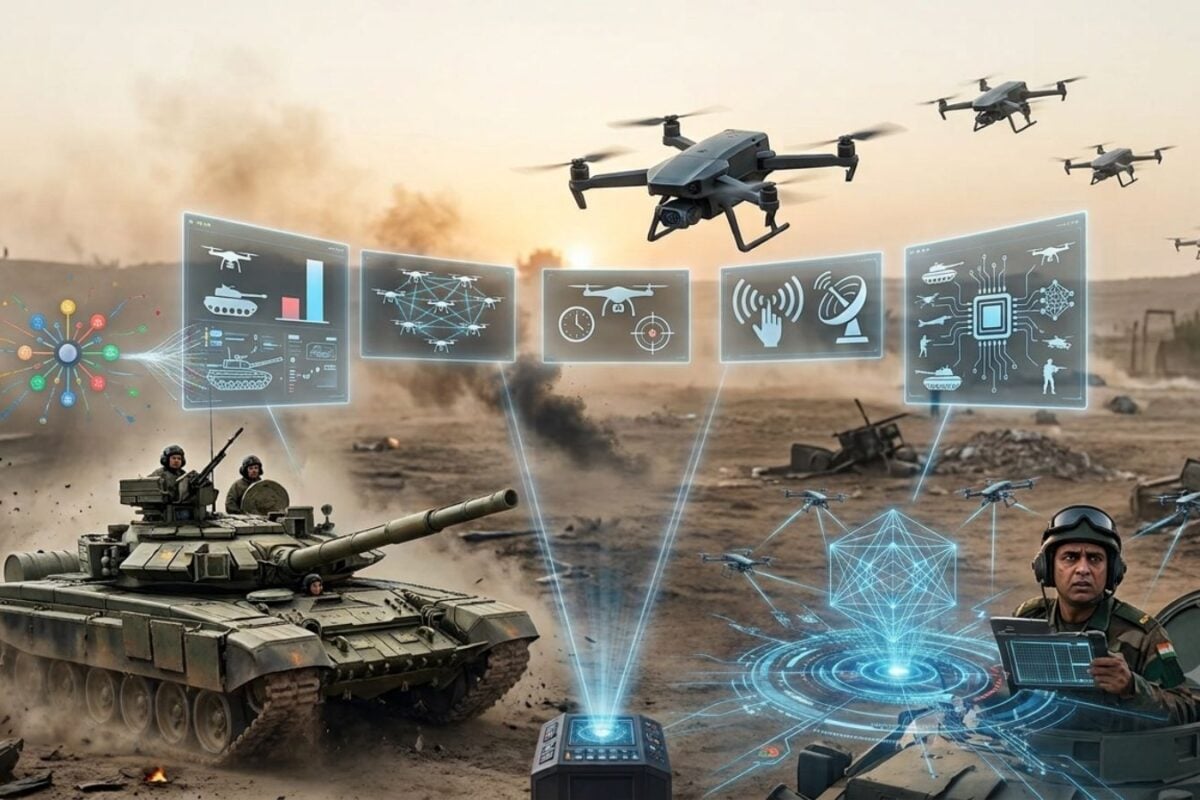
Rs 10 Lakh Drone Vs Rs 100 Crore Tank: 5 Rules Rewriting Modern Warfare Published By, Last Updated: July 07, 2026, 15:22 IST The future battlefield will be defined less by platforms and more by networks, algorithms, autonomy and mass-produced unmanned systems Rapid Read The emphasis is shifting from simply owning advanced weapons to processing information faster than the enemy. (AI-Generated Image) For decades, military power was measured in tanks, fighter jets, aircraft carriers and expensive missiles. Bigger armies with bigger weapons were expected to dominate the battlefield. That trend has changed. The wars in Ukraine, the Middle East and elsewhere are rewriting long-held assumptions about military power. Cheap drones assembled for a fraction of the cost of conventional weapons are destroying tanks worth crores. Artificial Intelligence is compressing battlefield decision-making from hours to minutes. Electronic warfare is proving as decisive as firepower. And software, increasingly, may matter as much as hardware. ALSO READ | US Wants To Break China’s Drone Dominance, But Why It Won’t Be So Easy: 2 Reasons Explained Military analysts now argue that warfare is undergoing its biggest transformation since precision-guided weapons entered service in the late 20th century. An analysis by The Wall Street Journal makes it clear that the future battlefield will be defined less by platforms and more by networks, algorithms, autonomy and mass-produced unmanned systems. Rule 1: Expensive Doesn’t Always Mean Better One of the biggest shifts is economic. In previous wars, armies invested heavily in platforms that could survive enemy attacks, for example, battle tanks, combat aircraft and aircraft carriers. Today’s conflicts have shown that inexpensive drones costing anywhere from a few lakh rupees to a few thousand dollars can disable equipment worth tens or even hundreds of crores. Ukrainian drones costing as little as a few hundred dollars have damaged or destroyed Russian military equipment worth thousands of times more. By early 2025, drones were estimated to account for 60-70 per cent of damage inflicted on Russian equipment, Bloomberg reported.
ALSO READ | Drones, Precision Strikes & AI: How Op Sindoor Triggered India’s Biggest Defence Overhaul Since Kargil This has created what military planners call a cost asymmetry. Instead of asking, “Can we destroy the enemy?", militaries are increasingly asking, “Can we afford to defend against thousands of cheap attacks?" Rule 2: The Battlefield Now Belongs To Drones The Ukraine war has become the world’s biggest laboratory for drone warfare. Initially used for recce, drones now identify targets, direct artillery, attack tanks, destroy bunkers, strike logistics hubs and even intercept other drones. According to the International Institute for Strategic Studies (IISS), first-person-view (FPV) drones and one-way attack drones have become pervasive on the battlefield. The organisation notes that UAVs have overtaken artillery as the leading cause of frontline casualties in parts of the war. Military experts say drones are changing tactics themselves. The Center for Strategic and International Studies (CSIS) notes that large armoured assaults have become increasingly risky because hundreds of drones can detect and attack troop concentrations before they reach enemy lines. Instead, armies are dispersing into smaller units that rely on constant aerial surveillance. Rule 3: AI Is Becoming The New Battlefield Commander The next revolution is not just drones, but the software behind them. Artificial Intelligence is increasingly helping militaries analyse sensor feeds, identify targets, prioritise threats and coordinate multiple unmanned systems. CSIS argues that future autonomous warfare will depend less on the drone itself and more on the AI-enabled “kill chain" that links sensors, data, target identification and weapons into one integrated network. Ukraine’s Delta battlefield management system is one example. It fuses data from drones, satellites, radars and ground units into a common operational picture, allowing commanders to make decisions far more quickly. Analysts quoted by The Indian Express say such software reduces the time between detecting a target and launching a strike from hours to minutes. Put simply, the emphasis is shifting from simply owning advanced weapons to processing information faster than the enemy.
 The BriefWire