Can India, Europe build a clean energy supply chain beyond China?
With China dominating every step of the solar energy production chain, governments in India and Europe are looking to reduce their overreliance on a single
With China dominating every step of the solar energy production chain, governments in India and Europe are looking to reduce their overreliance on a single supplier. In December 2025, Italy awarded more than 1.1 gigawatts of solar capacity across 88 projects in the country's first auction restricted exclusively to projects built without Chinese-manufactured equipment. The winning bids averaged €66.38 ($75.80) per megawatt hour, 17% above the price set in an unrestricted renewable auction held in 2025, according to data from Italy's electricity services agency, GSE. It was a deliberate premium, paid to buy solar hardware from anywhere other than China. But with more than 90% of solar modules installed in the European Union still imported from China, the auction exposed just how thin Europe's alternatives really are. China still produces more than 80% of the world's solar components, dominating every stage of the value chain from polysilicon to finished modules. That scale has delivered affordable panels to the world, but it has also left the governments in Brussels and New Delhi increasingly uneasy about relying so heavily on a single supplier. "China is present in almost every global solar supply chain," Ajay Srivastava, founder of the Global Trade Research Initiative, told DW. Even panels assembled in India or Vietnam, he said, typically rely on Chinese-made cells, wafers or polysilicon further up the chain. EU's solar industry in crisis despite new 2040 climate goals To view this video please enable JavaScript, and consider upgrading to a web browser that supports HTML5 video India's manufacturing push India's transformation from buyer to builder has been rapid, at least on paper. The country's solar photovoltaic (PV) module manufacturing capacity reached 172 gigawatts (GW) in early 2026, while cell capacity has nearly tripled to 30 GW.
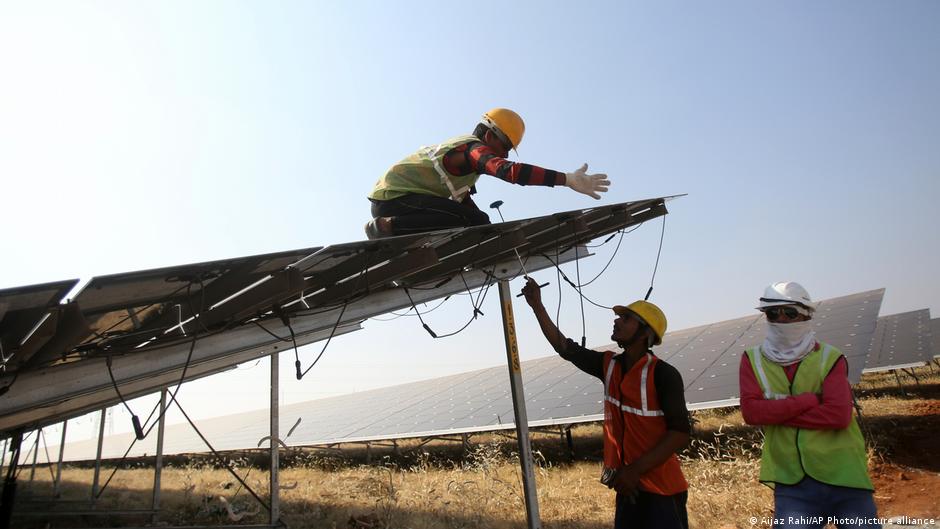
This shift has been largely policy-driven. Sanjay Varghese, a senior executive at Indian firm ReNew, credited the government's "Make in India" push — tariffs and non-tariff barriers, such as the Approved List of Models and Manufacturers (ALMM), backed by a roughly $2.5 billion Production-Linked Incentive (PLI) scheme — with reshaping the sector almost overnight. "Five years ago, all solar modules being installed in India were being imported from China," Varghese said. "But today, all modules, and about 50% of the cells being consumed in India, are made in India." Varghese is hopeful that the complete value chain from modules, cells, wafers, ingots, and polysilicon to even metallurgical-grade silicon will become domestic within five to seven years. Dries Acke, CEO of SolarPower Europe, described India's capacity as already outstripping its own demand. "This clearly means that you will have a country looking for export opportunities," Acke said. India's solar sector has received a major boost from the government's 'Make in India' drive [FILE: August 2025] Image: Manish Swarup/AP Photo/picture alliance Where the limits lie But analysts also cautioned against overstating India's readiness to replace China. Jochen Rentsch, head of technology transfer at the Fraunhofer Institute for Solar Energy Systems, pointed to wafers as the critical bottleneck: roughly 99% of the world's photovoltaic wafers are still made in China. He also warned that Chinese manufacturers can price wafers below production cost, making it "nearly impossible" for new entrants to compete on economics alone. While India has become largely self-sufficient in cells and modules, Rentsch added, it remains dependent on China for wafers, polysilicon and manufacturing equipment, suggesting that a shift towards Indian panels would only relocate part of the process rather than eliminate Europe's exposure to China.
 The BriefWire