8th CPC: Odisha meetings and Railway inspection
The 8Pay Commission started its another round of consultations with employee, pensioner bodies and other stake holders in Bhubaneswar, Odisha, today (July 6, 2026). The
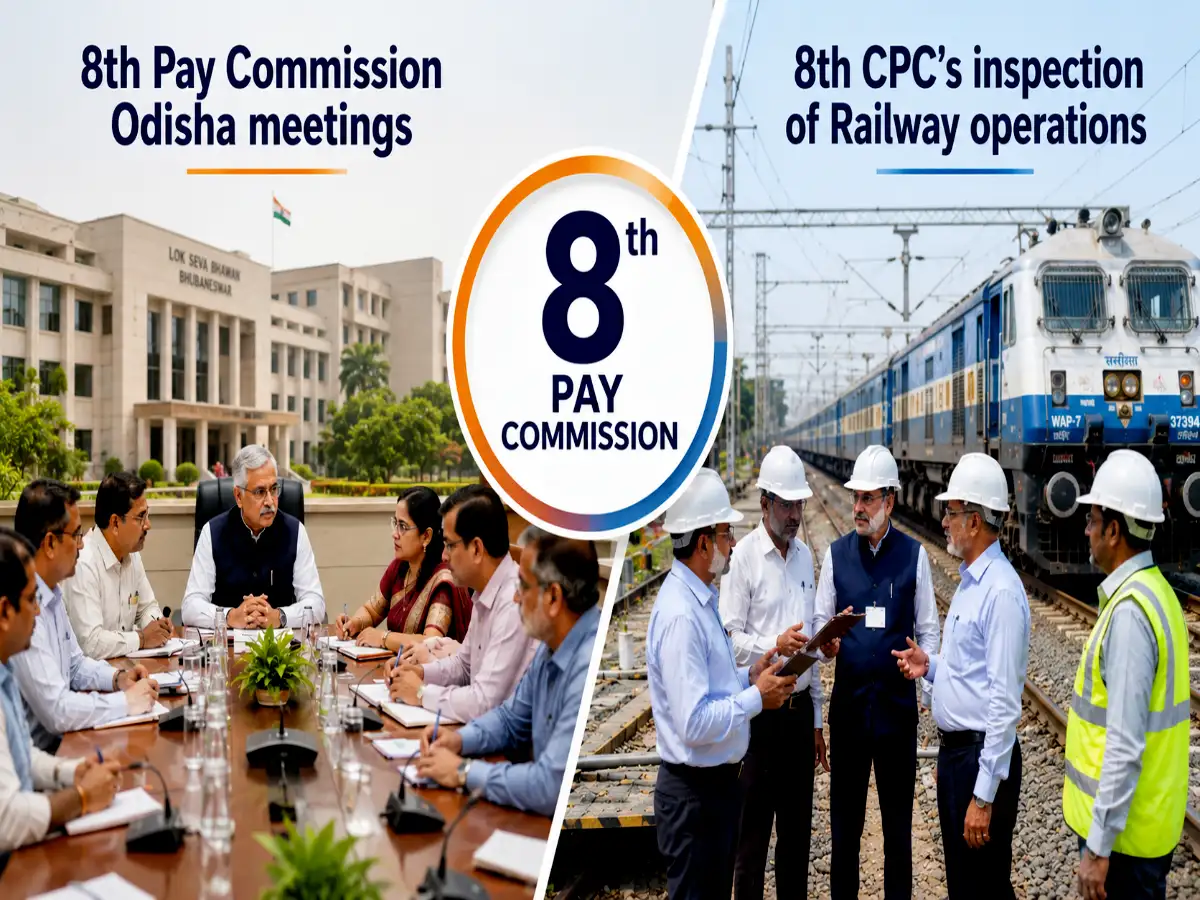
The 8Pay Commission started its another round of consultations with employee, pensioner bodies and other stake holders in Bhubaneswar, Odisha, today (July 6, 2026). The pay commission with discuss issues such as salary, pension, work conditions, allowances with stake holder in its two-day visit to the capital city of Odisha. The 8Pay Commission completed its round of discussions in Lucknow in June. The commission will have its next discussions in Kolkata, West Bengal, from July 9 to 10, 2026.Railway Board, in a letter dated July 2, 2026, has informed the Federation of Indian Railwaymen (NFIR) and All India Railwaymen’s Federation (AIRF), that the 8Pay Commission has desired to witness firsthand the working of Indian Railways and all aspects associated with operations and maintenance of rail traffic.The venue of the 8Pay Commission’s visit is yet to be decided. However, the Railway board has proposed the commission’s visit to be organised at Mumbai (CSMT/Central Railway) as at this Railway station, it can showcase different aspects of train operations and maintenance.In the inspection, the 8Pay Commission is proposed to inspect and understand the nature of railway jobs firsthand, risks, hardships, complexities involved in different railway operations and multifarious operations performed by various departments.The firsthand experience of these operations will give the 8Pay Commission an idea about renumerations of these employees in salary revision.The Railway board letter says that the 8Pay Commission may observe these operations and activities run by different employees. The operations under consideration for the visit are-i) Track maintenance activities by track maintainers, particularly that of keymen and patrolmen with special emphasis on the physical hardships faced by them and the high risk of death and grievous injuries in course of duty.(ii) Activities of technicians and related categories of P way, bridge, S&T and electrical departments.(iii) Duties and activities of pointsmen.(iv) Signal maintenance activities.(v) Bridge inspection activities.(vi) Footplate inspection in a high speed corridor to understand the working of running staff and the high pressure faced by them during train operations.(vii) Visit to control room to observe working of controllers.(viii) Station operations including the regulation of train movement, shunting, crowd management, sanitation and commercial activities.(ix) Visit to a workshop for showcasing the arduous maintenance activities and the innovations by Railway engineers in the field.(x) Presentation regarding management of trains and crowd during the recently concluded Kumbh Mela at Prayagraj.(xi) Track maintenance and train operations in Ghat Section.Indian Railway Technical Supervisors’ Association (IRTSA), the main employee body of Railway technical staff in India, has, meanwhile, demanded the Railway board to include the inspection of more operations during the 8Pay Commission’s visit.IRTSA, in a letter dated, July 4, 2026, wrote to the Railway board that certain vital and highly specialised activities, which are indispensable to the safe and efficient functioning of Railways, also deserve to be included in the programme of the 8CPC’s visit.IRTSA says these areas involve advanced technology, round-the-clock maintenance, high safety responsibilities and considerable occupational hazards.IRTSA wants the Railway board to include these activities for the 8Pay Commission visit.a) Activities involving TRD/OHE maintenance.b) Maintenance of electric locomotives.c) Maintenance of EMU suburban trains.a) Coaching depot – Pit line inspection, IOH, interior maintenance particularly related to passenger amenities.b) Wagon maintenance depot – ROH, sick line & rake examination.“A comprehensive exposure to the above activities will provide the Commission with a balanced understanding of the diverse nature of Railway operations, the technological advancements achieved by Indian Railways, and the high degree of skill, responsibility, risk and hardship borne by rail engineers and other employees,” says IRTSA in its letter.
 The BriefWire