How Vijay is redefining Opposition politics: Target BJP, but tango with Centre
When C Joseph Vijay entered politics, he drew a clear ideological battle line against the Bharatiya Janata Party (BJP). Throughout the 2026 Tamil Nadu Assembly
When C Joseph Vijay entered politics, he drew a clear ideological battle line against the Bharatiya Janata Party (BJP). Throughout the 2026 Tamil Nadu Assembly election campaign, the Tamilaga Vettri Kazhagam (TVK) chief repeatedly accused the BJP of centralising power, imposing Hindi and the Education Policy (NEP), and undermining Tamil Nadu's rights. His speeches left little doubt that the BJP would remain his principal political adversary. Yet, upon taking office as Tamil Nadu's CM, Vijay has crafted a governing style that sharply contrasts with his campaign rhetoric. Read Full Story While continuing to oppose the BJP on ideological and policy issues, Vijay has also maintained a consistent channel of engagement with Prime Minister Narendra Modi and the Union government. Rather than allowing political rivalry to dictate administrative relations, Tamil Nadu's new CM has seemingly sought to separate politics from governance, a balancing act rarely seen in recent Centre-State relations. The approach signals what could become a new template for opposition politics: oppose where necessary, cooperate where beneficial — a model that has been largely absent from opposition-ruled states for nearly a decade. Click to read Vijay's quiet federal reset, an Opinion piece by senior journalist TR Jawahar. A DEPARTURE FROM THE POLITICS OF CONFRONTATION Over the past decade, relations between the Narendra Modi government and several opposition-ruled states have often been marked by public confrontation. Tamil Nadu under the DMK frequently accused the Centre of withholding funds and attempting to impose policies contrary to the state's interests. Chief Minister of West Bengal, Mamata Banerjee, repeatedly alleged financial discrimination by the Centre and skipped several meetings convened by the Prime Minister. Arvind Kejriwal, while in power in Delhi, often accused the BJP-led Union government of obstructing his administration through constitutional and administrative mechanisms.
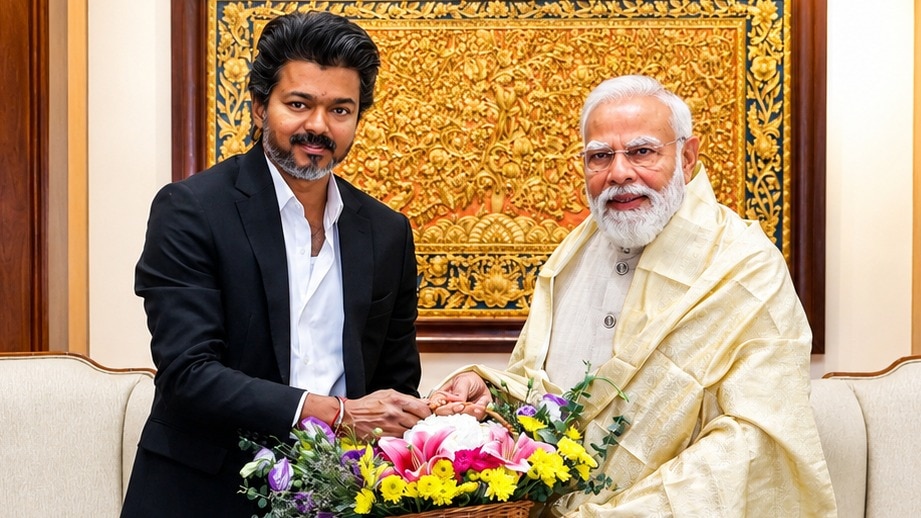
The political messaging of these governments largely revolved around resistance to the Centre. But Vijay appears to be pursuing a different path. His government has not diluted its ideological opposition to the BJP. It continues to reject the three-language policy, opposes linking education funding to the NEP, and has maintained Tamil Nadu's traditional positions on federalism and state autonomy. What has changed is the method of engagement with the Modi government. Instead of reducing interactions with New Delhi, Vijay has chosen to increase them. VIJAY'S OLIVE BRANCH AFTER SHARP CAMPAIGN AGAINST BJP The first indication of an olive branch came immediately after Vijay's swearing-in on May 10. Prime Minister Narendra Modi congratulated the newly elected chief minister through a public message and reportedly over a phone call as well. Vijay responded by thanking the Prime Minister and expressing hope that the Union government would extend its full cooperation for Tamil Nadu's development. For a leader who had spent months attacking the BJP, the tone was notably measured. It suggested that while electoral politics had ended, governance had begun, and CM Vijay started his New Delhi outreach. On May 27, Vijay travelled to New Delhi for his first official visit as chief minister. The meeting with Prime Minister Modi lasted around half an hour, but its significance extended beyond its duration. Rather than treating it as a courtesy call, Vijay arrived with a comprehensive memorandum covering virtually every major issue pending between Tamil Nadu and the Union government. Vijay sought central intervention in the Mekedatu dam dispute with Karnataka to safeguard Tamil Nadu's Cauvery water rights. He requested the release of pending education funds, highlighted the issue of Tamil fishermen being arrested by the Sri Lankan Navy, pressed for defence manufacturing projects in Tamil Nadu, and sought support for highways, railways, ports and industrial corridors.
 The BriefWire