Far-right AfD doubles down in bid to govern Germany
The AfD has strengthened its hardline leadership despite ongoing scrutiny from Germany's domestic intelligence agencies. Co-leader Alice Weidel says the far-right party is ready to
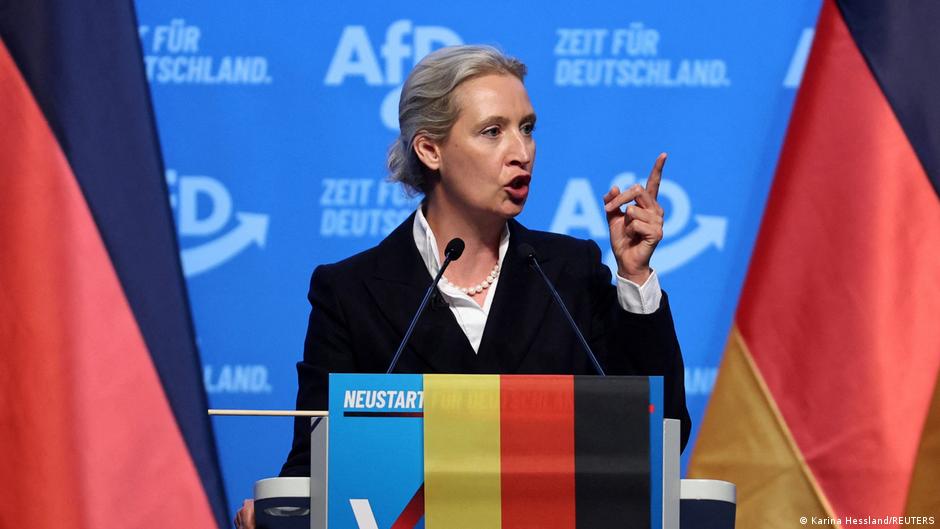
The AfD has strengthened its hardline leadership despite ongoing scrutiny from Germany's domestic intelligence agencies. Co-leader Alice Weidel says the far-right party is ready to govern after strong polling gains. Germany's far-right Alternative for Germany (AfD) has reaffirmed its ambition to govern the country. Wrapping up the party's national convention in Erfurt, the capital of the eastern state of Thuringia, re-elected co-leader Alice Weidel was pointing to current opinion polls that see the party in the lead across Germany. "We are the strongest force. We are a people's party with 30% support. And we will govern," she said. Earlier, delegates had confirmed the party's co-leadership. Weidel, who ran as the AfD's main candidate in Germany's 2025 federal election, slightly improved on her result from two years ago, winning 81.3% of the vote. Her co-chair, Tino Chrupalla, by contrast, lost significant support and received just 70%. More importantly for Weidel, many of her supporters were elected to the new federal board. This has strengthened the influence of Weidel, who holds a doctorate in economics, over the party's future direction. Within the AfD and in the media, there has long been speculation over Weidel's ambition to lead the party on her own in the future. Boost for the far-right wing The composition of the newly elected board suggests that the AfD is set to continue pursuing a hardline strategy to set itself apart from all other parties. No fewer than six of the 14 members of the new board come from state branches that Germany's domestic intelligence authorities classify as right-wing extremist organizations.
The party convention surrounded by strong police presence Image: Martin Schutt/dpa/picture alliance One of the new additions to the party leadership is Jean-Pascal Hohm, a far-right politician who also heads the newly founded party youth group, "Generation Deutschland.” In the past, Hohm had to give up his job with the AfD parliamentary group in the eastern state of Brandenburg because of his contacts to right-wing extremists. Stefan Möller, from Thuringia, is also joining the board. He is considered one of the closest political allies of Björn Höcke, one of the AfD's most controversial figures. In 2025, Höcke was twice ordered to pay fines after repeatedly using a slogan associated with the Nazi-era SA, a paramilitary organization under Adolf Hitler. His ally Möller is now expected to oversee the party's dealings with Germany's security authorities. Domestic intelligence agencies versus the AfD Germany's domestic intelligence agency, the Federal Office for the Protection of the Constitution, along with its state-level counterparts, is a particular target of AfD criticism. In five states — Brandenburg, Lower Saxony, Saxony, Saxony-Anhalt and Thuringia — the AfD is officially classified as confirmed right-wing extremist. In six other states, and at the national level, it is under observation as a suspected extremist organization. The authorities point to repeated negative statements by party members about Germany's democracy and judiciary. But above all, they point to repeated attempts by AfD politicians to question the legal equality of German citizens, especially when it comes to migrants, Muslims and Black people. Stefan Möller, now a member of the federal board, has also questioned the equality of all Germans in the past.
 The BriefWire