The moral test US founding father Thomas Jefferson failed?
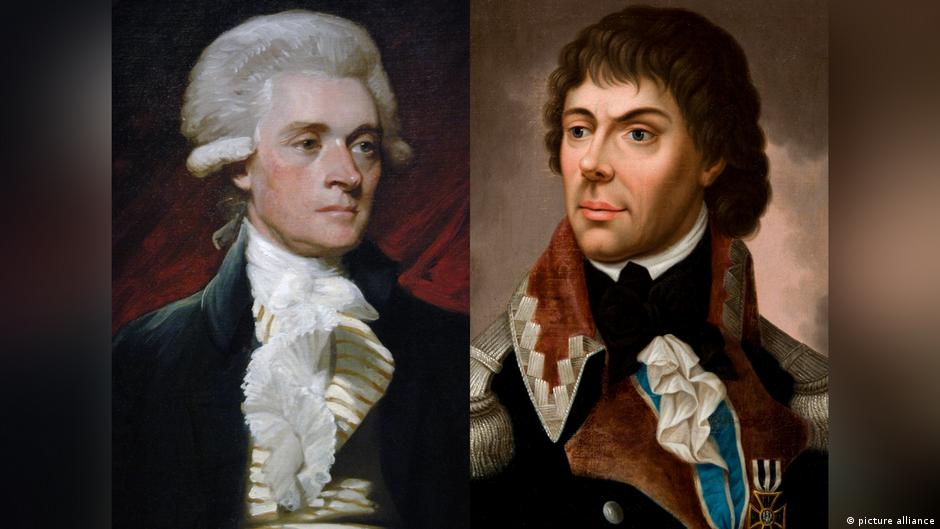
Polish general and freedom fighter Thaddeus Kosciuszko presented US founding father Thomas Jefferson with a moral test. Historians still disagree on whether Jefferson passed or
Polish general and freedom fighter Thaddeus Kosciuszko presented US founding father Thomas Jefferson with a moral test. Historians still disagree on whether Jefferson passed or not. The bronze statue of the man in 18th-century clothing gazes into the distance. The statue stands in the US capital, Washington, and is a likeness of Thomas Jefferson. His likeness can also be found carved into the rocks of Mount Rushmore in South Dakota, alongside those of three other US presidents, George Washington, Abraham Lincoln and Theodore Roosevelt. As the author of the US's Declaration of Independence, Jefferson is well known as one of the founding fathers of the country. Jefferson was a lawyer, plantation owner and politician. He served as the first secretary of state of the young republic, as its second vice president and then as its third president. His term as president is remembered for what is known as the Louisiana Purchase, the acquisition of the territory of Louisiana from the French. By buying this vast territory, the young nation almost doubled in size. The Jefferson memorial in Washington Image: Alexander Farnsworth/picture alliance But like almost every celebrated historical icon, Jefferson also had a dark side, one that has really only been openly discussed for the last few decades. This darker aspect of his biography is closely linked to Thaddeus Kosciuszko, a military engineer from Poland, who became one of the most important figures of the American war against the British. Many streets, squares and bridges in the US bear his name today – although the spellings of his name are not always the same, with some calling him Tadeusz and others leaving the "z" out of his surname. Kosciuszko has also been honored in Poland, where he is mostly celebrated as the leader of the failed 1794 uprising against Tsarist Russia, that he led when he first returned from America.
'A son of liberty' Jefferson first met Kosciuszko in 1780 during the war of independence. The future president was then just the governor of Virginia while the Polish officer had already made a name for himself as an exceptionally talented military engineer. The two men did not develop a closer friendship until 1797. After his release from Russian prison, Kosciuszko went to Philadelphia, which was then the capital of the US. Still suffering from the impact of his Russian imprisonment, Kosciuszko met regularly with Jefferson, who had become vice president by then. In a letter to another general, Jefferson wrote that he saw Kosciuszko often. "He is as pure a son of liberty as I have ever known, and of that liberty which is to go to all, and not to the few or rich alone," the vice president said. Portrait of Thaddeus Kosciuszko in a painting by Richard Cosway Image: Fine Art Images/Heritage Images/picture alliance Then when Kosciuszko decided to leave America permanently in 1798, he asked Jefferson for an extraordinary favor. He would leave behind the fortune he'd amassed in the US and he asked that after his death, it be used to free and educate Jefferson's slaves. Kosciuszko was a staunch opponent of serfdom and slavery and it was no coincidence that, as an officer in the US army, he conspicuously chose a Black soldier as his adjutant. Was Kosciuszko's request an attempt to shame his American friend? Or did he simply want to remind him of the American ideals he had risked his own life for? After 250 years, is US still living up to its 1776 promise? To view this video please enable JavaScript, and consider upgrading to a web browser that supports HTML5 video Promise broken Kosciuszko died in Switzerland in 1817 and two years after his death, in May 1819, Jefferson appeared before a local court in Virginia with his friend's will.
 The BriefWire