Why India is planning Namo Cities—and what they could mean for Delhi-NCR
These proposed urban centres, officially described as "Namo Cities" under the Regional Plan-2041 Why does NCR need new cities? So what exactly are Namo Cities?
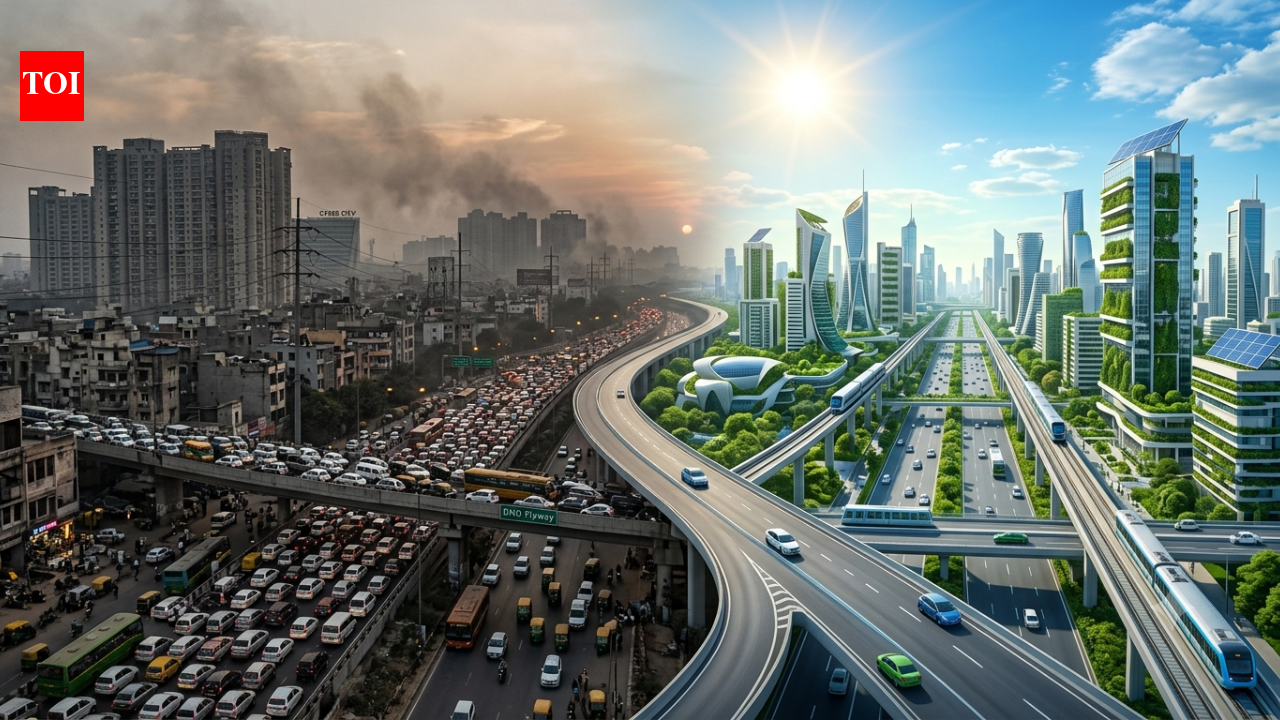
These proposed urban centres, officially described as "Namo Cities" under the Regional Plan-2041 Why does NCR need new cities? So what exactly are Namo Cities? Why is the RRTS central to the project? Delhi–Ghaziabad–Meerut (already functional) Delhi–Gurugram–Shahjahanpur-Neemrana-Behror–Alwar Delhi–Panipat How will the cities be selected? More than just housing How are Namo Cities different from the Smart Cities Mission? India has tried planned cities before Can new cities really solve NCR's problems? The biggest challenges ahead A long-term bet on planned urbanisation India is preparing for one of the biggest urban transformations in its history.Over the next 15 years, the population of the Capital Region (NCR) is projected to almost double, from about 7.86 crore today to 14.73 crore by 2041. That means nearly seven crore additional people will need homes, jobs, transport and public services in and around Delhi.The question confronting planners is straightforward: where will all these people live?Instead of allowing Delhi and its existing satellite cities to keep expanding outward, the government now wants to create entirely new urban growth centres connected by high-speed public transport.These proposed urban centres, officially described as "Namo Cities" under the Regional Plan-2041 (RP-2041), represent one of the most ambitious planning ideas introduced for the NCR in years.Announced after the 42nd meeting of the Capital Region Planning Board (NCRPB) in June 2026, the proposal aims to develop four semi-greenfield, mixed-use cities around existing and upcoming stations on the Namo Bharat Regional Rapid Transit System (RRTS).The idea is simple in theory but ambitious in practice: instead of building transport after cities expand, build cities around transport from the very beginning.Whether that vision succeeds, however, will depend on far more than railway stations and real estate.The NCR is already India's largest urban agglomeration.According to the housing and urban affairs ministry, it covers 55,083 square kilometres across Delhi and 27 districts of Haryana, Uttar Pradesh and Rajasthan. The region contains 230 urban settlements and nearly 11,800 villages, while contributing roughly 8% of India's GDP.Its economic importance has continued to grow for decades, attracting migrants from across the country seeking employment, education and better opportunities.But success has created its own challenges.Delhi, Gurugram, Noida, Ghaziabad and Faridabad have experienced rapid expansion, resulting in increasing traffic congestion, rising housing costs, pressure on water resources, deteriorating air quality and growing demand for civic infrastructure.The NCR Planning Board believes those pressures will intensify as urbanisation accelerates.Most of the projected population growth by 2041 is expected to occur in urban areas rather than villages, making better regional planning increasingly urgent.Instead of allowing existing cities to become denser indefinitely, planners now hope to distribute future growth across multiple new urban centres.That means they will combine undeveloped land with existing settlements, allowing urban expansion while making use of infrastructure already available nearby.Despite the name, the proposed developments are not entirely new cities built from scratch.The government describes them as semi-greenfield cities.Even more importantly, they are being planned as Transit-Oriented Developments (TODs).Transit-oriented development is an urban planning approach in which homes, offices, schools, hospitals, shopping areas and recreational spaces are concentrated within walking or cycling distance of high-capacity public transport.Instead of designing cities around private vehicles, TODs place railway or metro stations at the centre of neighbourhood planning.The objective is to reduce dependence on cars, shorten commuting times and create compact, mixed-use communities where people can live, work and access daily services without travelling long distances.Cities such as Hong Kong, Singapore and Copenhagen have successfully integrated transport and urban planning using similar principles, although each has adopted different models suited to local conditions.Unlike conventional city expansion where transport often follows development, TOD makes the transport network the foundation around which development takes place.In the case of Namo Cities, the transit backbone will be the Namo Bharat Regional Rapid Transit System, India's first high-speed regional rail network.Unlike conventional metro systems, which mainly serve travel within cities, the Namo Bharat network is designed to connect cities across the wider NCR at much higher speeds.Phase-I includes corridors connecting:The proposed Namo Cities will be located around selected existing and future stations along these corridors.This reflects a major shift in planning philosophy.Historically, Indian cities have often expanded first, with transport infrastructure struggling to catch up later.The NCR Planning Board now wants infrastructure to become the starting point for urban development rather than an afterthought.The expectation is that reliable regional rail connectivity will encourage businesses, educational institutions, healthcare facilities and housing projects to develop around these transport hubs.Explaining the vision behind the network, Shalabh Goel, managing director of the Capital Region Transport Corporation (NCRTC), said Namo Bharat "was envisioned as a catalyst for sustainable and balanced regional development".He added that the network would "unlock new growth corridors, encourage development beyond traditional urban centres and foster vibrant transit-oriented communities" by bringing people closer to jobs and opportunities.One notable aspect of the proposal is that the locations have not yet been finalised.Instead of pre-selecting sites, the Centre has asked participating states to compete.Under the framework approved by the NCR Planning Board, Delhi, Haryana, Uttar Pradesh and Rajasthan will submit proposals identifying suitable locations.The final four cities will be selected through a competitive challenge process.According to Union housing and urban affairs minister Manohar Lal, the Centre has proposed a performance-linked incentive package worth Rs 5,000 crore to support the selected projects.The package includes a blend of grants, loans and guarantees, including a Rs 1,000 crore grant, with the aim of helping states develop these new urban growth nodes.Uttar Pradesh has already proposed Noida, Dadri, Jewar and Bulandshahr as potential candidates, while Rajasthan is expected to submit its proposals separately.The minister has also indicated that Delhi could identify suitable land on its outskirts for a similar development.While the announcement has generated attention because of the proposed new cities, RP-2041 is far broader than a housing plan.The Regional Plan seeks to create a more balanced and environmentally sustainable NCR by integrating transport, housing, employment and ecological conservation.Alongside the proposal for Namo Cities, the Planning Board also approved measures aimed at increasing green cover across the region.It decided to develop a scheme that would incentivise states to expand forests and urban greenery while encouraging participation from private companies and citizens.The Board also discussed innovative tools such as green canopy credits and transferable Special Development Rights to promote environmental conservation.The emphasis reflects a growing recognition that future urban expansion cannot simply replicate older models of low-density sprawl.Although both initiatives focus on urban development, they address different challenges.The Smart Cities Mission, launched in 2015, largely concentrated on improving infrastructure within existing cities through better technology, governance and public services.Namo Cities, in contrast, are about creating new growth centres before congestion reaches unsustainable levels.Rather than retrofitting existing urban areas, the proposal seeks to plan entirely new urban nodes around mass transit from the outset.In other words, Smart Cities attempted to modernise cities that already existed.Namo Cities aim to shape where future cities emerge.India is no stranger to planned urban development.After Independence, Chandigarh was developed as a purpose-built capital city.
 The BriefWire