Welcoming the Taliban? — Germany's new Afghanistan policy
To facilitate the deportation of criminals to Afghanistan, the German government is allowing Taliban diplomats into the country. Just under a year ago, Hamid Nangialay
To facilitate the deportation of criminals to Afghanistan, the German government is allowing Taliban diplomats into the country. Just under a year ago, Hamid Nangialay Kabiri found himself caught up in a difficult situation: Having worked at the Afghan Consulate General in Bonn for six years, most recently as its head, he decided to step down in September 2025 rather than comply with the German government's demand that he cooperate with Taliban representatives. "I said: I'm sorry, but I can't do that. They are terrorists. I grew up under their government in Afghanistan, and I watched many of my classmates being killed. I cannot accept them as colleagues," he told DW. Just nine months later, it has become reality: Both the Afghan Consulate General in Bonn and the embassy in Berlin are now headed by Taliban representatives. Four more diplomats are expected to arrive in Germany, the federal government has confirmed. Acting Consul for Afghanistan, Hamid Nangialay now fears for his safety Image: privat Meanwhile, Kabiri, who steadfastly refused to cooperate with the Islamist group, now doesn't ever leave his apartment on his own, out of concern for his safety. He has also been forced to apply for asylum so he can remain in Germany. "I lost my first homeland, Afghanistan, and I do not want to lose my second home, Germany, because I truly feel at home here," he said. "In the past, anyone applying for asylum was subjected to intense scrutiny to ensure they had not cooperated with the Taliban.
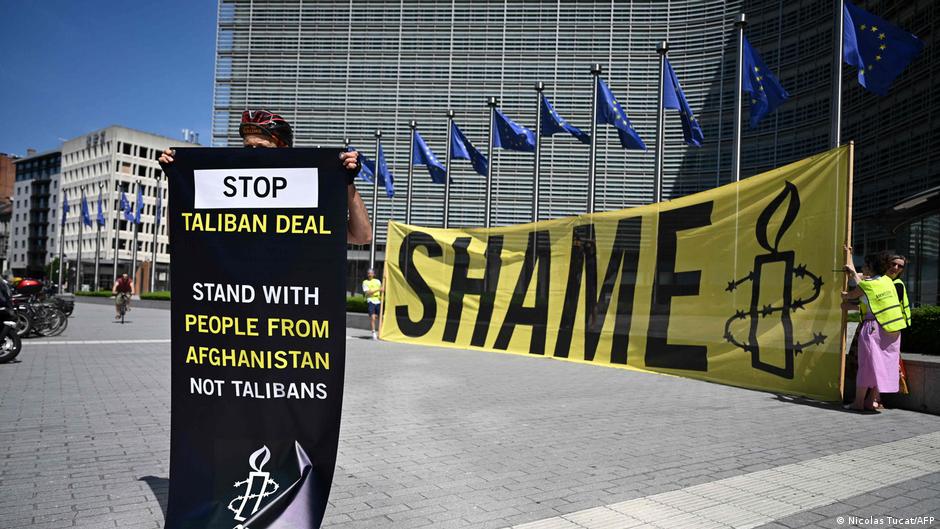
Now I may have to leave the country because I refused to cooperate with them. That's a double standard." More deportations to Afghanistan The German government is determined to increase deportations to Afghanistan, with Interior Minister Alexander Dobrindt of the center-right Christian Social Union (CSU) proposing three charter flights per month, supplemented by individual deportations on scheduled commercial services. To facilitate those returns, Berlin is opening channels of communication with a regime German troops joined a war against for nearly two decades. Fifty-nine German soldiers lost their lives on that mission, and Germany still does not officially recognize the Taliban as the government of Afghanistan. EU-Taliban talks spark debate over normalizing Taliban rule To view this video please enable JavaScript, and consider upgrading to a web browser that supports HTML5 video In response to DW's inquiry, the German Interior Ministry said: "By accepting returns from Germany, Afghanistan's de facto government is fulfilling its obligation under customary international law to readmit its own nationals. At the same time, the functioning of Afghanistan's diplomatic missions in Germany is a prerequisite for issuing replacement travel documents required for deportations." Chancellor Friedrich Merz, of the center-right Christian Democratic Union (CDU), recently told a parliamentary question session: "We are not extending a hand to the Taliban regime." He added, however, that Germany was seeking cooperation with the Taliban "at the necessary technical level" where doing so served the country's interests, particularly in relation to the deportation of criminals.
 The BriefWire