How one wolf's death in the 1920s helped transform modern conservation
A routine US Forest Service predator control task became a lasting moral reflection Early conservation mindset in the American West Early shift from land management
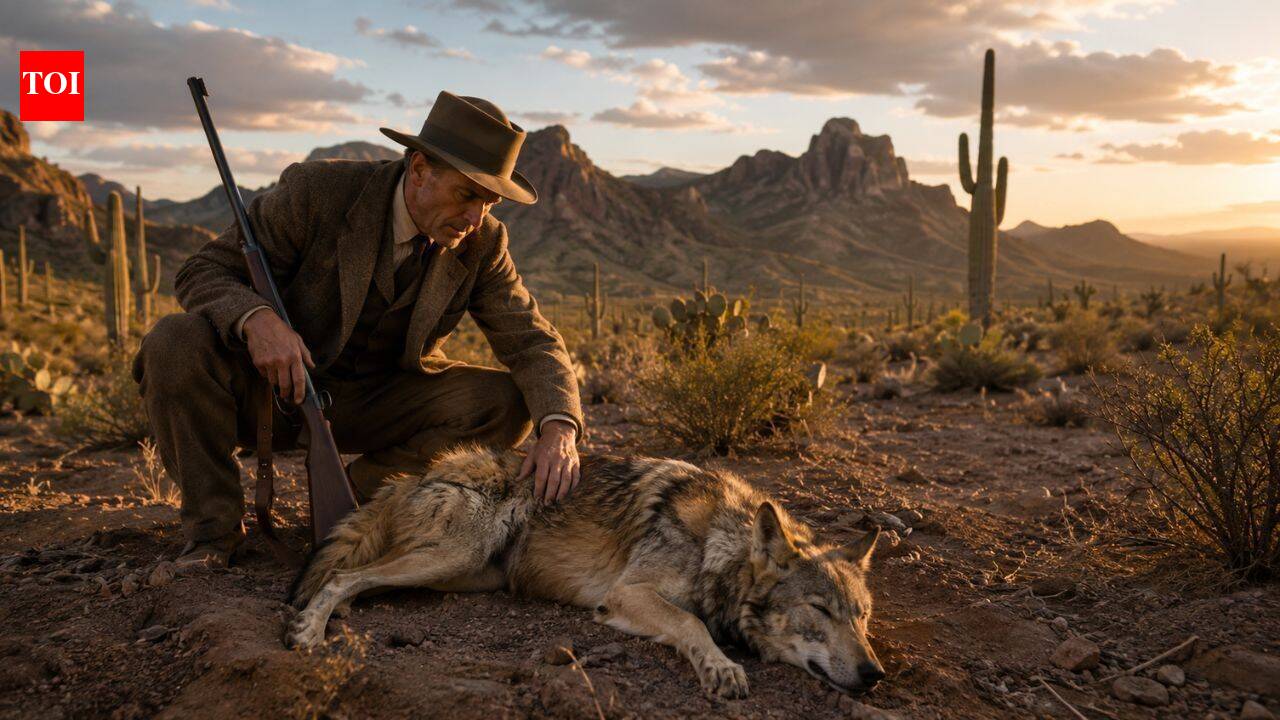
A routine US Forest Service predator control task became a lasting moral reflection Early conservation mindset in the American West Early shift from land management to ecological understanding How a change in perspective reframed human relations with the natural world The emergence of a “middle ground” between wild nature and human design The academic years that helped define a new ecological consciousness Leopold’s death and the continuing legacy of his ecological thought In the early years of the 20th century, conservation in the United States was still taking shape as a profession rather than a philosophy. Forests were being mapped, species counted, land divided into managed zones with a confidence that nature could be organised if only enough data were gathered. Among the young men entering that system was a forester who had been trained at Yale and posted to the American Southwest. He arrived with the habits of his time, rifle included, and a belief that removing certain animals was part of keeping the landscape “healthy”.It was on one of these field assignments that he shot a wolf on a rocky slope in Arizona. What followed was not a celebration of control but a moment of hesitation that he later struggled to describe clearly. The animal’s death seemed to interrupt something previously unquestioned, leaving him with a sense that the rules he had been working within were incomplete.The forester was Aldo Leopold, then still working within the early US Forest Service mindset that treated predators as problems to be solved. Wolves were routinely removed to protect livestock and game animals, and few in his circle saw any contradiction in that approach.On that day in Arizona, the shot came quickly, almost casually, as part of routine work in rough terrain.He later wrote about standing over the animal afterwards. The detail that stayed with him was not technical or scientific, but visual. The wolf’s expression seemed to shift in the final moments, something he described as a fading intensity rather than a simple absence of life.
It was not framed at the time as a revelation, more a discomfort that lingered without immediate explanation. In later years, he would return to the memory often, as if trying to locate what exactly had changed in that brief exchange between hunter and hunted.At the start of his career, conservation in the American West was still closely tied to resource management. Land was to be protected for use, not for its own sake. Forest Service policy focused on timber, grazing, and game populations, with predators frequently seen as interference in a system that could otherwise be balanced through regulation.Leopold worked within that structure, contributing to surveys and land assessments across the Southwest. His early writing reflected the language of control common at the time, where wildlife was often divided into useful and destructive categories. Yet field experience gradually complicated those divisions. He began noticing that removing one species had effects that travelled beyond immediate expectations, altering vegetation patterns and the behaviour of other animals in ways that were not easily corrected.The shift was slow rather than abrupt. It came through repeated observation rather than a single intellectual break.By the 1920s, conservation debates were beginning to widen. Wilderness preservation was no longer entirely theoretical. Areas such as the Gila Wilderness Area were being set aside, partly through arguments that Leopold himself helped advance while working as a forester and later as an academic.His work started to move between technical forestry and something closer to ecological interpretation. He wrote about land as an interlinked system, where soil, water, vegetation and animal life could not be treated as separate administrative concerns. This was not common language at the time. The prevailing assumption still leaned towards optimisation of land use rather than participation within it.Even so, his position was not fixed. Early writings supported predator removal in some contexts, particularly where livestock losses were involved. Later, he reconsidered that stance, not as an abstract correction but as a response to what he had seen on the ground.
 The BriefWire