German coalition agrees on changes to pensions, tax rates
After its first year in office, Germany's coalition government plans to push through sweeping changes with the stated goal of reviving a sluggish economy. The
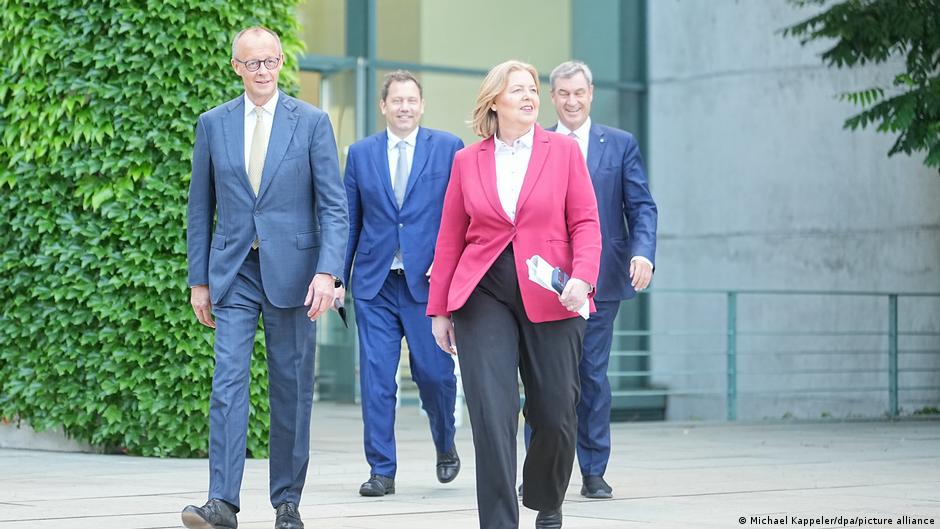
After its first year in office, Germany's coalition government plans to push through sweeping changes with the stated goal of reviving a sluggish economy. The plans met with a mixed reaction. Germany's chancellor, Friedrich Merz, said his conservative Christian Democratic Union/Christian Social Union (CSU) bloc and the center-left Social Democrats (SPD) had approved a "catalog of significant reforms" to "modernize" the economy and restore competitiveness. The announcement came at a press conference on Thursday, with Merz standing alongside SPD leaders Bärbel Bas and Lars Klingbeil, as well as the leader of Bavaria's conservative CSU, Markus Söder. The four coalition leaders had met in Berlin the previous day to hammer out the final details of their package. Measures include €10 billion ($11.4 billion) in income tax relief, the end of phone-based sick notes and the implementation of pension commission proposals by the end of 2026. German coalition announces sweeping reform package To view this video please enable JavaScript, and consider upgrading to a web browser that supports HTML5 video Germany's reform plan at a glance Pensions: Implementing pension commission proposals, including a new investment-based element to Germany’s mainly pay-as-you-go state pension system, and gradually raising the retirement age over the coming decades. Implementing pension commission proposals, including a new investment-based element to Germany’s mainly pay-as-you-go state pension system, and gradually raising the retirement age over the coming decades. Ta Giving households around €10 billion in annual relief, partly funded by raising the top tax rate from 45% to 47% for very high earners. Giving households around €10 billion in annual relief, partly funded by raising the top tax rate from 45% to 47% for very high earners. Labor: Abolishing workers' ability to obtain sick notes by phone, requiring medical certificates from day one of sickness, and giving firms more flexibility on fixed-term contracts and dismissals for high earners. Abolishing workers' ability to obtain sick notes by phone, requiring medical certificates from day one of sickness, and giving firms more flexibility on fixed-term contracts and dismissals for high earners.
Industry: Supporting strategic sectors including cars, chemicals, medicines, batteries, semiconductors, AI and clean tech. Supporting strategic sectors including cars, chemicals, medicines, batteries, semiconductors, AI and clean tech. Welfare: Tightening action against benefits fraud through more data sharing and stronger enforcement. Tightening action against benefits fraud through more data sharing and stronger enforcement. Energy: Speeding up electricity grid expansion and giving industry clearer grid-connection timelines. Speeding up electricity grid expansion and giving industry clearer grid-connection timelines. Trade: Strengthening EU anti-dumping and anti-subsidy tools, with more scrutiny of strategic non-European investments. Strengthening EU anti-dumping and anti-subsidy tools, with more scrutiny of strategic non-European investments. Housing: Creating a federal housing company, supporting affordable housing and easing mortgage financing. Creating a federal housing company, supporting affordable housing and easing mortgage financing. Bureaucracy: Cutting forms and reporting duties for companies, and automatically approving some applications if officials do not act within four months. German economy under pressure To view this video please enable JavaScript, and consider upgrading to a web browser that supports HTML5 video What has the government said about the plans? "We are providing relief to employees and businesses by cutting taxes and reducing bureaucracy. We have now completed our first year of reform. From the very beginning, we set an agenda serving a single goal: We want to get Germany moving again. It is now clear that this is possible," Merz said. With his party lagging behind the far-right Alternative for Germany party in polls, Merz faces pressure to pass reforms to reinvigorate Europe's largest economy but has struggled to overcome wrangling within the coalition. Appearing alongside Merz at the Chancellery garden press conference, the three other leaders of the coalition parties enthusiastically hailed the reforms. Klingbeil, the SPD co-leader and finance minister, said he believes the reforms will enjoy widespread public support, particularly regarding fairness. The coalition had "agreed on solutions that can be supported by a broad majority of our society," he said, adding that he was "firmly convinced that these decisions will give our country new strength." Bas, another SPD co-leader, said the package would "indeed ensure that the economy grows again, that we achieve growth and secure jobs, while maintaining social balance, and, above all, that we strengthen cohesion within our country." Meanwhile, CSU leader Söder described the package as "well-rounded." Each coalition partner would have liked to see more in certain areas, he said, adding, "But a coalition means compromise." "We are making progress," said Söder.
 The BriefWire