You Booked A Cleaner, They Brought Camera: Inside Bengaluru Startup Pronto's Viral Home-Recording Row
You Booked A Cleaner, They Brought Camera: Inside Bengaluru Startup Pronto's Viral Home-Recording Row Published By, Edited By Last Updated: May 26, 2026, 08:09 IST
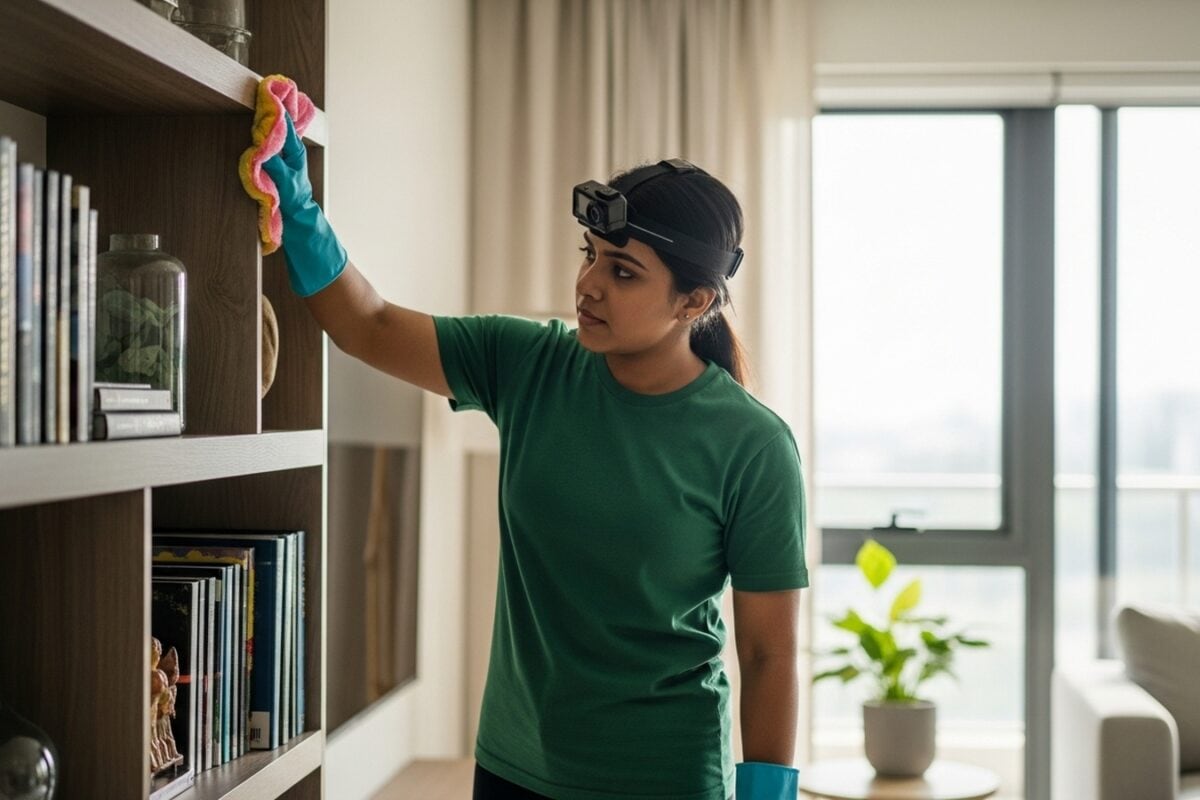
You Booked A Cleaner, They Brought Camera: Inside Bengaluru Startup Pronto's Viral Home-Recording Row Published By, Edited By Last Updated: May 26, 2026, 08:09 IST Pronto's newest investor co-founded a US robotics AI startup. The startup recently doubled its valuation to $200 million. The timing set off alarm bells. Customers pay Rs 29 extra per booking to opt in; workers get additional pay too. Crucially, consent must be reaffirmed before every single booking. (AI image) A small pilot programme, a head-mounted camera, and a leaked investor memo have combined to raise a question Indian home-services users never thought they would have to ask: is someone training a robot with footage from inside my house? You book a cleaner through an app. Someone shows up at your door. Standard enough. But this time, there is a camera strapped to the worker’s head, pointed outward, recording your home as they move through it — your kitchen shelves, your countertops, your clutter, your life. That is the image at the centre of a fast-moving privacy controversy involving Pronto, a Bengaluru-based home-services startup that has confirmed it runs a pilot programme where select household jobs are recorded using head-mounted cameras worn by workers. What began as a niche disclosure has exploded into a wide-ranging debate about AI, consent, trust, and what exactly happens to footage shot inside Indian homes. So What Exactly Is Pronto Doing? According to a Times of India report, Pronto confirmed that a small subset of customers can opt into a programme where workers wear visible, head-mounted cameras during bookings. Pronto cofounder and CEO Anjali Sardana told TOI the pilot is designed for customers who feel uneasy about leaving unfamiliar workers alone at home. “They worry about what’s happening in their home during their booking. Something may be stolen or broken, or work may not be done properly," she said.
Customers who opt in pay an extra Rs 29 per booking. Workers are paid additionally as well. The company says opt-in is not a one-time decision — it must be confirmed before each booking. Sardana told TOI the pilot covers just 0.1% of users, and Pronto has spent months ensuring compliance with India’s Digital Personal Data Protection norms. So far, so reasonable — a security feature for anxious customers. The controversy, however, is about what happens to the footage after the job is done. What Triggered The Backlash? The controversy gained traction after online portal Entrackr reported that an investor memo linked Pronto’s workflows to “physical AI" and robotics training data. Journalist Harsh Upadhyay amplified it further on X, claiming Pronto professionals were using cameras as part of its investors’ “Physical AI vision" — effectively turning Indian homes into training grounds for AI systems. Adding fuel to the fire: one of Pronto’s newest investors, Lachy Groom, is also a co-founder of Physical Intelligence, a US startup that builds foundation models for robotics. Pronto recently raised fresh capital, doubling its valuation to $200 million in just a few months. The timing and the connections were enough to set off alarm bells. What Does Pronto Say About The Data? This is where things get complicated. Pronto says videos are anonymised, no audio is recorded, and footage is deleted within 48 hours. But the company confirmed to TOI that “derived datasets" from those recordings are retained — including “key point mapping" data that tracks body joints and hand movements. When TOI asked whether those datasets could eventually be monetised or shared with third-party AI or robotics firms, Pronto declined to comment. That silence has done more damage than any direct admission might have. On X, a post declaring “recording inside your house to train AI!
This is scary" drew thousands of views. “Trust is the cornerstone of any consumer/service business and Pronto just lost it," wrote another user. Why Are People Worried Even If They Haven’t Opted In? Because anonymisation inside a home is harder than it sounds. As one frequent home-services app user told TOI: “Think name plates, ID cards, credit cards, bills." A kitchen counter alone can contain enough identifying information to reconstruct who lives there and how. Behind the broader unease is a rapidly emerging global market for what is called “egocentric," or first-person, data — footage shot from a human point of view as someone moves through real-world environments. Unlike chatbots trained on text, physical AI systems need exposure to actual kitchens, shelves, utensils, and repetitive human movement to learn how to operate in the world. Some AI labs globally pay between $4 and $10 an hour for such data, according to one founder building in the space, as reported by TOI. Indian homes, it turns out, are valuable territory. What Have Rivals Said? Swiftly and loudly: not us. Urban Company cofounder and CEO Abhiraj Singh Bhal posted a public statement on X distancing his platform entirely from the practice. “We are in the business of trust, and we take customer trust and privacy extremely seriously. We do not engage in any such activities, have never done so in the past, and have no plans to do so in the future," Bhal wrote. Snabbit founder Ayush Agarwal similarly confirmed his company is not involved in any such programme. In light of recent reports regarding recordings inside customers’ homes by one of our competitors, many people have asked whether @urbancompany_UC engages in anything similar, or intends to do so in the future.The answer is clear and unequivocal: we do not. We are in the… Abhiraj Singh Bhal (@abhirajbhal) May 24, 2026 Is Any of This Illegal?
That remains genuinely unclear. Nikhil Narendra, a partner at law firm Trilegal, noted to TOI that anonymised household data could potentially fall outside India’s Digital Personal Data Protection Act — meaning it may not be governed by the rules that protect personal data. India also lacks a broader governance framework for non-personal data, leaving a significant grey zone that startups can, for now, operate within. Pronto maintains it has acted within the law and with full customer consent. Critics argue that consent, when buried in an app flow and sweetened with a Rs 29 discount, is not quite the same as informed agreement. What Does This Mean For You As A Home-Services User In Bengaluru? For now, if you have not explicitly opted into Pronto’s pilot programme, no camera is involved in your booking. But the row has surfaced a question worth sitting with: when you let a gig-economy worker into your home through an app, how much do you actually know about what the platform behind that app is building — and with what? The front door has always been the last line of privacy. The debate now is about how long that holds. News18 Newsletter Handpicked stories, in your inbox A newsletter with the best of our journalism submit First Published: May 26, 2026, 08:04 IST News cities bengaluru-news You Booked A Cleaner, They Brought Camera: Inside Bengaluru Startup Pronto's Viral Home-Recording Row Disclaimer: Comments reflect users’ views, not News18’s. Please keep discussions respectful and constructive. Abusive, defamatory, or illegal comments will be removed. News18 may disable any comment at its discretion. By posting, you agree to our Terms of Use and Privacy Policy Loading comments...
 The BriefWire