Pride Month has great significance for those who feel invisible. In Slovenia, many LGBTQ+ people understand just what that means
One of the first steps taken by Slovenia's new right-wing government in June was to remove the rainbow flag outside the Culture Ministry. As Pride
One of the first steps taken by Slovenia's new right-wing government in June was to remove the rainbow flag outside the Culture Ministry. As Pride Month draws to a close, DW surveys the situation of the LGBTQ+ community. Pride Month, in June, assumes greater significance if you feel invisible for the rest of the year. And many LGBTQ+ people in Slovenia understand just what that means. There is no district — or even a single street — in the picturesque capital, Ljubljana, which could truly qualify as "gay friendly." The same goes for the country's other, smaller cities. "In the sense of physical places that would be explicitly LGBT-friendly, there are not a lot," said Barbara Rajgelj, a lawyer who also co-runs a city center bar that stages events for gay people in Ljubljana. Rajgelj is concerned that intolerance encouraged by political leaders is having a growing impact in her country. "Safe spaces will be more and more important, because the violence is coming from the top down, from parliament to the digital media and to the physical spaces. And I can see that people are more and more courageous in explicitly expressing their hate," she told DW. Pride Month 2026 was different In previous years, Pride Month and its various events would have offered some of those safe spaces. It has also served as an annual reminder that despite the dearth of physical infrastructure, Slovenia has a thriving LGBTQ+ community. In the past, a rainbow flag appeared next to the flags of the city of Ljubljana, the EU and Slovenia (intertwined) [File photo 2021] Image: Balkans Cat/Depositphotos/IMAGO But this year, Pride Month has been less joyous than usual — in large part due to Slovenia's recently-installed right-wing government.
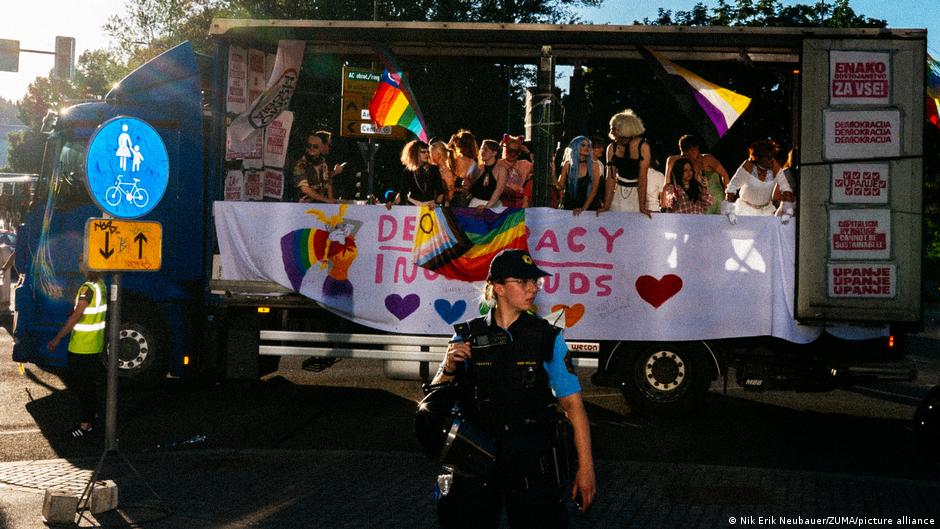
It decided that the run-up to the centerpiece Pride Parade in Ljubljana on June 13 was the perfect time to take down the rainbow flag, which had been flying outside the Culture Ministry. As justification, an official statement insisted that the ministry "must represent all citizens and all cultural creators, regardless of their personal beliefs, identities or worldviews." It did not elaborate on how it was representing LGBTQ+ people by removing the rainbow flag or whether appeasing homophobic views was now official policy. New government's move to remove flag 'extremely symbolic' Under the previous, center-left government of Robert Golob, the flag had always flown throughout Pride Month. Indeed, the outgoing government raised it at the start of June, before the new prime minister, Janez Jansa, took office a few days later. Removing the rainbow flag was one of the first actions of his new administration. And as far as campaigners for LGBTQ+ rights in Slovenia are concerned, that sent a powerful signal. Was the decision of the Jansa (pictured) government to take down the rainbow flag an attempt to gratify the far-right elements of its support? Image: Andrej Tarfila/SOPA Images/ZUMA/picture alliance "Even though we expected this would happen, it was still extremely symbolic, making sure that we understand — within the LGBT community and society — that things have changed," said Simona Mursec, the organizer of Ljubljana Pride. Pride Parade participation up this year Those changes are already being felt — and reacted to — by LGBTQ+ people and their allies. Participation in this year's Pride Parade was higher.
 The BriefWire