Manifesta 16 Ruhr: The legacy of postwar churches
In the wake of the destruction of World War II, about 1000 new churches were built in the Ruhr region, but today many stand empty
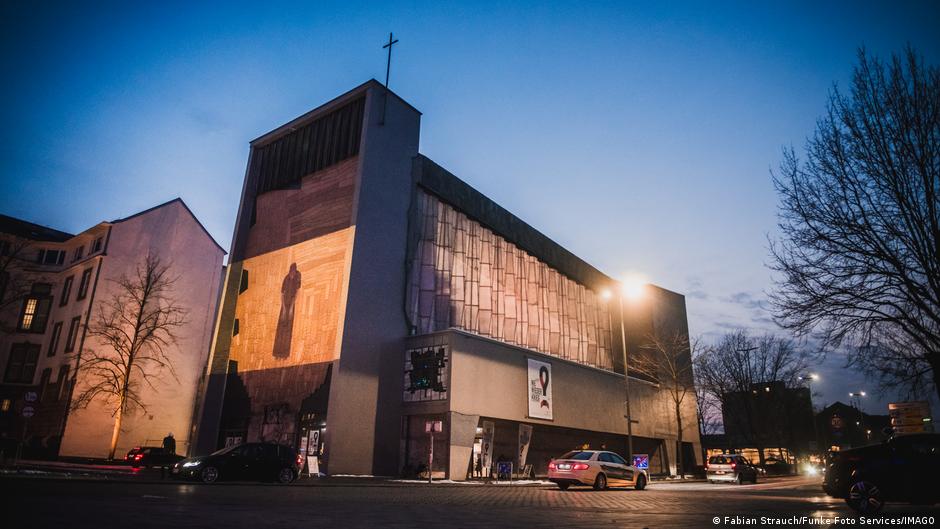
In the wake of the destruction of World War II, about 1000 new churches were built in the Ruhr region, but today many stand empty. Manifesta is exploring new ways to put them to use. The 16th edition of Manifesta — the European traveling biennial for contemporary art and urban development — is taking place in the western German Ruhr region this year. Under the title "This is not a church," the main program sees international artists designing commissioned works of art for 12 churches that have fallen out of use in Bochum, Duisburg, Essen and Gelsenkirchen. They include German artist Emil Walde's large-scale installation made of old, damaged wired-glass windows from Duisburg Central Station — which are being put on display within the church's confessional booths. And St. Anna Church in Gelsenkirchen is showing an exhibition featuring works by internationally renowned artists such as Ming Wong, Philipp Gufler and Cana Bilir-Meier. The program also offers a rare opportunity to gather and play basketball in a church. Churches long in decline The freefall in attendance at Catholic and Protestant churches underlines the decline in congregations in the Ruhr region, Germany's largest metropolitan area. Dozens of places of worship are deconsecrated each year. It all began in World War II when the western Ruhr region was frequently struck by Allied bombing raids — with targets including both industrial sites and city centers. The aim was to break citizen morale. The damage was devastating — with entire districts of Dortmund, Gelsenkirchen and Bochum lying in ruins by war's end. And churches were not spared. While housing was the focus of reconstruction efforts, churches were also considered critical places for people to practice their faith, find comfort and foster community. When US troops crossed the Ruhr in 1945, they encountered many destroyed towns Image: akg-images/picture alliance But a new era of church architecture was already emerging.
Postwar church architecture emblematic of modern Germany The young Federal Republic of Germany — where significantly more churches were built than in the socialist German Democratic Republic — was able to draw on a large number of architects who had embraced modernism even before World War II and shifted away from traditional styles. Driven by social change and the separation of church and state, a highly experimental phase of church architecture had already emerged before the war. Many of these architects then proceeded to resume their work in the postwar period — which also proved to be a boon for the country politically. "The Republic of Germany was able to cast itself as a progressive, open and modern country on the international stage," explains Manuela Klauser, an art historian and member of the Sakralraumtransformation (Sacred Space Transformation) research group at the University of Bonn. Working within ostensibly conservative churches, architects were able to look back to a pre-Nazi period when Germany had embraced these "open-minded ideas long before many other countries." Architects thus reconstructed destroyed or damaged historical churches, planned new ones and oversaw their construction. Rudolf Schwarz (1897–1961) was the creative force behind many Catholic churches. "At the moment, we are building almost only churches. Each time, it is hard and desperate work. You might think we ought to be getting better at it, but in reality the opposite is true — it gets harder every time," he said in 1957. St. Antonius Church in Essen was designed by Rudolf Schwarz and completed in 1959 Image: Dennis Strassmeier/Funke Foto Services/IMAGO The high density of churches in the Ruhr region was explicitly driven by bishops, and around 1,000 were built. They were nicknamed "slipper churches," because churchgoers could reach them in a few minutes — still in their slippers if they had overslept on Sunday morning and wanted to make it to mass on time.
 The BriefWire