German lawyers: Ban on far-right AfD 'likely successful'
A new report by legal experts has found that efforts to ban Germany's far-right Alternative for Germany (AfD) could be successful — but there would
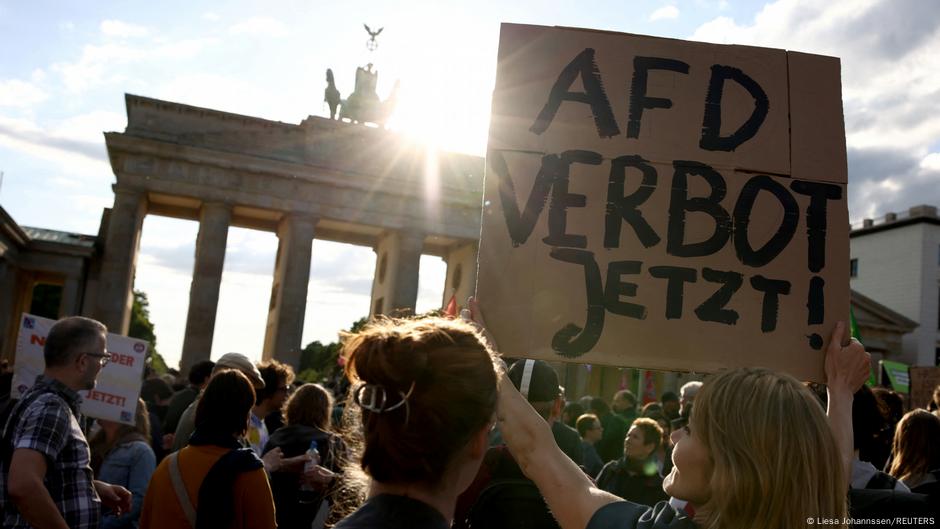
A new report by legal experts has found that efforts to ban Germany's far-right Alternative for Germany (AfD) could be successful — but there would be political dangers to such a move. The debate over banning Germany's far-right Alternative for Germany (AfD) gained new impetus this week when the Society for Civil Rights (GFF) presented a legal assessment which concluded that the party was "demonstrably unconstitutional" and that an attempt to ban it could be successful. The GFF was originally founded by a Green Party politician, who still serves as its Secretary General, but the board is made up of lawyers and law professors.The NGO's team of legal experts and researchers said they spent a year combing through 77,000 parliamentary documents, 55,000 press releases and 2.9 million social media posts to "examine the AfD according to academic standards." The researchers claimed that the report represented "the first comprehensive assessment on the unconstitutionality of the AfD" that would "significantly improve the basis for a discussion on a ban." However, any attempt to ban the party is likely to be politically explosive, not least because the AfD is currently the most popular political party in Germany, with up to 29% vote share nationwide in some polls. How much of a neo-Nazi party is the German AfD? To view this video please enable JavaScript, and consider upgrading to a web browser that supports HTML5 video Can a political party be banned? A ban would only be possible if a motion is filed to the Federal Constitutional Court, and only three constitutional bodies have the power to do that: The federal government or either of the two chambers of Germany's parliament: The Bundestag or the Bundesrat. There doesn't seem to be the political appetite for a ban at the moment: The last time the Bundestag addressed the issue, in January 2025, only 124 out of 733 members were in favor of calling for a ban.
The conservative Christian Democratic Union (CDU) and many members of the center-left Social Democratic Party (SPD) were opposed to pursuing a ban. Rolf Frankenberger, director of the Institute for Right-Wing Extremism Research at Tübingen University, said that the GFF report was an important contribution to the debate. "From a social science perspective, this provides more than sufficient evidence of the ideologies driving the AfD and that these are incompatible with the Basic Law," he told DW. But Frankenberger admitted that the political circumstances are not conducive to a ban. "At the moment, it does not seem realistic that a ban proceeding will take place, as the CDU/CSU in particular is opposed to it," he said. "It is primarily up to the CDU/CSU, but also to parts of the SPD, to abandon their resistance to a long-overdue ban." For her part, AfD co-leader Alice Weidel dismissed the report, pouncing on the fact that the AI system Claude Opus had been used to analyze some AfD officials' statements (though the report also said that the AI analyses had been checked by a human). "As suspected, the NGO's 'report' was generated using AI, and the allegations are completely far-fetched," Weidel wrote on X. "It's a joke like no other. Instead of pursuing sound policies, the other parties are taking potshots at us in a scandalously amateurish manner." AfD 'opposes the principle of democracy' Presenting the GFF report in Berlin on Thursday, project leader Bijan Moini, said, "the AfD opposes the principle of democracy by seeking to suppress its political opponents. And it opposes human dignity because its racially charged political concept, much like that of the NPD, establishes different classes of people." But the NPD is perhaps not the best example to use: Two attempts to ban the Democratic Party of Germany, which harbors many outright neo-Nazis, have already failed — most recently in 2017.
 The BriefWire