2 more Indian vessels cross Hormuz, third takes U-Turn
Days after Washington and Tehran reached a preliminary agreement and the Strait of Hormuz began to reopen, Indian vessels stranded inside the Persian Gulf were
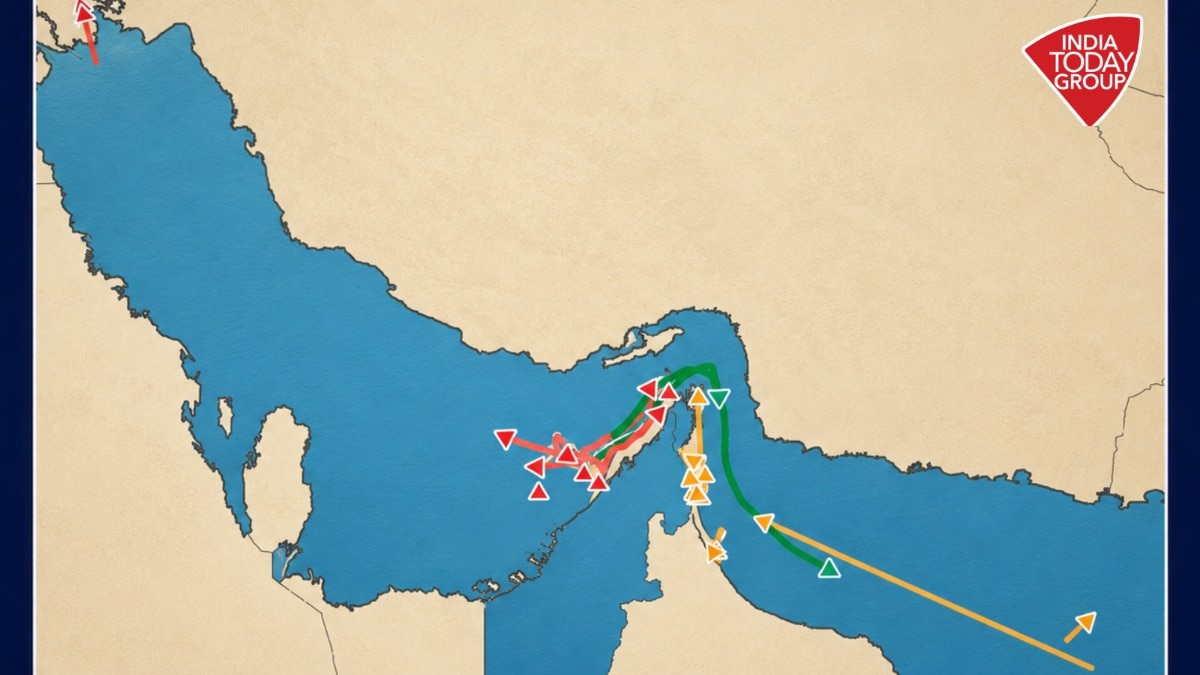
Days after Washington and Tehran reached a preliminary agreement and the Strait of Hormuz began to reopen, Indian vessels stranded inside the Persian Gulf were expected to start moving out. But the release of ships through one of the world’s most consequential maritime chokepoints has been cautious and uneven. An Indian-bound crude-oil tanker and a container ship crossed the Strait of Hormuz on Friday morning. Read Full Story Over the weekend, three Indian-flagged crude-oil tankers, Desh Vaibhav, Desh Vibhor and Sanmar Herald, cleared the strait carrying more than 8.6 lakh tonnes of oil and 94 Indian crew members. Their passage marked the first substantial movement of Indian energy cargoes through Hormuz after the agreement, even as several other India-linked vessels remained west of the passage. On Friday morning, vessel tracks reviewed by India Today showed two more Indian ships, Desh Suraksha and SSL Kaveri, sailing east through the strait after weeks of waiting. Their route was notable. Both vessels travelled along the Omani side of the passage, making them the first Indian ships observed taking the southern route since the war began.
The Indian vessels that exited earlier had sailed through the Larak Channel, or close to it, broadly following the corridor indicated by Iran’s Islamic Revolutionary Guard Corps. Indian-flagged LPG tanker BW Loyalty made a failed attempt to cross the Strait of Hormuz A third vessel, BW Loyalty, an Indian-flagged LPG tanker, was seen approaching the passage before appearing to make a sharp U-turn. Yesterday, the United Kingdom Maritime Trade Operations, or UKMTO, reported a separate maritime-security incident near Oman. The agency said a cargo vessel had been struck on its starboard side by an “unknown projectile” about 7.5 nautical miles southeast of Dahit. No casualties were reported. There is no evidence so far to establish a connection between the reported strike and BW Loyalty’s change of course. Two Indian vessels crossed Hormuz through Omani waters, but a tanker turned back and others moved deeper into the Gulf India Today tracked the 10 India-linked vessels remaining inside the Persian Gulf after Desh Suraksha and SSL Kaveri crossed the strait.
They included one LPG tanker, two oil tankers, four container ships, a hopper dredger and other commercial vessels. Their tracks showed no common movement towards the exit. Volvox Olympia, a hopper dredger, maintained the clearest eastward course towards Hormuz. BW Loyalty approached the passage before turning back, while APJ Priti 2 followed a looping track and returned close to its earlier position. Sanmar Suparna, a crude-oil tanker, and Jag Pavitra, a chemical and oil-products tanker, moved westward, deeper into the Persian Gulf. The divergent tracks suggest that the reopening had not yet translated into an immediate passage towards Hormuz. Instead, ship movements remained fragmented and cautious, with operators appearing to transit, wait, reposition or withdraw according to their own security assessments. The UN's International Maritime Organization (IMO) has paused the planned evacuation of more than 11,000 sailors stranded in the Strait of Hormuz after a cargo ship passing through the waterway was attacked. The IMO on Tuesday began evacuating 600 ships and around 11,000 mariners stranded by the closure of the Strait of Hormuz during the US-Israeli war on Iran, helping them leave the Gulf through two routes – one via Iranian waters and another via Omani waters with US oversight.
 The BriefWire