The 'Flamingo Revolution': What's behind Albania's protests?
For weeks now, images of crowds of Albanians protesting on the streets have been relayed around the world. The protesters say they are fighting for
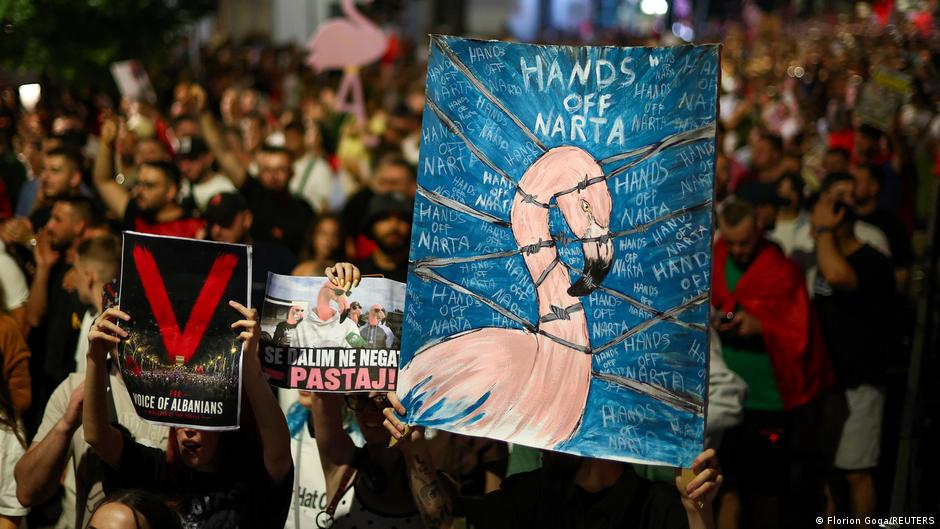
For weeks now, images of crowds of Albanians protesting on the streets have been relayed around the world. The protesters say they are fighting for democracy. PM Edi Rama insists the movement is part of a hybrid war. Every evening at 7 p.m., protesters return to the same square in the Albanian capital, Tirana, with the same symbols and make the same demands. More than three weeks of uninterrupted daily demonstrations have turned the "Flamingo Revolution" into Albania's largest civic protest movement since the fall of communism. It began when a government-approved luxury tourism project in Zvernec, a protected coastal area in southern Albania, triggered protests that soon evolved into a broader political movement. Initially driven by environmental concerns, the demonstrations have expanded into broader demands, including calls for the resignation of Prime Minister Edi Rama. Rama rejects the idea that the unrest can be explained by domestic political grievances alone. Instead, he argues that the protests are unfolding within what he describes as a "hybrid war" driven by external influences and digital manipulation. Kushner's luxury resort For Rama, the controversy gained international visibility only after it became associated with Jared Kushner, the son-in-law of US President Donald Trump, who is planning to build a luxury tourism project in Zvernec. Prime Minister Edi Rama says that the protests are unfolding within a "hybrid war" driven by external influences and digital manipulation Image: Stevo Vasiljevic/REUTERS "The world did not wake up because of the fate of Narta, but because of the name of Jared Kushner," Rama said at a meeting of the Socialist Party's parliamentary group on June 20. The prime minister argues that what he referred to as the "digital cyclone" has allowed the protests to be amplified by a broad constellation of external actors, including opponents of Donald Trump, anti-Israeli groups and what he calls state- "digital mercenaries." "State- actors have been identified, including those from Iran," he said.
Echoes of Albania's communist past Jonila Godole, scholar of political communication and collective memory at the University of Tirana, argues that Rama's interpretation of the protests reflects a familiar communications strategy: shifting the focus from the protesters' demands to the alleged forces behind them. "When a civic protest is presented as Iranian, anti-Israeli, or driven by Trump's opponents, attention shifts away from what protesters are demanding. The debate moves instead to the alleged authors of the protest — the external enemy," she told DW. The protests, which have been going on for almost four weeks, have been dubbed 'The Flamingo Revolution' Image: Vlasov Sulaj/NurPhoto/picture alliance Godole also sees echoes of Albania's communist past in Rama's rhetoric. During Albania's communist period, political dissent was routinely portrayed as the work of hostile foreign forces. She argues that the language of external enemies continues to resurface whenever those in power face sustained domestic pressure. "Fear was the political capital of the communist regime," she said. "It kept society under control and concentrated power around the leader. Today, that language no longer works in the same way. Young people no longer recognize that political code. They reject it." Can algorithms explain a protest? Academic and communications theorist Artan Fuga argues that attributing the protests to algorithms risks confusing the medium with the cause. Digital platforms may accelerate the circulation of information, he says, but they cannot explain why citizens choose to take to the streets. Academic and communications theorist Artan Fuga says that while digital platforms may accelerate the circulation of information, they cannot explain why citizens choose to take to the streets Image: Vlasov Sulaj/NurPhoto/picture alliance "The algorithm is part of the communication environment. It can accelerate the circulation of messages, amplify emotions and increase visibility.
 The BriefWire