Lost for 2,500 years, the ancient Poseidon sanctuary emerges from the Greek marshlands with mysterious inscribed artefacts
AI Generated The forgotten origins of the Poseidon sanctuary How archaeologists traced the hidden Poseidon sanctuary What the Poseidon sanctuary’s unusual design reveals What discoveries
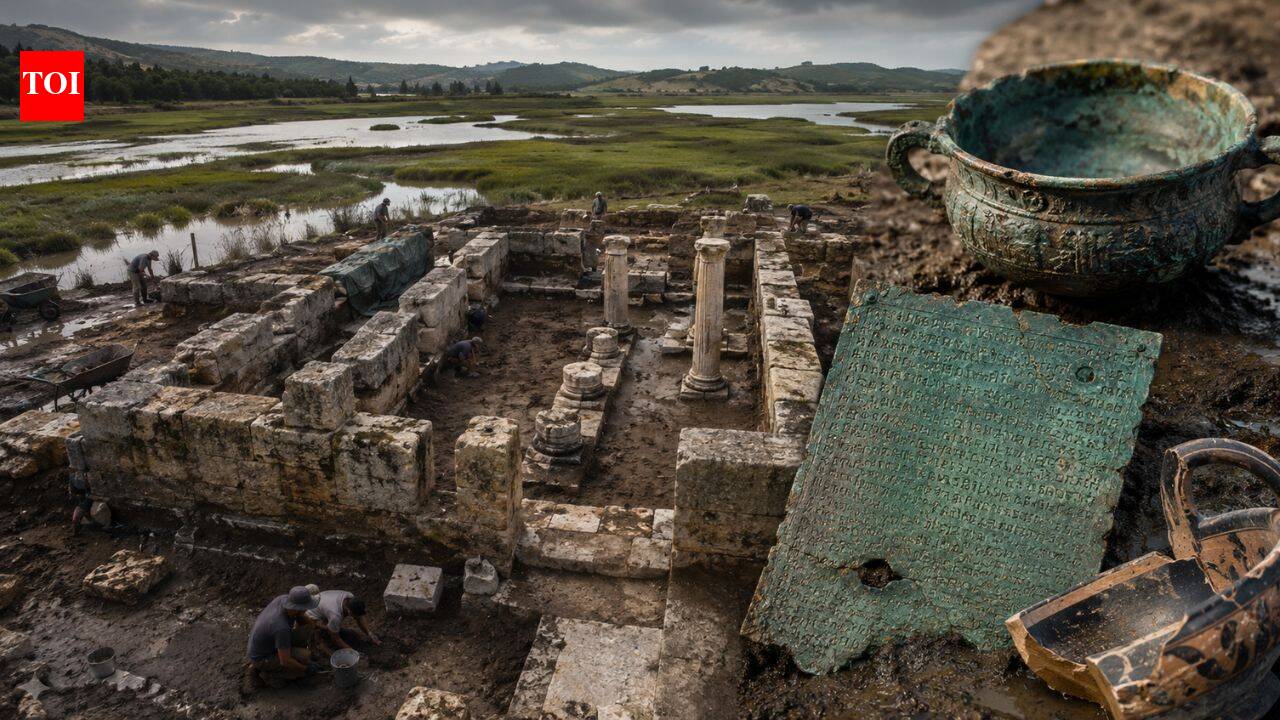
AI Generated The forgotten origins of the Poseidon sanctuary How archaeologists traced the hidden Poseidon sanctuary What the Poseidon sanctuary’s unusual design reveals What discoveries inside the Poseidon sanctuary tell us How builders protected the Poseidon sanctuary from flooding The Poseidon sanctuary’s link to ancient waterways The landscape along the western edge of the Peloponnese has never stayed entirely still. Coastlines shifted, wetlands expanded and receded, and places that once sat beside open water gradually became trapped within layers of mud and reeds. Ancient writers recorded many of these locations with surprising confidence, yet centuries of environmental change often left later generations unsure whether such places had ever existed in the form described. Among the lingering puzzles was a sanctuary linked to Poseidon, a deity whose sphere extended far beyond the sea itself. The temple appeared in surviving geographical accounts, but its exact whereabouts remained uncertain. For a long time, it seemed to belong somewhere between documented history and local tradition.Now, after years of archaeological work near Samikon in southern Greece, traces of the sanctuary have emerged from ground that had concealed them for more than two millennia.In antiquity, the coast near Samikon lay closer to the sea. At the same time, low-lying ground behind it was vulnerable to flooding and gradual environmental transformation, as reported by Greek City Times.Ancient descriptions placed a sanctuary of Poseidon in this area, serving communities scattered across the region of Elis.
It was not an isolated rural shrine. The site appears to have held shared importance for neighbouring settlements, providing a place where religious observance and regional identity intersected. Over the centuries, however, water and sediment altered the terrain. Marshland spread across sections of the coast, obscuring structures that had once stood in more open surroundings.As the environment changed, the sanctuary disappeared from view. By the modern era, only written references hinted at its former presence.Interest in locating the temple did not begin recently. Archaeologists and historians had been attempting to connect ancient descriptions with real locations for decades. Early investigations in the region identified intriguing architectural remains, including substantial stone constructions that suggested efforts to manage water in an area prone to flooding.Those clues were never enough to settle the question. The landscape itself complicated matters. Marshes, shifting soil, and centuries of accumulated deposits made it difficult to determine where significant structures might still survive beneath the surface.More systematic excavation campaigns eventually gathered momentum in the early 2020s. As trenches expanded and buried architectural elements came into view, a clearer picture began to emerge. What had initially appeared as scattered remains started to reveal the outline of a substantial sanctuary complex.The foundations uncovered at the site point to a building that differed from many familiar Greek temple layouts. Rather than a straightforward arrangement centred on a single sacred chamber, the structure appears to have incorporated two principal rooms connected through a shared entrance area.This arrangement has attracted particular attention because it suggests a more complex function than simple worship alone.
 The BriefWire