Poland, Ukraine: Dispute between two close allies deepens
Polish President Karol Nawrocki last week stripped Ukrainian President Volodymyr Zelenskyy of Poland's highest state honor. How did it come to this? And what has
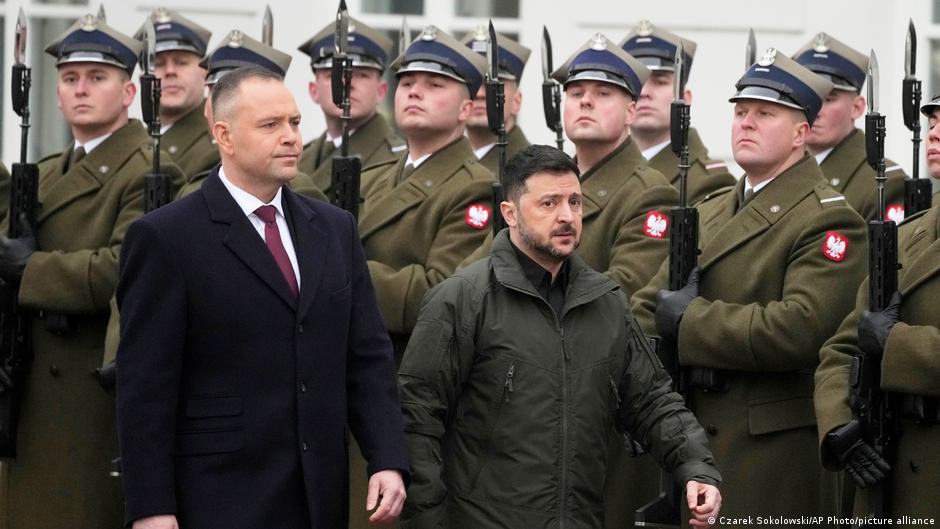
Polish President Karol Nawrocki last week stripped Ukrainian President Volodymyr Zelenskyy of Poland's highest state honor. How did it come to this? And what has it got to do with next year's election in Poland? For a long time, Poland and Ukraine were the staunchest of allies. The political and military support Ukraine received from Poland made a major contribution to Ukraine's ability to successfully defend itself in the early days of Russia's full-scale invasion, which began in February 2022. Now, however, a dispute about the past, which has been rumbling on for weeks, is plunging the two neighbors into an ever-deepening crisis. Withdrawal of Poland's highest state honor On Friday evening, Polish President Karol Nawrocki announced on X that he was revoking the Order of the White Eagle, Poland's highest state honor, from Ukrainian President Volodymyr Zelenskyy. In doing so, Nawrocki made good on a threat he made several weeks previously during the dispute about the name given to a Ukrainian special forces unit, "Heroes of the UPA." The announcement triggered strong responses in the Ukrainian capital. "We believed that the Order of the White Eagle, awarded in 2023, was meant for the Ukrainian People and our army. That is what was said at the time. Today, I sent the Order back to the President of Poland," Zelenskyy wrote on his social media accounts on Saturday. In an interview at the weekend, Zelenskyy suggested that Nawrocki had withdrawn the honor from him for domestic political reasons Image: Jakub Porzycki/NurPhoto/picture alliance He thanked Poland for its support and solidarity thus far and said that since the honor had also been bestowed on Russian Empress Catherine II, Italian dictator Benito Mussolini and former German chancellor Gerhard Schröder, "we in Ukraine will not argue with this." He also posted photos without comments showing him sending the order back to Nawrocki via the private Ukrainian postal and courier service Nova Post. Nawrocki motivated by domestic politics? Speaking in an interview with the Ukrainian television channel 1+1, Zelenskyy later accused his Polish counterpart of having taken the step because of next year's parliamentary election in Poland. "President Karol Nawrocki is fighting for the position of his party against the prime minister [Donald Tusk].
It is the same thing that [former Hungarian Prime Minister Viktor] Orban did. It is the wrong way. I think it will end badly," said Zelenskyy. Ukrainian politicians return honors Over the weekend, there was an almost united response from politicians in Ukraine. Three of the country's four living former presidents — Leonid Kuchma, Viktor Yushchenko and Petro Poroshenko — returned their Polish orders. The fourth, the pro-Russian Viktor Yanukovych, fled to Russia in 2014. Presidential Chief of Staff Kyrylo Budanov and Foreign Minister Andrii Sybiha also returned their honors. 'No president of another country will dictate our history to us,' said Ukrainian Foreign Minister Andrii Sybiha Image: Marius Burgelman/AP Photo/dpa/picture alliance "Nawrocki has become the destroyer of the positive progress we have made in recent times. It's not for nothing that he receives applause from Moscow," said Sybiha, adding, "No president of another country will dictate our history to us." Without going into the specifics, the foreign minister said that Ukraine would mirror Nawrocki's move. The UPA: the root of the present dispute This is the most serious dispute between Warsaw and Kyiv since Russia's full-scale invasion of Ukraine over four years ago. It began at the end of May, when Zelenskyy issued a decree approving the request from a special forces unit within the Ukrainian army to use the honorary name "Heroes of the UPA." In doing so, Zelenskyy expressly honored the memory of the fighters of the Ukrainian Insurgent Army (UPA), which continued to put up armed resistance to the Soviet regime in Ukraine well into the 1950s. This resistance is very much to the fore in Ukraine's current public culture of remembrance and is one of its central elements. Ukrainian President Zelenskyy and his Polish counterpart, former Polish President Duda (both center), at a memorial for the victims of the Volhynia massacre in 2023 Image: Maxym Marusenko/NurPhoto/picture alliance The view of the UPA in Poland is, however, very different indeed. During World War II and starting in 1943, the UPA carried out several massacres, targeting the Polish population in the western Ukrainian region of Volhynia, while fighting for an independent Ukraine. In total, UPA units killed around 100,000 civilians.
 The BriefWire