Beyond Shiv Sena: How Splintering Regional Parties Could Benefit BJP In 2029
Beyond Shiv Sena: How Splintering Regional Parties Could Benefit BJP In 2029 Written By, Last Updated: June 23, 2026, 14:20 IST BJP’s greatest electoral advantage
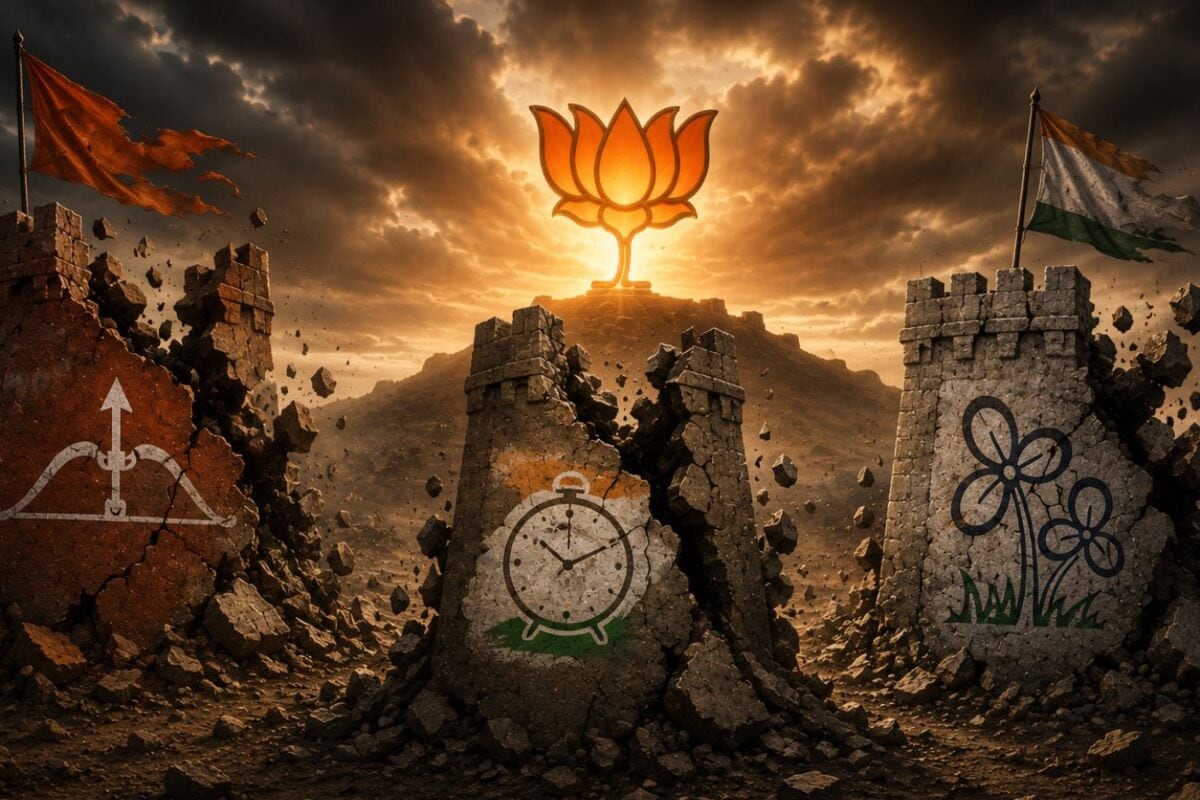
Beyond Shiv Sena: How Splintering Regional Parties Could Benefit BJP In 2029 Written By, Last Updated: June 23, 2026, 14:20 IST BJP’s greatest electoral advantage may not be the seats it wins directly, but the regional rivals that arrive at the next election weaker than they were five years earlier Rapid Read The coalition era that emerged after the decline of Congress was built on the rise of regional parties, but the political era taking shape before 2029 may be defined by their fragmentation. (AI-Generated Image) The latest crisis within the Shiv Sena (UBT) has once again triggered a familiar accusation from the Opposition—the Bharatiya Janata Party (BJP)’s long-term political project is not merely to defeat regional parties, but to gradually weaken, divide and replace them. The charge resurfaced after fresh turbulence within Uddhav Thackeray’s camp, prompting Shiv Sena (UBT) MP Sanjay Raut to allege that BJP was pursuing a larger strategy ahead of the 2029 Lok Sabha election. “The BJP’s long-term plan is to finish off all regional parties before 2029," Raut claimed. Whether one accepts that allegation or not, the political landscape of the past few years suggests that India’s regional parties are facing one of their toughest phases since the coalition era began in the 1990s. From the Shiv Sena and NCP in Maharashtra to the Trinamool Congress in West Bengal, several regional formations that once acted as formidable barriers to the BJP’s expansion have either fractured internally, suffered electoral setbacks, or seen their political space shrink. The result could have profound implications for 2029. From Coalition Era To BJP Era For nearly three decades after 1989, regional parties were among the most powerful actors in Indian politics. Parties such as the Shiv Sena, DMK, AIADMK, TMC, BJD, SP, BSP, JD(U), RJD and TDP often determined who governed in New Delhi. governments depended on them, coalition arithmetic revolved around them and state identities increasingly shaped electoral outcomes.
ALSO READ | Sunset Of Satraps: A Modi-fied India Has Outgrown The Politics Of Fragmentation The rise of regional parties reflected the growing assertion of linguistic, caste-based and state-specific political identities that challenged the dominance of national parties. That ecosystem, however, is under unprecedented pressure as the BJP expands beyond its traditional Hindi-heartland base. The States BJP Has Already Breached The BJP’s recent gains have not merely come at the Congress’s expense. They have come directly against regional parties that were once seen as politically impregnable. In Odisha, the BJP ended Naveen Patnaik’s 24-year rule by defeating the Biju Janata Dal. In Delhi, it displaced the Aam Aadmi Party. In Maharashtra, splits within the Shiv Sena and Nationalist Congress Party fundamentally altered the state’s political balance. If latest rumours are to be believed, five out of eight Nationalist Congress Party (SP) Lok Sabha MPs are considering an exit to join the Bharatiya Janata Party (BJP)-led Democratic Alliance (NDA) in bad news for Sharad Pawar. Indian Express, in an analysis of the BJP’s expansion, observed that “the BJP’s gains have increasingly come from regions where regional parties once enjoyed near-hegemonic control". Why Splits Matter More Than Defeats The Shiv Sena offers perhaps the clearest example. The split between the Uddhav Thackeray and Eknath Shinde factions transformed Maharashtra’s politics. The subsequent division within the NCP between Sharad Pawar and Ajit Pawar further fragmented the opposition space. ALSO READ | The Great Squeeze: How Parties Are Shrinking Space For Regional Satraps Writing for The Indian Express, political scientist Suhas Palshikar argued that the developments in Maharashtra were not isolated events. “The crisis of the Shiv Sena is not merely a crisis of one party; it points to the vulnerabilities that many regional parties face today," he wrote. The significance of such splits goes beyond organisational damage. Once a regional party divides, its vote base, cadre structure and leadership often fragment as well. Even if both factions survive, the BJP benefits from a divided opposition.
 The BriefWire