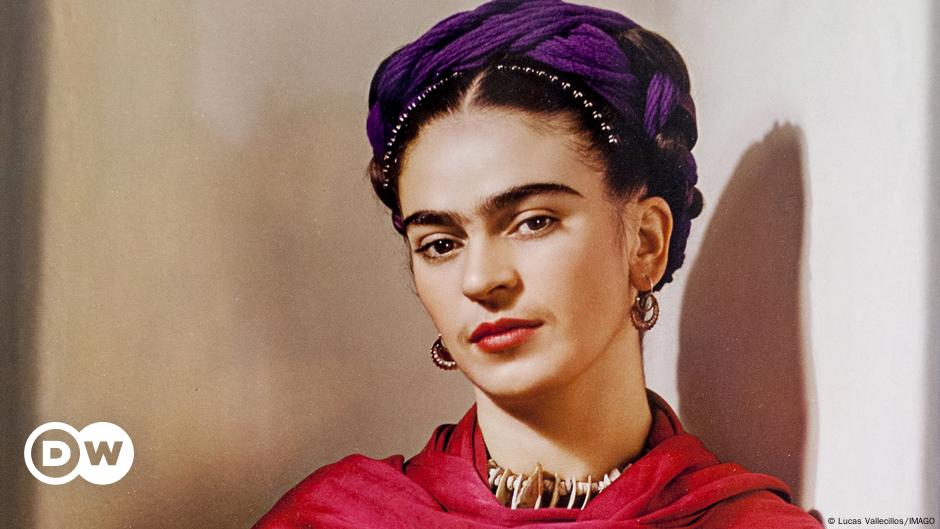
More than a unibrow: The enduring appeal of Frida Kahlo
She shunned feminine beauty ideals, was bisexual, politically active and brutally honest in her art — all while being ahead of her time. A major
She shunned feminine beauty ideals, was bisexual, politically active and brutally honest in her art — all while being ahead of her time. A major Frida Kahlo exhibition opens at London's Tate Modern. Few artists have turned personal suffering into visual language as powerfully as Frida Kahlo. More than 70 years after her death, the Mexican painter who died in 1954 remains one of the most recognizable figures in art history. Her iconic unibrow and flower crowns have made her image instantly identifiable around the world, while her works have been sold for millions at auction. Her life and work are being celebrated at London's Tate Modern with the exhibition, "Frida: The Making of an Icon," which opens June 25 and run until January 3, 2027. Born in 1907 in Coyoacan, now part of Mexico City, Frida Kahlo was the daughter of a German immigrant and a mother of mixed Spanish and Purepecha descent. Her early life was marked by physical pain — she contracted polio as a child, and at 18 experienced a devastating bus accident that left her with lifelong injuries and destroyed her dream of becoming a doctor. It was during her long recovery that she started painting by using a special easel and a mirror above her bed. Frida Kahlo: The enduring appeal of art born of suffering To view this video please enable JavaScript, and consider upgrading to a web browser that supports HTML5 video Brutally honest self-portraits Most people are familiar with Kahlo's striking self-portraits, which make up the majority of her work.
But instead of painting herself in an idealized way, she was brutally honest when depicting her body in artworks that explore her disability, miscarriages and heartbreaks. Such subjects were rarely depicted at the time — even less so from a woman's perspective. Kahlo's works are difficult to categorize. She rejected the surrealism label many have associated with her, famously saying: "I never painted dreams. I painted my own reality." That reality was certainly rich enough. Kahlo had a turbulent marriage to Mexican artist Diego Rivera, who was 20 years her senior and the most famous artist in the country at the time. During her lifetime, Kahlo was often overshadowed by Rivera's fame — but it is her legacy that has stood the test of time. Her image and artwork is seen everywhere, from TikTok feeds to souvenir shops to museum exhibitions in a phenomenon that has been called "Fridamania." In 2021, her painting "Diego y yo" (Diego and I) was sold at auction for $35 million (€31 million). It depicts Rivera enthroned as the third eye on the artist's head. Their passionate relationship was marked by much pain and suffering yet the couple shared a strong emotional and intellectual bond and remained together until Kahlo's death in 1954. Kahlo's self-portrait "Diego y yo" features her husband's image on her forehead Image: John Angelillo/UPI Photo/Newscom/picture alliance The 2025 auction of Kahlo's work "El Sueno" (The Dream) was the latest record-breaker, selling for a whopping $54.7 million (€47.2) — the most expensive artwork by a woman to ever be sold at auction.
 The BriefWire