Lucknow fire revives debate on smart locks turning buildings into traps
Every major fire leaves behind a familiar trail of grief, investigations, and half-answered questions. What caused the blaze? Could it have been prevented? Why couldn't
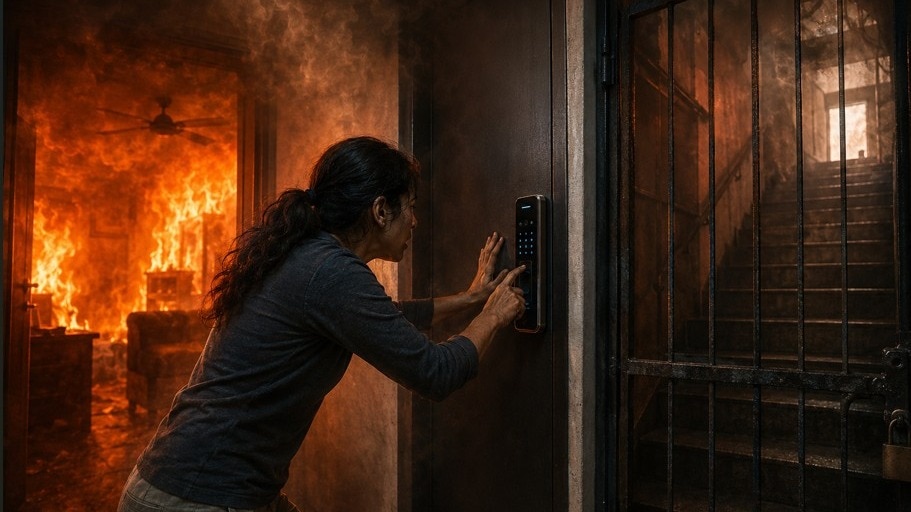
Every major fire leaves behind a familiar trail of grief, investigations, and half-answered questions. What caused the blaze? Could it have been prevented? Why couldn't the victims escape? But a disturbing pattern emerging from several recent fires has added another question to that list: Did the very systems meant to keep people safe end up trapping them inside? From residential complexes and office towers to luxury apartments and independent homes, electronic locks, biometric access systems, and automated security gates have become part of modern urban life. They promise convenience, security and control. Yet recent incidents in Lucknow, Delhi and Indore have exposed a troubling reality: when fire strikes, the line between security and entrapment can become dangerously thin. Read Full Story The debate is no longer about technology alone. It is about whether modern buildings are being designed with evacuation in mind. THE PARADOX OF MODERN SECURITY For decades, urban India worried about unauthorised entry. Builders responded with stronger gates, access-controlled staircases, biometric doors, smart locks, terrace restrictions and security grills. The result is visible everywhere. Buildings today are harder to enter than ever before. But fire safety experts argue that another question often receives far less attention: How easy is it to get out? In many buildings, security planning has evolved faster than evacuation planning. Doors that automatically lock, staircases accessible only through controlled entry points, terraces kept shut to prevent misuse and balconies covered with permanent grills or nets may all appear sensible on ordinary days. During a fire, however, these features can transform into obstacles. What protects a building during normal times can become a barrier during an emergency. WHEN SECONDS MATTER Fire does not provide the luxury of time.
According to fire officials, a small flame can grow into a major blaze in less than half a minute. Within minutes, smoke can spread through corridors, staircases and ventilation shafts. The danger is often misunderstood. People tend to imagine fire as a wall of flames advancing through a building. In reality, smoke and heat frequently reach occupants first. A Delhi Fire Service officer notes that temperatures inside a burning room can rise from around 100 degrees Celsius near the floor to as high as 600 degrees Celsius at eye level. Long before flames arrive, toxic smoke can make breathing difficult, impair judgment and leave occupants unconscious. In such conditions, every second matters. An exit that opens immediately can save lives. An exit that delays evacuation by even a few moments can have devastating consequences. LESSONS FROM LUCKNOW, DELHI, AND INDORE Recent fire incidents have brought these concerns into sharp focus. In Lucknow, where 15 people lost their lives, investigators are examining whether auto-locking access systems and the absence of accessible emergency exits contributed to the tragedy. Rescue teams reportedly had to breach walls to reach those trapped inside. Big revelation in Lucknow fire probe Auto-locking gate trapped youngsters inside Biometric entry door under probe scanner No emergency exit left victims with no escape Many forced to jump from windows to escape Smoke inhalation left several unable to flee#UttarPradesh pic.twitter.com/wvOccAqAXU— IndiaToday (@IndiaToday) June 23, 2026 In Delhi's Vivek Vihar fire, smart locks, a single staircase, locked terrace access and enclosed balconies emerged as key concerns during the investigation. Residents reportedly found themselves cut off from multiple escape routes as smoke rapidly spread through the building. In Indore, questions were raised about whether electronic locking systems failed during a residential fire.
 The BriefWire