75 years of Germany's Goethe-Institut
For 75 years, the Goethe-Institut has stood for cultural exchange, education and partnerships around the globe — even under challenging political conditions. Shortly after speaking
For 75 years, the Goethe-Institut has stood for cultural exchange, education and partnerships around the globe — even under challenging political conditions. Shortly after speaking with DW, Gesche Joost, who has served as president of the Goethe-Institut since 2024, traveled to Mexico alongside German Foreign Minister Johann Wadephul. The Goethe-Institut in Mexico City is one of the largest in the world and, in Joost's view, exemplifies the institution's work. "Latin America is an incredibly important region for Germany and we maintain very strong partnerships there," Joost explains. "Mexico is one of our key partners, particularly when it comes to attracting skilled workers." The Goethe-Institut prepares young Mexicans interested in careers in fields such as nursing or engineering in Germany, not only through language courses but also by providing information on everyday life and culture in Germany. "For me, the Mexico branch encapsulates everything the Goethe-Institut stands for," Joost says. A difficult start after World War II For 75 years, the Goethe-Institut has worked to represent Germany abroad and promote German language and culture around the world. It was founded in 1951, at a time when Germany needed to regain international trust following World War II and the crimes committed under Socialism. Initially established as Goethe e.V. zur Fortbildung ausländischer Deutschlehrer, the association invited foreign German teachers to Germany for language training courses. But before long, the focus shifted to teaching German abroad. The first Goethe-Institut opened in Athens in 1952, and just 10 years later there were already 54 branches abroad, compared with 17 in Germany itself. Today, the Goethe-Institut operates a global network employing just under 4,400 staff across 154 locations in 100 countries.
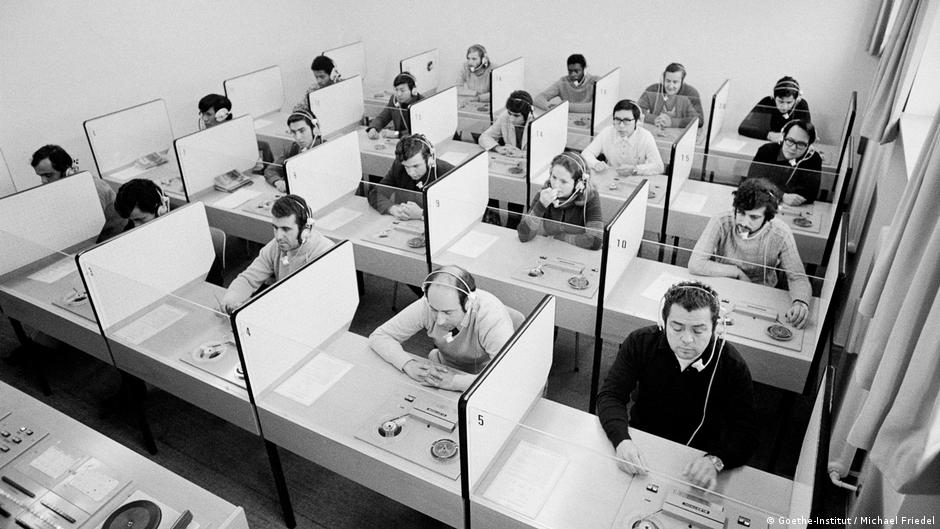
Around 1 million people take an official German language examination annually through a Goethe-Institut, or one of its partner organizations. Language students from Ghana out and about in Murnau, Bavaria, with their host family, 1969 Image: Goethe-Institut / Michael Friedel From classical culture to jazz and literature The institute's credibility as an independent association was key to its success from the start. Though two-thirds of its funding comes from Germany's Foreign Office, it develops its programs independently — and has continually adapted them to reflect the spirit of the times and the political climate. Beyond language learning, cultural programming and public engagement were intended to help convey a broader picture of Germany. "[But] this wasn't about exporting so-called German culture to the world," says Joost. "Rather, it was about asking how we could start afresh — and how we might shape society and the future together." In the early years, the institute consciously drew on Germany's classical culture, with the Nazi era failing to diminish the international appeal of figures such as Schiller, Bach and Beethoven. By the 1960s, German jazz had become one of the Goethe-Institut's most successful cultural exports, as was literature, with Nobel Prize-winning authors Günter Grass, Heinrich Böll and Herta Müller traveling on behalf of the institute. Amid the social upheaval of the 1968 generation and student protests, the Goethe-Institut engaged more deeply with social and political issues, including confronting Germany's Nazi past. Pope Francis, who died in 2025, also learned German at a Goethe-Institut: In 1985, he took a course in Boppard (Rhineland-Palatinate) Image: Vatican Media/picture alliance Dialog and mutual learning The Goethe-Institut was likewise moving away from its focus on cultural exports towards the principles of dialogue, cooperation and mutual learning.
 The BriefWire