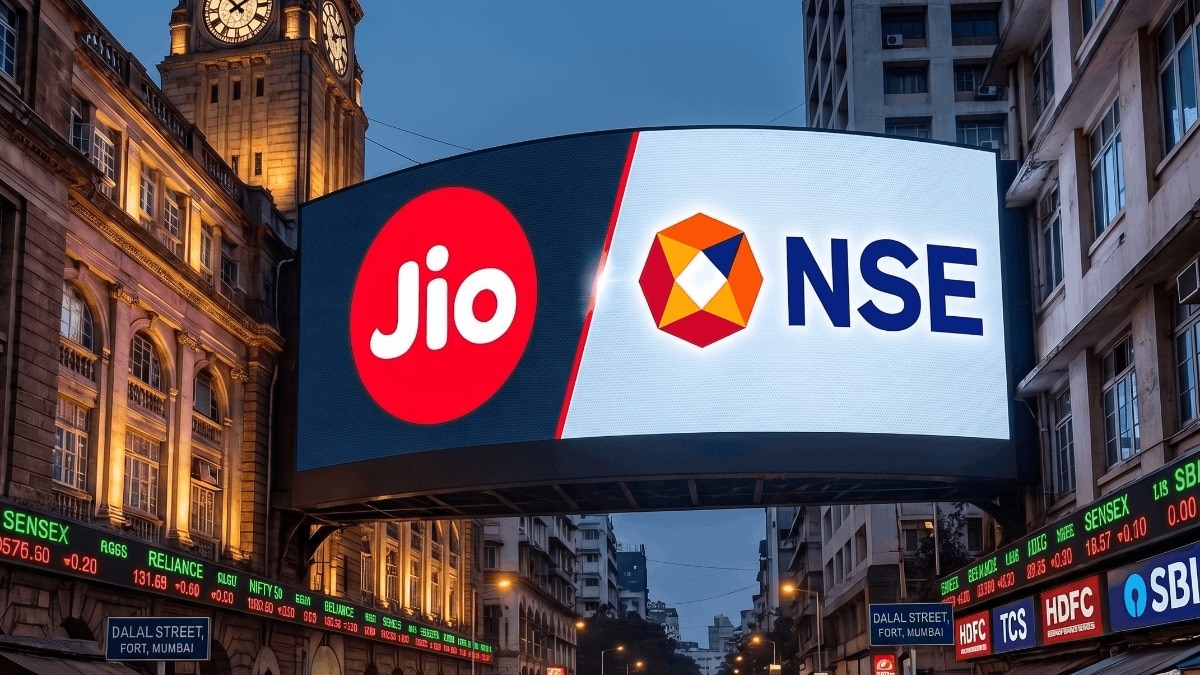
NSE and Jio are finally coming to Dalal Street. How do the two IPOs compare?
After a year marked by geopolitical tensions, volatile crude oil prices, foreign investor outflows and a slowdown in public issues, India's IPO market may finally
After a year marked by geopolitical tensions, volatile crude oil prices, foreign investor outflows and a slowdown in public issues, India's IPO market may finally be getting its biggest moment. In the space of just two days, two of the country's most anticipated listings moved a step closer to reality. On Wednesday, the Stock Exchange (NSE) filed its draft red herring prospectus (DRHP) after nearly a decade of regulatory hurdles and delays. Read Full Story A day later, Reliance Industries Chairman Mukesh Ambani announced at the company's 49th Annual General Meeting that Jio Platforms' draft prospectus had been approved and would be filed with Sebi. The developments set the stage for what could become two of the biggest IPOs India has ever seen. But while both are mega listings, the similarities largely end there. One is India's largest stock exchange and sits at the heart of the country's financial markets. The other is India's biggest telecom and digital services company that transformed how millions of Indians access the internet. Together, they represent two of the biggest themes shaping India's economy today: financialisation and digitalisation. THE SIZE OF THE IPOs The first difference is the structure. NSE's proposed IPO is entirely an Offer for Sale (OFS). Existing shareholders will sell around 14.89 crore shares, or about 6% of the company's equity. The exchange itself will not raise fresh capital. Vincent K A, Senior Research Analyst, Geojit Investments Limited, said, "NSE’s IPO is expected to attract strong investor interest, supported by its dominant market position, robust profitability, and direct exposure to the long-term growth of India’s capital markets. At current unlisted market valuations, the issue could be worth around Rs 28,000-30,000 crore and value NSE at roughly Rs 5 lakh crore.
Jio's IPO, on the other hand, will include a fresh issue of up to 27 crore equity shares with a face value of Rs 10 each, according to the filing approved by the board. Market participants expect Jio's IPO to be worth around $4 billion, or over Rs 34,000 crore, making it potentially larger than the NSE offering. A LOOK AT THE BUSINESSES The two companies operate in completely different worlds. NSE runs India's largest stock exchange and is also the world's biggest derivatives exchange by trading volume. Every day, billions of rupees worth of shares, derivatives and other securities are traded on its platforms. Its fortunes are closely linked to India's growing investing culture. More investors, more trading activity and more IPOs generally translate into higher revenues. "The recent moderation in financial performance—impacted by lower trading activity, particularly in derivatives amid regulatory changes, and elevated operating expenses from technology investments and one-off SEBI settlement charges—is likely to normalise over time. The relative positioning in valuations compared to BSE can be influenced by the latter’s stronger recent growth trajectory, which may moderate over time," said Vincent. Jio, meanwhile, is a telecom and technology giant. Since its launch in 2016, the company has disrupted India's telecom sector, driven a sharp fall in data prices and built a subscriber base of more than 500 million users. It has also expanded into broadband, enterprise services, cloud computing, artificial intelligence and digital platforms. If NSE is a bet on India's capital markets, Jio is a bet on India's digital future. PROFITABILITY VS GROWTH Another major difference lies in what investors are buying.
 The BriefWire